 Lynden Siding
 Siding Repair for Everson: Built for Whatcom County's Wet, Salt-Touched Air
Everson sits a short drive from Lynden, in the same stretch of Whatcom County that catches marine air off the Sound, long wet winters, and a moss season that can run most of the year on shaded walls. Homes here face the same core siding stresses as the rest of the county: salt-laden air working on fasteners and finishes, wind-driven rain finding its way sideways into wall assemblies, and steady moisture keeping organic growth active longer than a drier climate would allow. Siding repair in Everson isn't a cosmetic errand — done right, it's about catching a moisture problem before it spreads, and done wrong, it's a patch that fails again in a season or two.
We're based in Lynden and work Everson regularly as part of that same service area, which matters more than it sounds. A repair crew that already knows how this specific stretch of the county behaves — which wall orientations stay damp longest, which trim details tend to fail first — makes better calls on-site than a crew seeing the area for the first time.
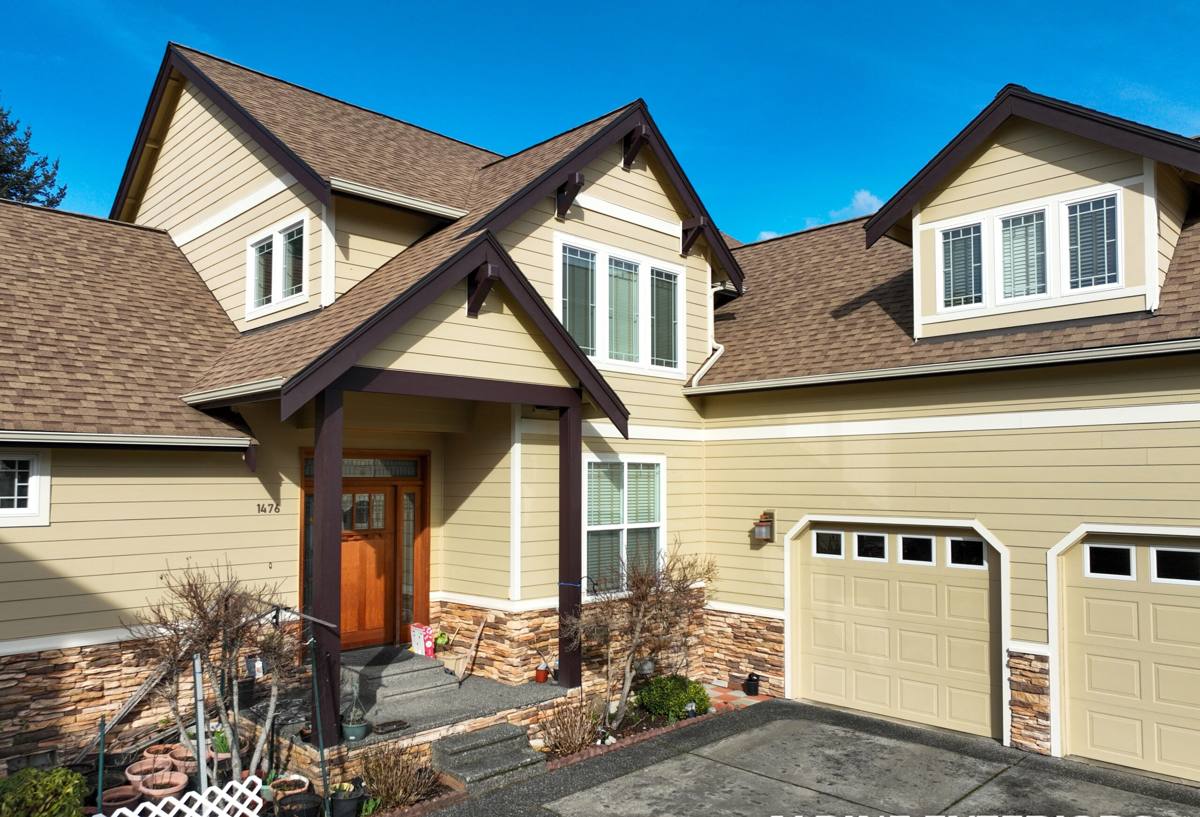
What Everson's Climate Does to Siding Over Time
Salt Air and Fastener Corrosion
Even away from the immediate shoreline, this part of Whatcom County gets a steady dose of salt-influenced marine air. Over years, that air accelerates corrosion in lower-grade fasteners, flashing, and trim hardware. A repair that reuses corroded fasteners or skips corrosion-resistant materials is a repair that's already on a shorter clock than it should be.
Wind-Driven Rain
Rain in this region doesn't just fall straight down — wind pushes it sideways into seams, laps, and trim joints. That's a different load than a simple rainfall total suggests, and it's the reason siding failures often show up first at horizontal joints, window trim, and inside corners rather than on flat wall sections. A repair that doesn't account for wind-driven rain paths just relocates the leak.
A Long Moss and Mildew Season
Mild temperatures and consistent moisture keep moss and mildew active across much of the year here, especially on north-facing and shaded walls. Moss holds moisture against the siding surface, and on damaged or improperly sealed boards, that constant dampness is what turns a small crack or gap into rot underneath.
Signs Everson Homeowners Should Watch For
Most siding problems give some warning before they become expensive. The list below covers what we see most often on repair calls in this area:
- Soft or spongy siding when pressed, especially near the bottom of walls or around window and door trim
- Cracked, chipped, or missing caulk at joints, corners, and trim intersections
- Moss or dark staining that returns quickly after cleaning, particularly on shaded or north-facing walls
- Visible gaps, warping, or separation at siding seams and butt joints
- Peeling or bubbling paint, which often signals moisture trapped behind the surface rather than a simple paint failure
- Interior signs — soft drywall, staining, or a musty smell on an exterior wall — that point to moisture already past the siding
What a Correct Siding Repair Actually Involves
Diagnosing the Cause, Not Just Patching the Symptom
The most common mistake in siding repair is treating the visible damage as the whole problem. A cracked board or a soft spot is usually a symptom of a water intrusion path somewhere nearby — a failed caulk joint, a flashing gap, or a nail that backed out and let water track behind the panel. We open up the area enough to find where the water is actually getting in before we decide what to replace, because a beautiful patch over an unresolved leak just hides the problem for another season.
Matching Material and Finish
Siding repair only looks right, and performs right, when the replacement piece matches the profile, exposure, and finish of what's already on the wall. Mismatched boards are an obvious cosmetic problem, but the bigger issue is performance — a repair using the wrong material can behave differently in moisture and temperature swings than the surrounding siding, which creates new stress points at the seams between old and new.
Flashing and Water Management
Most of the repairs that actually last start with fixing the water management detail, not just the siding itself — that means correcting flashing at windows, doors, and horizontal trim so water sheds outward instead of tracking behind the wall. Skipping this step is why some siding repairs fail again within a year or two: the new board looks fine, but the path that let water in the first time is still open.
Sealing and Fastening Correctly
Fastener spacing, type, and depth matter more on repair work than on new installation, because a repair has to tie into an existing wall assembly correctly. Overdriven or corroded fasteners, gaps at butt joints, and missed caulk lines are common shortcuts that show up as callbacks — usually right as the next wet season sets in.
Repair vs. Replacement: How We Make the Call
| Factor | Leans Toward Repair | Leans Toward Replacement |
|---|---|---|
| Extent of damage | Isolated to a few boards or one wall section | Spread across multiple walls or recurring in several spots |
| Underlying moisture | Surface-level, caught early | Rot has reached sheathing or framing |
| Age and condition of existing siding | Siding is otherwise sound and well-maintained | Siding is near end of service life or already failing broadly |
| Material match | Original product still available or closely matchable | Discontinued product with no reasonable match |
| Cost over time | Repair cost is a small fraction of full replacement | Repeated repairs are approaching replacement cost anyway |
We walk the property and give you a straight answer on which side of that table your home falls on — we don't default to replacement just because it's the bigger job, and we don't recommend a repair we don't think will hold.
Why We Repair and Replace Exclusively With James Hardie Fiber Cement
When a repair calls for new material — whether it's a few boards or a larger section — we use James Hardie fiber cement, and only James Hardie. We don't install or repair with LP SmartSide, vinyl siding, Cemplank, Allura, primed spruce, or cedar. That's not about any one of those products being bad outright; each has homeowners who are satisfied with it. It's a professional standard we settled on after years of seeing how materials actually hold up in this specific climate.
- Non-combustible core: Fiber cement doesn't feed a fire the way wood-based siding can.
- Factory-applied ColorPlus finish: Baked on under controlled conditions rather than site-applied, so repaired sections keep their color and resist fading and moisture better over time.
- HZ5 formulation: Engineered for regions with significant moisture exposure and freeze-thaw cycling, which fits Whatcom County's climate well.
- Dimensional stability: Fiber cement doesn't swell, warp, or cup with repeated wetting the way some engineered wood products can, so a new repair section stays true next to older, weathered siding.
- Transferable warranty: Hardie backs the product with a strong warranty structure when installed to spec, which matters on repair work as much as full replacement.
Repairing with a mismatched or lower-grade material might save a little upfront, but it usually just moves the same failure a few years down the road — and on a repair call, that's exactly the outcome we're trying to prevent.
Our Siding Repair Process
Repair calls in Everson generally follow the same process:
- On-site inspection: We look at the visible damage and probe the surrounding area, including trim, corners, and any interior signs, to find the actual source of the problem.
- Honest diagnosis: We tell you what we found — whether it's a contained repair or something that points to a bigger issue — before we talk about scope or cost.
- Clear scope and estimate: You get a straightforward explanation of what needs to happen and why, not just a number.
- Correct repair: Matching Hardie material, proper flashing and water management, correct fastening, and a finish that blends with the existing wall.
- Cleanup and walkthrough: We clear the site and walk the repair with you so you know exactly what was done and why it should hold.
Why Hiring a Crew That Already Works Everson Matters
A crew that regularly works Everson and the surrounding Lynden area has already seen how salt air, wind-driven rain, and moss behave on real houses here across different seasons — not just in theory. That familiarity shapes practical decisions on a repair call: which wall orientations are worth extra attention, which trim details tend to be the actual point of failure, and when a "small" repair is masking a bigger moisture problem worth flagging honestly. It also means a shorter response time and a crew that isn't learning the local climate on your dime. Whatcom County's coastal-influenced, high-moisture conditions aren't identical everywhere in the county, and local, repeated experience is what lets us tell the difference between a repair that will hold and one that's just a temporary fix.
Get a Free, No-Pressure Estimate
If you're seeing soft spots, cracked caulk, recurring moss, or any other sign your siding needs attention, we're happy to take a look and give you an honest read on whether it's a repair or something bigger. Reach out using the form below to schedule a free estimate for your Everson home — no pressure, no upsell script.