 Lynden Siding
 Siding Built for Acme's Climate
Acme sits in the foothills east of Lynden, in a part of Whatcom County where the weather works harder on a house than it does just a few miles west toward the coast. Homes here catch more direct rainfall off the Cascade foothills, sit under tree cover longer through the fall and winter, and hold onto damp air well after a storm has passed. Add in the salt-tinged marine air that rolls in off the Salish Sea and settles across the whole county, and you've got a combination that's tough on exterior building materials year after year. Siding in this area isn't just cladding — it's the first line of defense against moisture intrusion, wood rot, and the slow, creeping growth of moss and algae that shows up on north-facing walls and shaded siding runs.
We've worked on homes throughout Lynden and the surrounding communities long enough to know which products hold up out here and which ones start showing their age within a handful of years. That experience is why we install James Hardie fiber cement siding exclusively — not vinyl, not LP SmartSide, not cedar, not primed spruce. We'll get into why below, but the short version is that Acme's climate rewards materials that don't absorb water, don't feed mold and mildew, and don't need repainting every few years just to keep looking presentable.
What Homes in Acme Actually Face
Driving Rain and Wind-Driven Moisture
Whatcom County gets a lot of rain, but it's not always straight-down rain. Wind off the foothills and out of the Fraser Valley can push rain sideways into wall assemblies, especially on exposed gable ends and second-story walls. Siding that isn't dimensionally stable — meaning it swells, warps, or delaminates when it takes on moisture — starts failing at the seams first. Gaps open up, caulk lines stretch and crack, and water finds its way behind the cladding where it does the real damage: sheathing rot, insulation degradation, and eventually interior damage that's far more expensive to fix than the siding itself.
Salt Air's Slow Corrosion
Acme isn't waterfront, but salt-laden air off the Salish Sea travels inland across this part of the county, especially on windy days. Over years, that salt air accelerates the breakdown of certain paints, coatings, and fasteners. It's a slower process than what you'd see in a beachfront town, but it's real, and it's one more reason we favor a factory-applied finish over field-applied paint that has to fight the elements from day one.
Moss, Algae, and a Long Wet Season
Between the fall rains and a spring that doesn't fully dry out until June, Acme homes deal with a genuinely long moss and algae season. Shaded walls, areas under overhangs, and anything facing north tend to collect green growth faster than sun-exposed walls. Porous or wood-based siding gives moss something to grip and feed on. Fiber cement is far less hospitable to that growth, and it holds up to routine washing without the finish breaking down.
Quick Checklist: Signs Your Siding Is Losing the Fight
- Paint that's chalking, peeling, or needs recoating more than once every 5-7 years
- Soft spots, bubbling, or visible swelling near seams and bottom edges
- Persistent moss or algae staining that comes back within weeks of cleaning
- Visible gaps at butt joints or corners where caulk has failed
- Warping or waviness when you sight down a wall in low-angle light
- Rising energy bills that point to compromised insulation behind the siding
Why We Only Install James Hardie
We made a deliberate decision years ago to standardize on James Hardie fiber cement siding for every job we take on, and we tell every homeowner why up front rather than letting them assume it's the only option we know how to install.
What Fiber Cement Gets Right
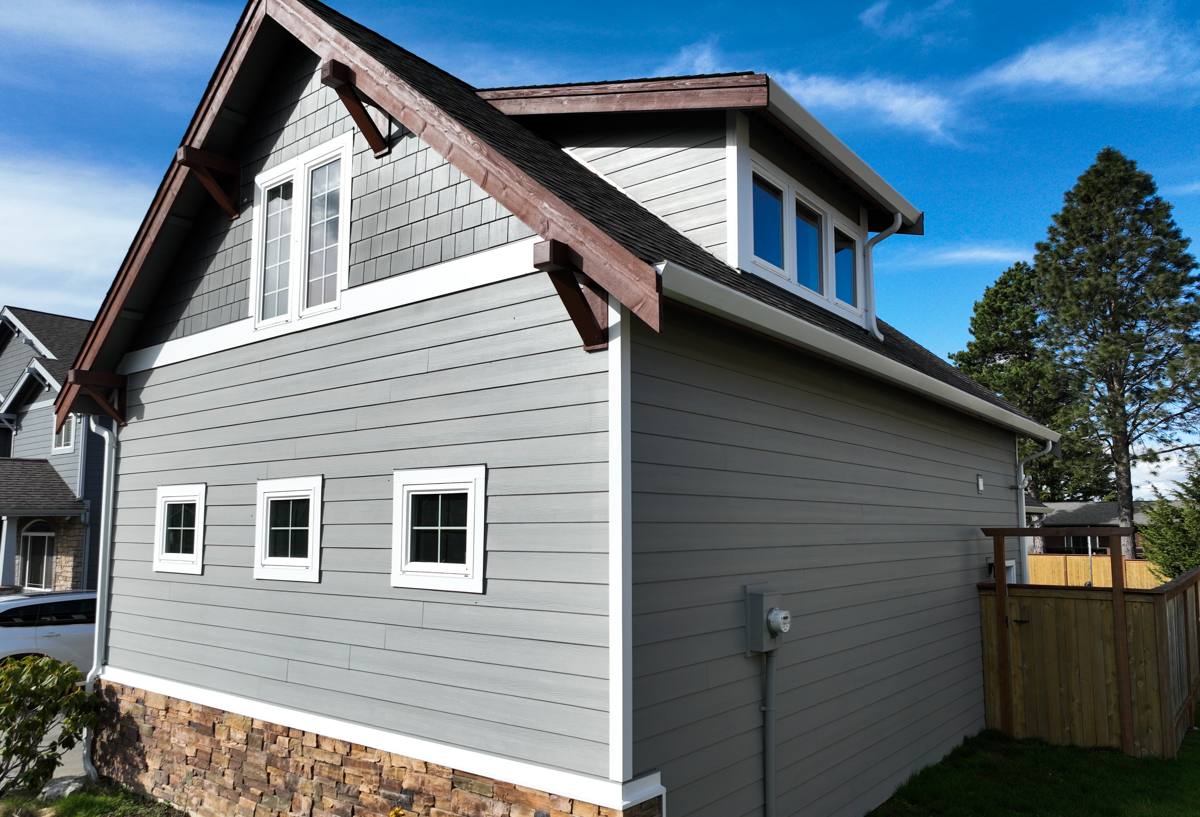
James Hardie siding is made from cement, sand, and cellulose fiber, which makes it non-combustible and far less prone to moisture-driven swelling or rot than wood-based products. It holds paint and color extremely well because Hardie applies its ColorPlus finish at the factory under controlled conditions, rather than relying on a crew painting boards on-site in whatever weather shows up that week. That factory finish is baked on and cured before the material ever reaches a job site, which means better adhesion and a longer color life than field-applied paint.
Why We Walked Away from the Alternatives
Vinyl siding is inexpensive and easy to install, but it expands and contracts with temperature swings, can crack in impacts, and its seams and J-channels give water plenty of paths inward over time — not ideal in a climate that delivers wind-driven rain as often as this one does. LP SmartSide and other engineered wood products perform reasonably when installation is flawless, but they're wood at their core, and wood-based products are more sensitive to the exact kind of sustained moisture exposure this region delivers; any gap in the factory coating or field caulking becomes a point where moisture can get in and start breaking the material down from the inside. Cedar and primed spruce are beautiful when new, but they demand a maintenance schedule — regular refinishing, vigilant caulk upkeep, moisture monitoring — that most homeowners don't sign up for and few contractors are honest about upfront. We're not saying any of these products are junk. We're saying that after years of installing and later repairing siding in this exact climate, we stopped installing products that put the burden of long-term performance on perfect maintenance rather than the material itself.
The Trade-Off We're Comfortable With
Hardie fiber cement costs more upfront than vinyl and is heavier and more labor-intensive to install correctly than most alternatives. It requires a crew that knows proper fastening, clearances, and joint treatment — sloppy installation can undercut even the best material. We accept that trade-off because the long-term outcome for the homeowner is fewer callbacks, less repainting, and a warranty that actually reflects confidence in the product.
Comparing the Options
| Material | Moisture Behavior | Maintenance | Finish Durability |
|---|---|---|---|
| James Hardie fiber cement | Non-combustible, dimensionally stable, resists swelling | Occasional washing; repaint on a much longer cycle | Factory-baked ColorPlus finish, long color retention |
| Vinyl | Doesn't rot but seams/channels allow water paths; expands/contracts with temperature | Low, but cracks and fades over time | Color molded in but fades and chalks with UV exposure |
| LP SmartSide / engineered wood | Wood-based core; sensitive to sustained moisture if coating is compromised | Moderate; caulk and coating need monitoring | Factory-primed or coated, but wood substrate underneath |
| Cedar / primed spruce | Natural wood; absorbs moisture, prone to rot without upkeep | High; regular refinishing and caulk maintenance | Field-applied paint or stain, shorter recoat cycle |
Beyond Siding: Roofing, Windows, and Decks
Siding doesn't work in isolation. A house in Acme is only as weathertight as its weakest exterior component, so we also handle roofing, windows, and decks — the other systems that either shed water properly or let it in. A roof with failing flashing will send water down behind good siding just as easily as bad siding lets it in directly. Old windows with failed seals rot the framing around them regardless of what's on the wall next to them. And a deck built without proper ledger flashing and drainage detailing rots from the connection point outward, often before the siding shows any wear at all. Looking at the whole exterior together, rather than treating siding as a standalone project, is how we catch problems before they become expensive ones.
What a Siding Project Looks Like Here
Assessment First
Before we talk product or price, we look at what's actually happening on your walls — moisture readings where we suspect trouble, a look at trim and flashing details, and an honest read on whether existing sheathing is sound. Skipping this step is how re-siding jobs end up covering damage instead of fixing it.
Installation to Spec, Not to Shortcut
James Hardie publishes specific fastening patterns, clearances from grade and roof lines, and caulking requirements for a reason — the warranty depends on it, and so does actual performance in a wet climate. We follow those specs because we've seen what happens when a crew doesn't: premature failure at exactly the joints and clearances that were cut short.
Local Crew, Local Accountability
We're based in Lynden and work throughout Whatcom County, which means we're not driving in from out of the area for a one-time job and disappearing. If something needs a follow-up look after a hard winter, we're close by and know the house. That local accountability matters more in a climate like this, where problems tend to show up gradually rather than all at once.
Color and Style Considerations for Acme Homes
James Hardie's HZ product lines are engineered for specific climate zones, which matters in a region that sees both sustained rain and occasional freeze conditions. Beyond the technical side, ColorPlus finishes come in a range of tones that hold up well against the muted, forested backdrop common around Acme — deeper, more saturated colors tend to read well against evergreen surroundings without looking out of place, while lighter tones can brighten a home that sits mostly in shade. We can walk through the full color and profile lineup — lap siding, panel, shingle-style — during an in-person estimate.
Get an Honest Look at Your Home
If you're noticing paint failure, moss buildup that won't quit, or just want a straight answer about whether your current siding still has years left in it, we're glad to come take a look. There's no pressure and no sales script — just an honest assessment of what your home in Acme actually needs, and what it would take to do it right. Reach out through the form below for a free estimate.