 Lynden Siding
 Birch Bay's Exterior Challenge: Salt, Wind, Rain, and Moss
Birch Bay sits right on the water in Whatcom County, and that location shapes everything about how a home's exterior ages here. Homes close to the shoreline take on salt-laden air that settles on siding, trim, and roofing day after day. Add the wind that comes off the bay, driving rain sideways into wall assemblies rather than straight down, and you have a set of conditions that punishes exterior materials faster than a typical inland Whatcom County property ever sees.
Then there's moss. Western Washington's long, wet, mild winters create a moss season that can stretch for months, and Birch Bay's proximity to the water only adds humidity to the mix. Moss doesn't just look bad on a roof or along the base of a wall — it holds moisture against surfaces, works into seams and laps, and accelerates rot in anything not built to shed water aggressively.
None of this means a house at Birch Bay is doomed to constant repairs. It means the materials and installation details matter more here than they do a few miles inland, and it means the people doing the work need to understand coastal exposure specifically, not just general Pacific Northwest weather.
Why Siding Is the First Line of Defense
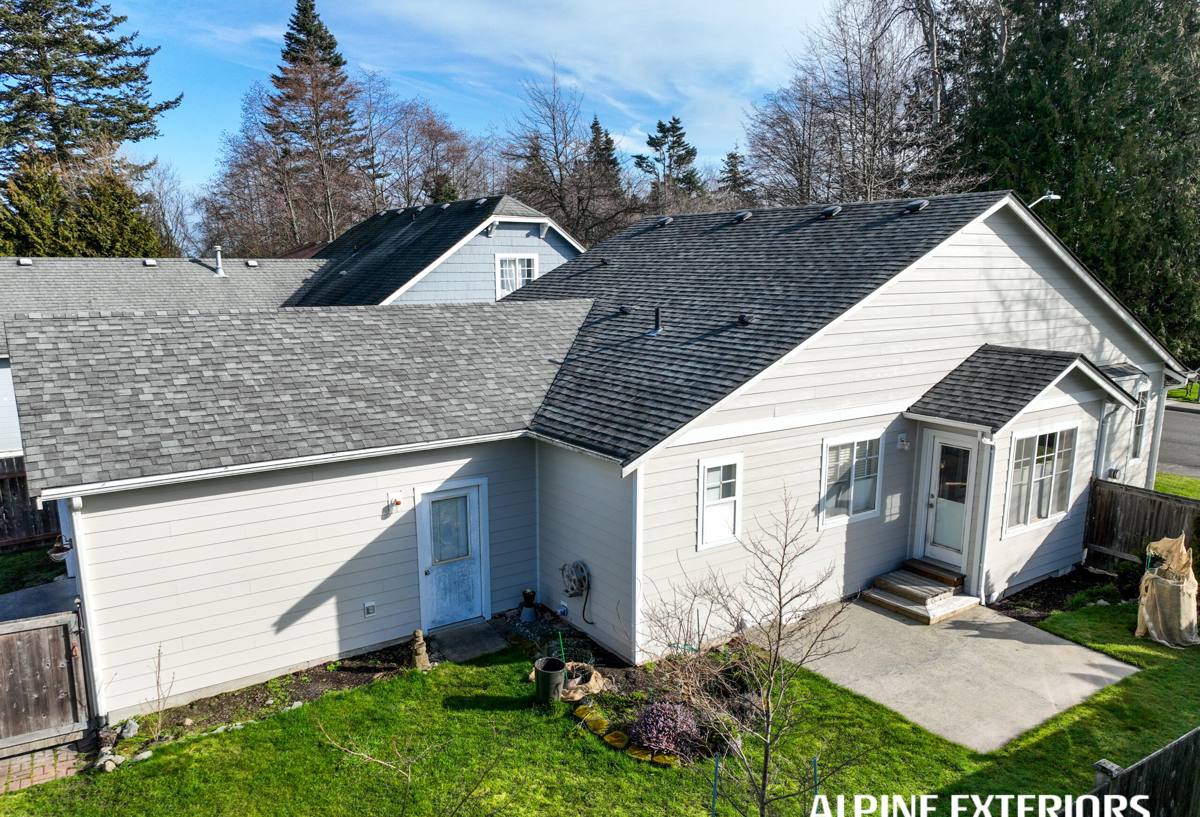
Siding is the single largest surface area on most homes, and it's the material standing between salt spray, wind-driven rain, and your framing. When siding fails at Birch Bay, it's rarely a dramatic, sudden event — it's usually a slow process of moisture getting behind panels, paint or coatings breaking down under salt exposure, and seams opening up just enough to let water track in behind the cladding.
That slow failure is why we're picky about what we put on coastal homes. Some siding materials handle constant moisture and salt exposure well for decades. Others need frequent recoating, are prone to swelling or delaminating when they take on water repeatedly, or simply weren't engineered with a marine-adjacent climate in mind. A homeowner a mile inland might get away with a product that would struggle at Birch Bay.
What We Look For in a Coastal-Grade Siding Material
- Dimensional stability when it gets wet and dries out repeatedly, season after season
- A factory-applied finish that isn't dependent on the homeowner's repainting schedule
- Resistance to moss and mildew growth on the surface itself
- Non-combustible composition, which matters given wildfire smoke and ember exposure risk across the broader region in late summer
- A manufacturer warranty structure that actually reflects confidence in long-term coastal performance
Our Standard: James Hardie Fiber Cement
We install James Hardie fiber cement siding exclusively. That's a deliberate choice, not a default. Fiber cement is engineered from cement, sand, and cellulose fibers, which gives it dimensional stability that wood-based and foam-core products can't match — it doesn't swell, cup, or delaminate the way materials with an organic or moisture-sensitive core can when they're repeatedly wetted by driving rain and salt air.
James Hardie also builds climate-specific product lines, and for a location like Birch Bay that sits directly in a wet, humid coastal exposure, that engineering is relevant rather than a marketing detail. The ColorPlus factory finish is baked on and warranted separately from the substrate, which matters in an area where UV, salt, and constant moisture cycling all work together to break down field-applied paint faster than it would inland.
We won't install LP SmartSide, vinyl, Cemplank, Allura, or primed wood species like spruce or cedar on the homes we work on — not because those products have no place in the market, but because we've standardized our crews, our warranty conversations, and our installation details around one system we can install correctly every time and stand behind. Vinyl can warp and gap under sustained wind-driven rain and doesn't offer the fire resistance profile we prefer for the region. Wood-based and other fiber cement alternatives each carry their own maintenance or moisture-management trade-offs that we've decided aren't worth the risk on a coastal exposure like this one.
James Hardie Product Lines We Work With
| Product | Best Use | Why It Fits Birch Bay |
|---|---|---|
| HardiePlank lap siding | Most homes, traditional lap look | HZ10 formulation engineered for wetter Pacific Northwest climates |
| HardiePanel vertical siding | Modern facades, accent walls | Clean lines with the same moisture-resistant core |
| HardieTrim boards | Corners, window and door trim | Matches siding durability so trim doesn't fail before the field material |
| HardieShingle siding | Accent gables, coastal cottage styling | Textured look without the maintenance burden of real wood shingle |
Full Exterior Protection: Roofing, Windows, and Decks
Siding is only part of the envelope. In a location like Birch Bay, roofing, windows, and decking all face the same combination of salt air, wind, and moss pressure, and they all need to work together as a system.
Roofing
A roof at Birch Bay deals with moss growth on shaded or north-facing slopes, wind uplift risk during winter storms, and flashing details that have to actually shed water rather than just direct it. We pay close attention to underlayment quality, valley and flashing work, and ventilation — a roof deck that can't dry out between rain events is a roof deck that rots from the inside regardless of what shingle sits on top.
Windows
Wind-driven rain finds weak flashing and poorly sealed window openings before it finds almost anything else on a house. Around Birch Bay, we treat window flashing and sill pan details as critical, not optional, since a leak at a window opening can travel inside the wall assembly for a long time before it's visible from either side.
Decks
Decks facing the water get direct salt exposure, sun, and rain with very little shelter. Fastener selection, board spacing for drainage, and ledger flashing all matter more here than on a sheltered inland deck, since corrosion and rot both move faster in this exposure.
What Correct Installation Actually Involves Here
Fiber cement siding performs the way it's engineered to only when it's installed correctly, and coastal exposure raises the stakes on details that get overlooked elsewhere. That includes proper flashing at every penetration, correct fastener spacing and type, adequate clearance between siding and grade or hard surfaces, and a drainage plane behind the siding that lets any incidental moisture escape instead of getting trapped.
We also pay attention to caulking and sealant choices at trim and window transitions — the wrong sealant breaks down faster under UV and salt exposure, and a failed sealant joint is one of the most common ways water gets behind well-chosen siding in the first place.
Cost Factors for Birch Bay Homes
Every home is different, but a few local factors tend to move the estimate more than they would on an inland property:
| Factor | Why It Matters at Birch Bay |
|---|---|
| Wall exposure to prevailing wind and water | Water-facing walls often need extra flashing and sealant detail |
| Existing moisture damage behind old siding | Coastal homes more often need sheathing repair discovered during tear-off |
| Access and site conditions | Waterfront lots can have tighter access, affecting labor and staging |
| Trim and detail complexity | Cottage-style gables and shingle accents add labor beyond flat lap runs |
| Scope bundling | Combining siding with roofing, window, or deck work can reduce total mobilization costs |
Choosing a Contractor for a Coastal Property
Not every contractor who works in Whatcom County has real experience with the specific demands of a shoreline exposure like Birch Bay. Before hiring anyone for exterior work here, it's worth asking pointed questions.
- Do they have specific experience with coastal or waterfront exposure, not just general regional work?
- Can they explain their flashing and drainage plane approach in plain terms, not just brand names?
- Are they licensed, bonded, and insured, and will they provide proof without being asked twice?
- Do they stand behind one siding system they know well, or do they install whatever's cheapest for the bid?
- Will the manufacturer's warranty transfer to a future buyer if you sell the home?
- Do they talk about moss, salt, and wind exposure specifically, or only give generic answers about "Northwest weather"?
Living With Your Exterior: Maintenance in a Salt-Air Environment
Even the right materials benefit from basic upkeep in this environment. Rinsing salt residue off siding periodically, keeping gutters clear so water doesn't back up against fascia and trim, and addressing moss on roofing and shaded siding areas before it spreads all extend the life of an exterior. Fiber cement siding with a factory finish reduces the maintenance burden significantly compared to field-painted materials, but it isn't a reason to ignore the exterior entirely — a five-minute seasonal walk-around catches small issues before they become expensive ones.
Get a Straightforward Look at Your Home
If you're weighing a siding, roofing, window, or deck project on a Birch Bay property, we're happy to take a look and give you an honest read on what your home actually needs given its exposure. There's no pressure and no obligation — just a straight conversation about your options and what correct, long-term protection looks like for your specific spot on the water. Reach out below for a free estimate.