 Lynden Siding
 Siding Built for Life Around Wiser Lake
Wiser Lake sits in the low, wooded country northwest of Lynden, and homes out there live with a different set of conditions than a house downtown. The lake itself keeps humidity higher in the immediate area, tree cover holds moisture against exterior walls longer after a storm, and the rural setting means more shade, more standing damp, and more organic growth working against your siding year-round. Add in Whatcom County's marine-influenced weather — long stretches of driving rain, salt-tinged air moving in off the Strait, and a moss season that can run from October clear through May — and you have an exterior environment that punishes the wrong siding choice faster than most homeowners expect.
We're a Lynden-based crew, and Wiser Lake is inside our regular service area, not a stretch job we drive an hour for. That matters more than it sounds like it should. A crew that works this specific stretch of Whatcom County knows what a north-facing wall under a stand of fir trees looks like after five winters, and we build our installation approach around that reality instead of a generic spec sheet.
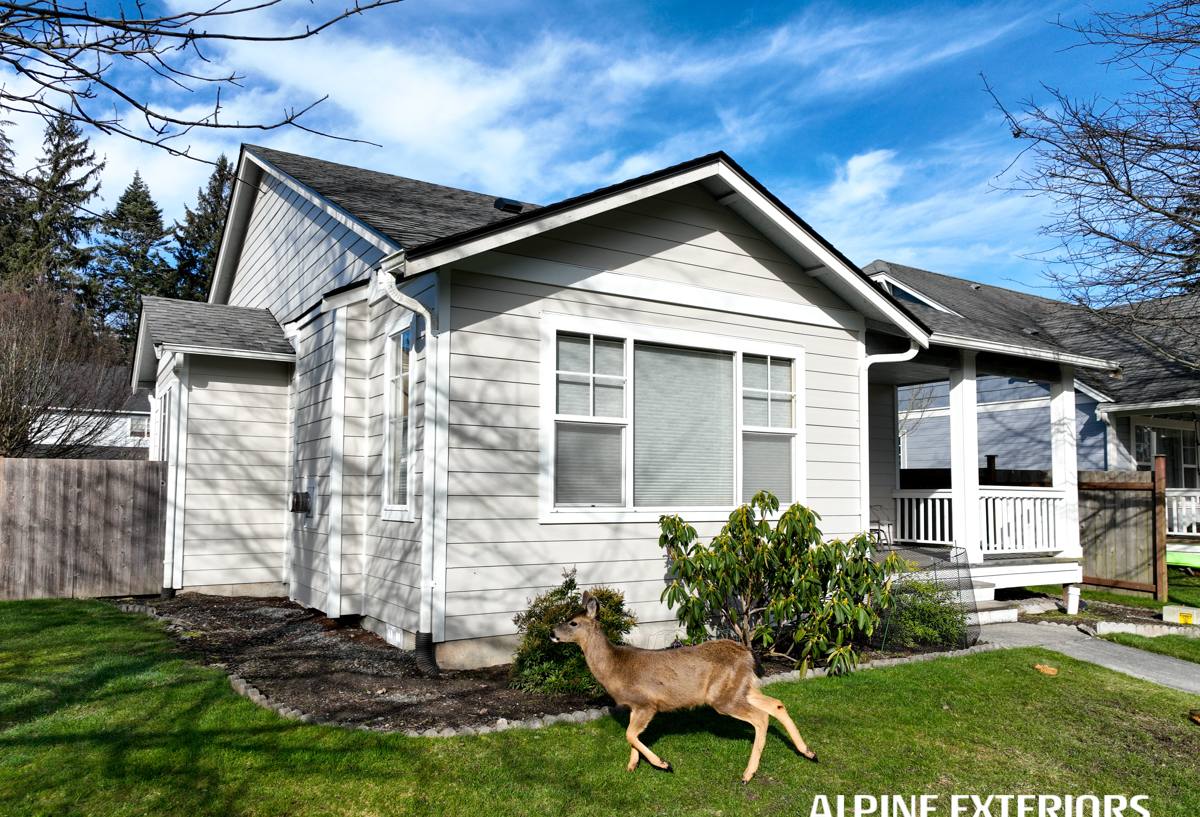
What the Climate Actually Does to a House Out Here
Moisture That Doesn't Leave
Coastal Pacific Northwest rain isn't just volume — it's duration. Storms roll through for days, and around Wiser Lake, tree canopy and lake-effect humidity slow down how fast a house dries out between weather systems. Siding materials that absorb water, swell, or trap moisture behind their surface stay wet longer here than they would in a drier, more open part of the county. That extended wet period is exactly what feeds rot, delamination, and paint failure.
Moss, Algae, and Organic Growth
Shade plus moisture equals moss, and Wiser Lake has more of both than most in-town lots. Moss and algae aren't just cosmetic — they hold water against a wall surface and, on materials with any wood content, accelerate decay underneath the growth you can see. A siding product's surface chemistry and finish matter as much as its core material when it comes to resisting this.
Salt Air and Temperature Swings
Whatcom County sits close enough to Puget Sound and the Strait that airborne salt is a real factor on fasteners, trim, and any exposed metal. Combine that with the freeze-thaw swings we get in a typical winter — wet, then a hard cold snap, then wet again — and you get a cycle that stresses caulk joints, seams, and any siding product that expands and contracts more than its trim.
Why We Standardized on James Hardie for This Kind of Environment
We install James Hardie fiber cement siding exclusively. We don't offer LP SmartSide, vinyl, Cemplank, Allura, primed spruce, or cedar as alternatives, and that's a deliberate professional standard, not a lack of options. For a climate like Wiser Lake's — sustained moisture, heavy shade, moss pressure, and salt air — the material behind the paint matters as much as the paint itself.
Fiber cement is non-combustible and doesn't rely on a wood or wood-fiber core, so it doesn't absorb and swell the way engineered wood products can when they stay wet for extended periods. James Hardie's ColorPlus factory-applied finish is baked on under controlled conditions rather than field-sprayed, which gives it more consistent adhesion and UV resistance than most site-applied paint jobs — a real advantage when a wall spends half the year damp and shaded. Hardie also engineers regional HZ5 product lines specifically for wetter climates, which is the category we spec for this area.
None of this means other products are junk — vinyl, engineered wood, and cedar all have legitimate uses and loyal installers. It means that after years of servicing exteriors in this specific climate, we decided we'd rather stand behind one system we trust completely than offer a menu of products with trade-offs we'd have to talk homeowners out of later.
How the Major Siding Categories Compare in This Climate
| Material | Moisture Behavior | Moss/Algae Resistance | Long-Term Maintenance |
|---|---|---|---|
| James Hardie fiber cement | Doesn't swell or rot from prolonged moisture | Non-organic core resists decay under growth | Periodic wash; factory finish holds color long-term |
| Engineered wood (LP-type) | Wood-strand core sensitive to sustained wet exposure | Growth can accelerate core breakdown if unaddressed | Requires more diligent moisture upkeep |
| Vinyl | Won't rot, but seams/edges can trap moisture | Growth sits on surface, can discolor over time | Low upkeep but limited repair options if damaged |
| Cedar/primed wood | Natural material, absorbs and releases moisture | Most vulnerable to moss-driven decay | Highest maintenance — refinishing on a recurring cycle |
Our Process for a Wiser Lake Job
Every property around the lake gets assessed on its own terms — shade pattern, exposure direction, tree proximity, and how the current siding has actually held up, not just how old it is. Our process for a full siding replacement typically runs:
- On-site walk-around to check current siding condition, moisture intrusion points, and trim/flashing status
- Moisture and rot check at vulnerable points — corners, bottom courses, window and door surrounds
- Removal of old siding and inspection of the sheathing underneath before anything new goes up
- Repair of any compromised sheathing or framing found during tear-off
- Installation of weather-resistant barrier and flashing details sized for sustained rain exposure
- James Hardie panel or lap installation to manufacturer fastening and clearance specs
- Final walkthrough covering caulking, trim, and touch-up paint matching
That sheathing check in step three is where a lot of hidden damage around Wiser Lake actually gets found — homes with mature tree cover and lake-adjacent humidity sometimes have moisture working behind the siding well before it's visible from outside. A rushed re-side skips that step. We don't.
Beyond Siding: The Rest of the Exterior
Siding rarely fails in isolation. On a property with heavy shade and consistent moisture, roofing, windows, and decks are working against the same conditions, and problems in one system often show up as damage in another — a failing roof valley can drive water down behind siding, and a leaking window flashing can rot the wall cavity around it. We handle all four:
- Roofing — moss growth, moisture-driven wear, and flashing failures around chimneys and valleys are common in shaded Whatcom County properties
- Windows — proper flashing integration with new siding is where a lot of long-term leaks either get solved or get built in
- Decks — outdoor living structures around the lake take the same rain and moss exposure as walls, just horizontally
- Siding — the exterior skin tying the whole envelope together
Because one crew handles all four, we catch cross-system issues — a roof drainage problem that's actually causing your siding failure, for example — instead of each trade only looking at their own piece.
Why a Local Crew Matters More Than It Sounds Like
A contractor based out of Seattle or a crew that mainly works drier inland counties doesn't have daily, repeated exposure to what a Lynden-area exterior actually faces. We do. We know how fast moss reestablishes on a shaded gable near the lake, how far up a wall splashback typically travels during a heavy rain event, and which trim details tend to fail first in this specific mix of humidity and temperature swing. That local pattern recognition shapes real decisions — where we add extra flashing attention, which fastening spec we follow for HZ5-rated product, and how we sequence a job around our actual rainy-season weather windows rather than a generic install calendar.
Being local also means we're still in the area for warranty service, follow-up questions, or a future project — not a phone number that stops picking up once the invoice is paid.
Signs Your Current Siding Is Losing the Fight
- Persistent moss or algae staining that returns within weeks of cleaning
- Soft spots, bubbling, or visible swelling near the bottom courses or corners
- Paint that's chalking, peeling, or fading unevenly across shaded vs. sun-exposed walls
- Gaps opening at seams, trim joints, or around window and door surrounds
- A musty smell or visible staining on interior walls that back up to exterior siding
What a Wiser Lake Siding Project Typically Involves
Every property is different, but homeowners planning ahead generally want to understand the rough factors that drive scope and cost on a project like this.
| Factor | Why It Matters Here |
|---|---|
| Tree cover and shade exposure | Drives moss pressure and how long walls stay wet after rain |
| Current sheathing condition | Only known once old siding comes off; hidden rot adds repair scope |
| Home size and wall complexity | More corners, dormers, and trim detail add labor time |
| Existing product being removed | Vinyl and wood tear-off differ in disposal and prep work |
| Access and site conditions | Lake-adjacent lots and long driveways can affect staging and logistics |
We give a straightforward, itemized estimate after the on-site walk-around rather than a phone quote, because a Wiser Lake property's shade and moisture profile is too specific to guess from a description alone.
If you're weighing a siding, roofing, window, or deck project on your Wiser Lake property, we're glad to come take a look. The estimate is free, there's no pressure attached to it, and you'll get a straight answer about what your home actually needs — use the form below to get started.