 Lynden Siding
 Windows Built for Birch Bay's Coastline, Not a Showroom Catalog
Birch Bay sits right on the water, and that changes what a window has to survive compared to a house a few miles inland in Lynden or further out in Whatcom County. Salt-laden air moves off the bay and settles on everything it touches, including window frames, hardware, and glazing seals. Add in driving rain that comes sideways during winter storms and a moss season that can stretch from fall through spring, and you have a climate that is genuinely harder on windows than most manufacturers' warranty language assumes. A window that performs fine in a dry inland climate can start showing corrosion, seal failure, or frame swelling within a few years on a Birch Bay lot facing the water.
This page is specifically about custom window installation and replacement for homes in and around Birch Bay. We are not going to give you a generic rundown of window brands. We are going to explain what actually matters for a home in this exact location, what a correct installation looks like, and how our crew handles the job from first walkthrough to final cleanup.
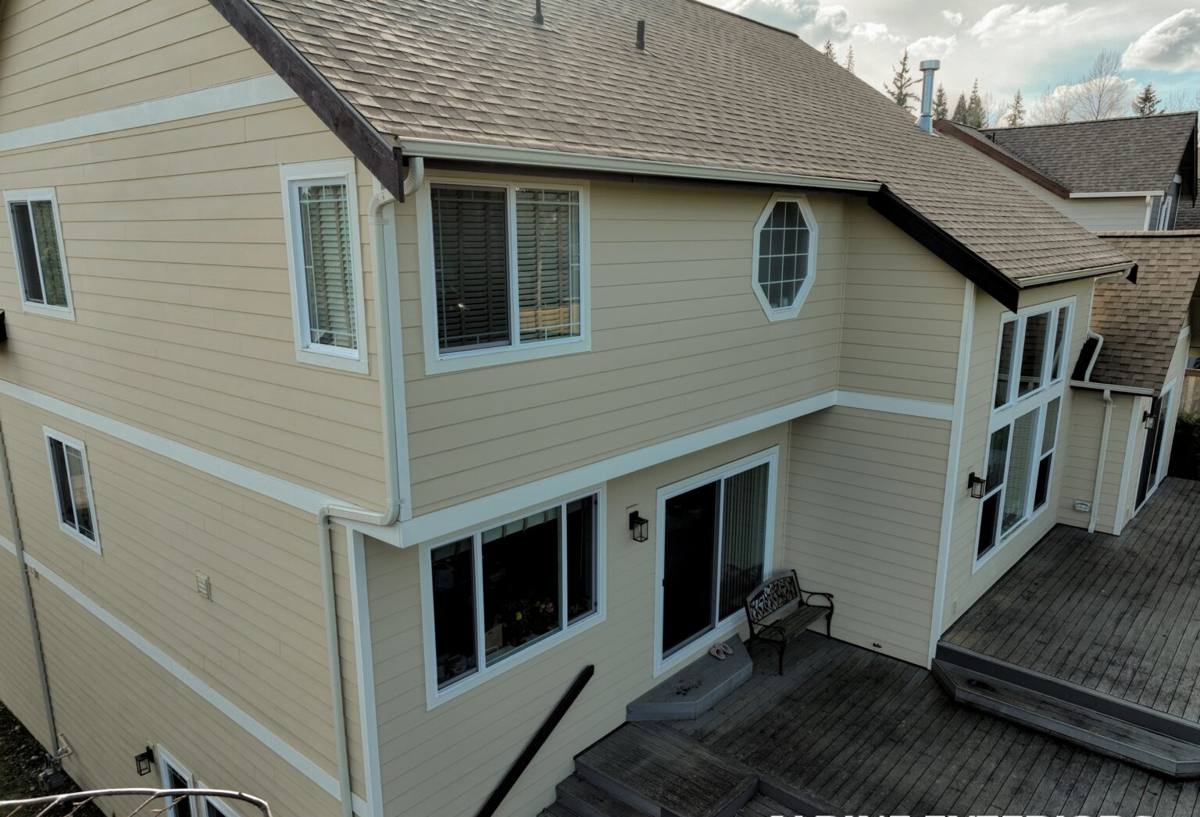
What Birch Bay's Climate Actually Does to Windows
Salt Air and Corrosion
Salt air is the biggest long-term threat to window hardware in Birch Bay. Hinges, cranks, locks, and screen frames made from lower-grade metals will pit and corrode faster here than almost anywhere else in Whatcom County that isn't directly on the water. This isn't a defect in any one product line — it's simple chemistry, and it applies to nearly every manufacturer's standard hardware package unless you specifically ask for coastal-rated components.
Wind-Driven Rain
Rain in Birch Bay often doesn't fall straight down. Wind off the water pushes it sideways into window walls, which puts far more stress on flashing and seals than a typical vertical rain event. A window that's watertight in a still-air test can still leak under real Birch Bay storm conditions if the flashing detail and sill pan weren't done correctly at install.
Moss and Prolonged Moisture
Whatcom County's long wet season means moss and algae get a real foothold on north-facing walls, window sills, and anywhere water sits instead of draining. Moss holds moisture against wood trim and frame surfaces for weeks at a time, which accelerates rot in any organic material that isn't properly sealed or flashed.
What a Correct Window Job Looks Like Here
None of the climate challenges above are unsolvable. They just require an installation approach that treats them as the default condition, not an edge case. Here's what we build into every Birch Bay window job:
- Corrosion-resistant hardware specified for coastal exposure, not the manufacturer's standard inland package
- Full sill pan flashing under every window opening, not just tape over the rough sill
- Properly lapped house wrap and flashing sequence so water sheds outward at every layer
- Low-expansion, weather-rated sealant at the frame perimeter, sized correctly for the gap
- Drip caps or head flashing on window tops exposed to direct wind-driven rain
- Frame materials and finishes chosen for how they'll hold up in salt air over a decade, not just how they look on install day
Skip any one of these and the window itself can be excellent quality and still fail early. Most window problems we get called out to fix in this area trace back to installation shortcuts, not bad glass or bad vinyl.
Frame Material: What Actually Holds Up on the Water
Frame material choice matters more in Birch Bay than in most parts of Lynden proper, simply because of the salt air exposure. Here's how the common options actually perform in this specific environment, based on what we see in the field.
| Frame Material | Coastal Performance | Maintenance | Honest Trade-Off |
|---|---|---|---|
| Vinyl | Good — won't corrode or rot, handles salt air well | Low — occasional cleaning | Limited color/finish options; can look less premium on higher-end homes |
| Fiberglass | Very good — dimensionally stable, resists salt and moisture | Low | Higher upfront cost than vinyl |
| Wood-clad | Fair — the clad exterior helps, but any exposed wood or seam failure invites rot | Higher — needs inspection and upkeep | Best interior look, but we're honest that it's the least forgiving option this close to the water |
| Aluminum | Fair — prone to corrosion and condensation unless it's a thermally broken, coastal-rated product | Moderate | We steer most Birch Bay homeowners away from standard aluminum for this reason |
We don't push one material on every homeowner. A wood-clad window can be the right call for a homeowner who wants that interior warmth and is willing to keep up with inspections. Our job is to lay out the real maintenance burden of each option honestly so you're not surprised five years in.
Glass and Seal Performance in a Wet Climate
Whatcom County's marine climate means the glass package matters as much as the frame. A few things worth understanding before you choose:
Insulated Glass Units and Seal Failure
Every dual or triple-pane window relies on a sealed edge to keep the gas fill and moisture barrier intact. In a climate with this much sustained humidity and temperature swing between a cold water-cooled night and a sunny afternoon, that seal is worked harder than it would be inland. Seal failure shows up as fogging or condensation between the panes — once you see that, the unit needs replacing, not just cleaning.
Low-E Coatings and Coastal Sun
Birch Bay gets strong reflected light and glare off the water on clear days. A quality low-E coating cuts glare and UV fading on interior floors and furniture without darkening the view — worth discussing if your current windows are original single-pane or older double-pane units.
Condensation on Interior Glass
If you're seeing regular condensation on the inside of your windows during winter, that's usually a sign of an aging seal or an under-performing frame — not a defect you have to live with. It's one of the most common reasons Birch Bay homeowners call us for a window evaluation.
Our Process: From Walkthrough to Final Seal
Here's how a custom window project runs with our crew, start to finish.
- On-site walkthrough. We look at each opening individually — orientation to the water and prevailing wind, current flashing condition, sill and trim condition, and any signs of past moisture intrusion.
- Honest assessment and options. We tell you which openings genuinely need full replacement versus which could be addressed with less invasive repair, and we explain frame material trade-offs specific to your exposure.
- Measurement and ordering. Custom windows are measured to the actual opening, not assumed standard sizes — this matters more on older Whatcom County homes where openings have settled or shifted slightly over the years.
- Removal and opening prep. We check the rough opening for hidden rot or moisture damage before anything new goes in. If we find deteriorated framing, we flag it and address it — installing a new window into a compromised opening just guarantees a repeat problem.
- Flashing and sill pan installation. This is the step that determines whether the window stays dry for the next twenty years. We build the sill pan and flashing sequence to shed water outward at every layer, every time.
- Window set and shim. Set level, plumb, and square, shimmed correctly so the frame isn't under stress that can cause premature seal failure.
- Insulation and air sealing. Gaps are filled with appropriate low-expansion foam or backer rod and sealant — not stuffed with excess material that can bow the frame.
- Exterior trim and final seal. Trim is reinstalled or replaced, and the exterior perimeter is sealed with a coastal-rated sealant matched to the substrate.
- Final walkthrough. We check operation, sightlines, and seal on every window with you before we consider the job done.
Signs Your Birch Bay Windows Need Attention
Not every window issue means full replacement. Use this as a rough guide before you call anyone:
- Fogging or moisture trapped between panes — seal failure, usually means replacement of that unit
- Visible corrosion on hinges, cranks, or locks — hardware issue, sometimes fixable without full replacement
- Soft or discolored wood trim around the frame — check for rot before it spreads into the wall framing
- Drafts you can feel with a hand near the frame edge — often a sealant or weatherstripping issue
- Difficulty opening, closing, or locking — frame may have shifted, or hardware has seized from corrosion
- Moss or dark staining building up on the sill or bottom trim — moisture isn't draining properly
- Visible daylight or gaps around the frame from outside — flashing or seal has failed
Why a Crew That Already Works Birch Bay Matters
Window installation done right requires understanding the specific conditions of the site, not just following a generic manufacturer install sheet. A crew that regularly works Birch Bay and the surrounding Whatcom County coastline already knows which orientations take the worst wind-driven rain, which older homes in the area tend to have flashing built to older standards, and where moss buildup tends to cause the most trim damage. That local pattern recognition shows up in fewer callbacks and windows that actually perform the way they're supposed to for the long haul.
We're a Lynden-based crew, and Birch Bay is part of our regular service area — not a stretch job we take occasionally. That matters when something needs a follow-up look or when you want a contractor who'll still be a local business a decade from now if a warranty question comes up.
Get a Straightforward Estimate
If your Birch Bay home has windows showing their age, or you're planning a renovation that includes new openings, we're happy to take a look and give you an honest read on what's needed. There's no pressure and no obligation — just a straight assessment from a crew that knows this stretch of coastline. Use the form below to request a free estimate.