 Lynden Siding
 Siding Repair for Sumas Homes
Sumas sits out at the far edge of Whatcom County, pressed up against the Canadian border in the flat farmland of the Nooksack valley. It's far enough inland that it doesn't take the same direct salt air that towns closer to Bellingham Bay see, but Whatcom County's marine-influenced weather still reaches this far — driving rain that comes in sideways more often than it falls straight down, valley humidity that lingers well after a storm passes, and a moss season that can run most of the year on shaded walls. That combination wears on siding differently than a drier, more sheltered climate would, and it's why siding repair calls in Sumas tend to follow a fairly consistent pattern once you've seen enough of them.
We're a Lynden-based crew that works siding jobs across Whatcom County, and Sumas is a regular stop for us. We install and repair James Hardie fiber cement siding exclusively — no vinyl, no LP SmartSide, no Cemplank, Allura, primed spruce, or cedar. That standard shapes how we approach repair work just as much as it shapes new installations, because a repair is only as good as the material and the technique behind it.
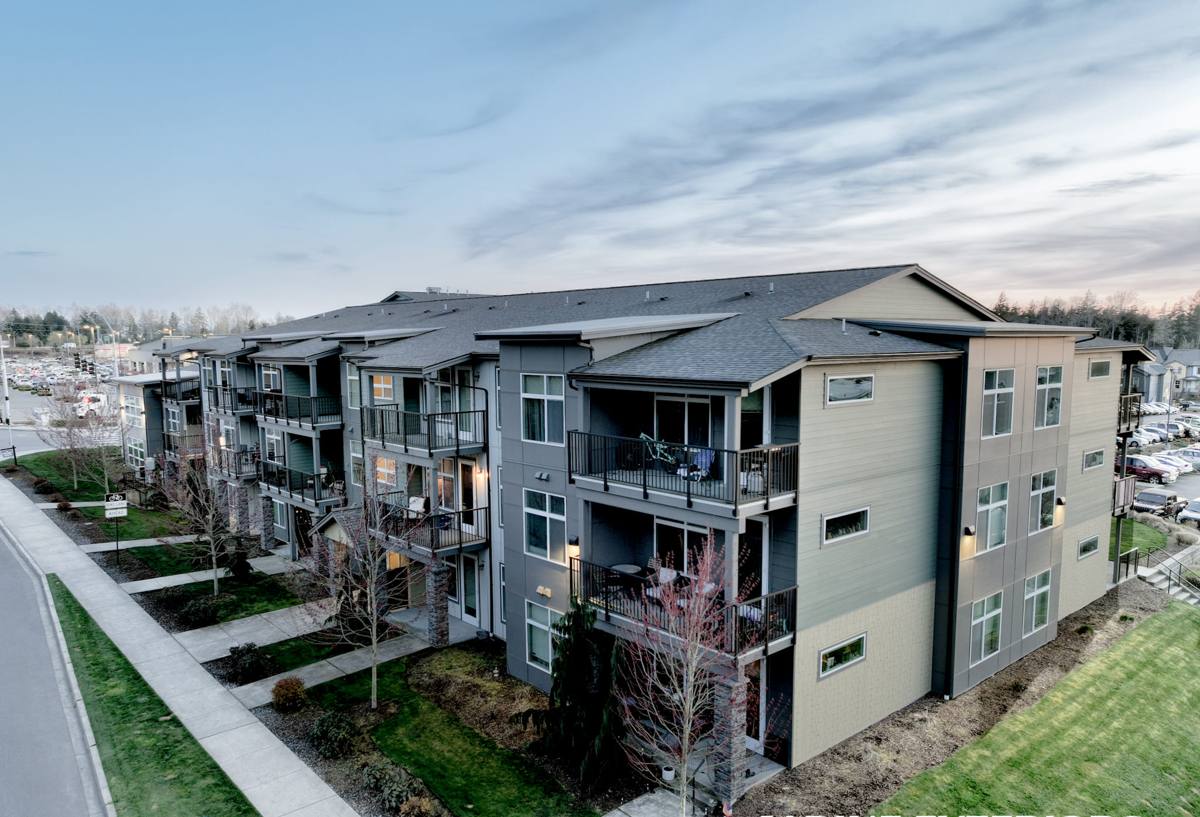
What's Actually Causing Siding Damage in Sumas
Wind-Driven Rain
Rain in this part of Washington rarely falls straight down. Wind pushes it sideways into seams, corners, and butt joints — anywhere a piece of trim or flashing isn't sealed the way it should be. On an older wall, or one that wasn't detailed correctly the first time, that's exactly where repair problems start: not in the middle of a flat panel, but at the transitions.
Valley Humidity and Slow Drying
Sumas sits low in the valley, and low, flat ground holds moisture longer than a hillside lot does. A wall that gets soaked during a storm needs time to dry back out before the next one rolls through, and in a valley setting that drying window is shorter than most homeowners assume. Siding and trim that stay damp for extended stretches are more prone to the slow, hidden deterioration that eventually surfaces as a repair call — often well after the moisture first got in.
A Long Moss Season
Mild temperatures, tree cover, and consistent dampness add up to a moss and mildew season that runs most of the year across Whatcom County, and Sumas is no exception. Moss holds water directly against whatever it's growing on, so on a shaded wall that means sustained dampness at seams and fastener points long after the surrounding air has dried out. Left alone, it's one of the more common reasons a small cosmetic issue turns into an actual repair.
Freeze-Thaw Cycling
Sumas sees colder snaps and more frequent hard frost than towns closer to the water, since it's more exposed to outflow wind funneling down from the north during winter storms. Water that's already worked its way into a crack, an open seam, or an unsealed cut edge expands when it freezes, which turns a small, cosmetic problem into a structural one faster than a milder coastal climate would allow.
Signs Your Sumas Home Needs Siding Repair
Most siding damage doesn't announce itself. It shows up as small, easy-to-dismiss details that get worse over a wet season if nobody looks closely. Worth checking for:
- Cracked, chipped, or split boards, especially near corners or window and door trim
- Soft or spongy spots when you press on the siding, usually near the bottom of the wall
- Gaps opening up at seams, butt joints, or where siding meets trim
- Moss or dark staining on shaded, north-facing walls that returns quickly after cleaning
- Bubbling, peeling, or fading paint on an older non-Hardie wall
- Visible warping, cupping, or bowing in individual boards or panels
- Rusting or backed-out fasteners, or nail heads visibly popping through the surface
- A noticeable draft or higher heating bills that coincide with visible wall damage
What a Correct Siding Repair Actually Involves
A siding repair that just covers up a damaged board without checking what's underneath is a temporary fix, not a real one. On a Sumas home, where moisture has usually had time to work its way in before anyone notices, a correct repair starts with finding out how far the problem actually goes.
Diagnosis Before Repair
Before we touch a board, we pull back enough of the damaged section to see what's behind it — the house wrap, the sheathing, the flashing at that spot. If water has been tracking behind the wall for a while, patching the visible damage and leaving the underlying moisture path untouched just guarantees a repeat call in a year or two. That inspection step is what separates an honest repair from a cosmetic patch.
Matching Material and Color
Because we work exclusively in James Hardie fiber cement, repairs on a home that already has Hardie siding are usually a straightforward material and profile match. Hardie's factory-applied ColorPlus finish is formulated to specific color codes, so a matched replacement board typically blends in far better over time than a field-painted patch would, since it isn't subject to the same fading rate as brushed-on paint. On older sections that have weathered for years, we'll talk through realistic expectations for how closely a new board will match, rather than promise a seamless result we can't guarantee.
Flashing and Fastening
Every repaired section gets reintegrated into the house wrap and flashing system correctly, with proper overlap at seams and joints — not just caulked over. Fastening follows Hardie's spec for the exposure this area sees, which matters given the wind-driven rain and outflow wind events that come through a valley location like Sumas.
Repair or Replace? How We Help You Decide
Not every siding problem on a Sumas home calls for a full re-side, and not every problem is actually fixable with a patch. The honest answer depends on how contained the damage is and what's happening behind the wall.
| Situation | Usually Points To | Why |
|---|---|---|
| Isolated impact damage, one or two cracked boards | Repair | Damage is contained and the surrounding wall assembly is likely sound |
| Wind or storm damage to a specific section | Repair | Localized failure with matchable material and no widespread moisture intrusion |
| Moisture staining spreading across multiple walls | Full or partial replacement | Suggests a systemic flashing or house wrap failure, not a single bad board |
| Older non-Hardie siding nearing the end of its service life | Replacement | Patching an aging, failing product usually just delays a bigger job |
| Soft sheathing or rot found once a section is opened up | Depends on extent | Small pockets can be repaired; widespread rot calls for a broader tear-off |
We'll tell you honestly which category your home falls into once we've actually looked, rather than defaulting to whichever option is more profitable for us.
Why We Only Repair With James Hardie Materials
We used to work with a broader range of siding products. We don't anymore, and that decision affects repair work as much as new installs. Fiber cement gives us a non-combustible material that holds its dimensions instead of swelling or warping after repeated wet-season moisture cycles, which matters on a valley property that stays damp longer than a well-drained hillside lot. Hardie's HZ5 formulation is engineered for regions with significant moisture exposure and freeze-thaw cycling, which describes a Sumas winter reasonably well. And because ColorPlus color is baked on at the factory rather than mixed on site, a matched repair board holds its color far longer than a field-painted patch on an older product would.
We don't install or repair with LP SmartSide, vinyl siding, Cemplank, Allura, primed spruce, or cedar. If your home currently has one of those products, we'll still come look at it and give you an honest assessment — sometimes a contained repair with a close-enough match is reasonable, and sometimes we'll tell you plainly that a product nearing the end of its service life is better replaced with Hardie than patched again.
Our Siding Repair Process in Sumas
- Inspection: We walk the affected area and pull back enough material to see what's actually happening behind the visible damage.
- Diagnosis: We identify whether the issue is isolated or connected to a broader flashing, drainage, or moisture problem.
- Honest recommendation: We explain whether a repair makes sense, what it will and won't fix, and when replacement is the more sensible long-term call.
- Material match: For Hardie homes, we source matching profile, texture, and color; for non-Hardie homes, we discuss realistic matching limits up front.
- Repair and reflashing: Damaged sections are removed, the wall assembly behind them is corrected if needed, and new material is installed and properly integrated into the flashing and house wrap.
- Final check: We walk the repair with you before we consider the job finished, not just before we invoice it.
What Siding Repair Costs Depend On
| Factor | What It Affects | Why It Matters in Sumas |
|---|---|---|
| Extent of hidden moisture damage | Whether the job stays a patch or grows into a larger repair | Valley humidity gives water more time to spread before it's found |
| Material match availability | Whether an exact profile and color match is possible | Older or discontinued Hardie colors may need a closer color blend rather than an exact match |
| Number and location of damaged sections | Labor time and staging | Repairs near rooflines, second stories, or tight setbacks take longer to access safely |
| Underlying flashing or house wrap condition | Whether reflashing is needed beyond the visible repair area | Wind-driven rain in this area tends to find and exploit any gap left in the wrap |
| Site access | Equipment and labor needs | Rural and agricultural lots near Sumas can have longer driveways or wider staging requirements |
Exact numbers depend on the specific home and what we find once we open up the damaged area, which is why we give real estimates after a walk-through rather than a number over the phone.
Why a Local Crew Matters for Repair Work
Repair work rewards local experience more than new construction does, because diagnosing a problem correctly depends on knowing how this specific climate tends to cause damage in the first place. A crew that works Whatcom County day to day, from coastal towns near Bellingham Bay out to valley communities like Sumas, has seen enough repair calls to recognize the difference between a cosmetic issue and a sign of something bigger behind the wall. That experience is what keeps a repair from becoming a repeat visit two winters later, and it's part of why we operate out of Lynden and stay close to the towns we actually work in rather than treating every job the same regardless of where the house sits.
If your Sumas home has damaged, aging, or failing siding and you want an honest opinion on whether it needs a repair or something bigger, we're glad to take a look. Reach out using the form below to schedule a free, no-pressure estimate.