 Lynden Siding
 Ferndale's Coastal Climate Is Harder on Siding Than Most Homeowners Realize
Ferndale sits close enough to the water that salt-laden air is a daily fact of life, not an occasional weather event. That salt air settles into caulk joints, fasteners, and any spot where a siding panel's factory finish has been nicked or worn through, and it accelerates corrosion and finish breakdown in ways that inland Whatcom County homes simply don't deal with as much. Add in the driving, wind-pushed rain that comes through on winter storm systems, and siding on the west- and south-facing walls of a Ferndale home takes a real beating over a heating season.
Then there's moss. Whatcom County's long, wet, mild winters and shaded, tree-lined lots mean moss and algae have months on end of ideal growing conditions on siding, trim, and the ground line where a wall meets grade or a deck. Moss holds moisture against the siding surface far longer than open air ever would, and that constant damp is what turns small finish problems into real ones — swollen edges, soft spots, and eventually moisture getting past the siding into the wall assembly behind it. None of this means Ferndale siding is doomed to fail. It means repairs here need to account for salt, standing moisture, and a moss season that runs longer than a lot of repair estimates assume.
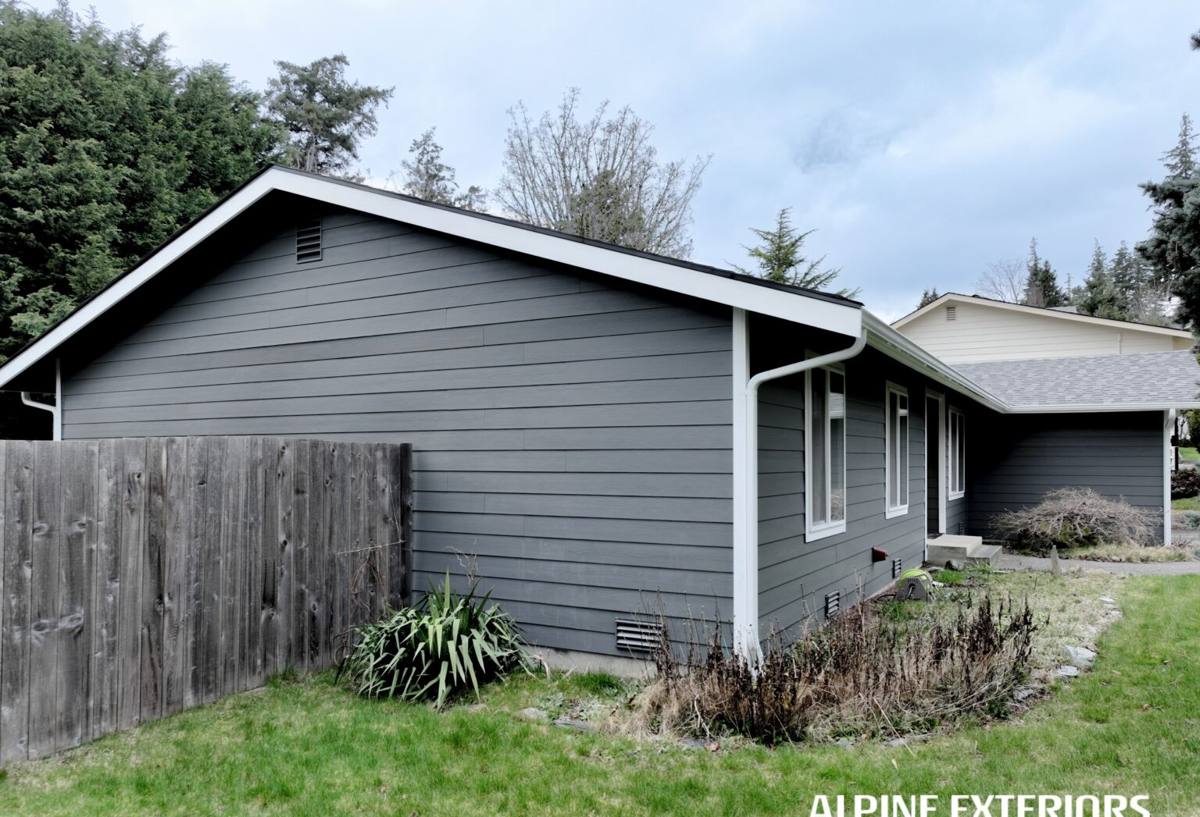
Signs Your Ferndale Home's Siding Needs Repair, Not Just a Repaint
A lot of siding problems get masked by paint for a season or two before they show up for real. Here's what we look for, and what you should too:
- Panels or boards that feel soft, spongy, or give slightly when pressed near the bottom edge or at seams
- Visible cracking, especially at butt joints, corners, or anywhere siding meets a window or door trim
- Persistent dark staining or streaking that comes back within weeks of being cleaned
- Moss or algae growth that returns quickly after washing, especially on north- and west-facing walls
- Bubbling, peeling, or chalky paint that wasn't there a year or two ago
- Gaps opening up at caulked joints, trim boards, or where siding meets flashing
- Any soft or discolored spot on interior drywall near an exterior wall, which often means water has already gotten past the siding
Any one of these on its own might be minor. Several showing up in the same area, or damage that keeps coming back after cosmetic fixes, usually means there's a moisture problem behind the siding that needs to be found before anything gets patched.
What a Correct Siding Repair Actually Involves
Diagnosing the Cause Before Touching a Panel
Cutting out a damaged section and nailing up a new piece is the easy part. The part that actually matters is figuring out why that section failed in the first place. Was it a flashing detail that let wind-driven rain behind the siding? A caulk joint that dried out and cracked open? A sprinkler head hitting the same spot every day? If we don't find and fix the actual cause, the replacement piece fails the same way in a year or two, and the homeowner pays for the same repair twice.
Checking What's Behind the Siding
Once a section is opened up, we look at the house wrap or building paper, the sheathing underneath, and the framing if there's any sign water has been getting through. Whatcom County's wet winters mean that when moisture does find its way behind siding, it doesn't dry out quickly — so sheathing that looks fine on the surface can still be soft or delaminating underneath. A repair that stops at the visible siding and skips this step is a repair that's guessing.
Matching Existing Material and Finish
On homes where the existing siding is James Hardie fiber cement with a factory ColorPlus finish, matching a repair is straightforward — the product line, plank width, and reveal are all standardized, and Hardie's factory-finish colors are consistent across production runs, so a patched section blends in rather than standing out as an obvious repair. On homes with older, non-Hardie siding, matching gets harder: discontinued profiles, faded field-painted finishes, and materials that behave differently than what's currently available all make a truly invisible patch difficult to guarantee, which is part of why we're upfront with homeowners when a small, clean repair isn't realistic and a broader re-side of the affected wall makes more sense.
Repair or Replace? How We Make That Call for Ferndale Homes
Not every damaged section needs a full re-side, and not every problem should be patched and left alone. We walk homeowners through the actual factors rather than defaulting to the biggest job:
| Factor | Leans toward repair | Leans toward replacement |
|---|---|---|
| Extent of damage | Isolated to one or two sections or walls | Recurring across multiple walls or the whole exterior |
| Underlying material | Existing James Hardie siding, still sound elsewhere | Older wood, vinyl, or discontinued fiber cement that's hard to match |
| Cause of failure | A single fixable issue (flashing, caulk, sprinkler) | Systemic issue — original installation defects, widespread moisture intrusion |
| Sheathing condition | Sound and dry once opened up | Soft, delaminated, or showing rot in multiple spots |
| Age of siding | Still well within its expected service life | Near or past the point where matching and long-term value make sense |
The honest answer for most Ferndale homes with existing Hardie siding is that a well-diagnosed repair is the right call. The honest answer for homes with aging, non-Hardie siding that's failing in more than one place is usually that a repair buys a year or two at best.
Why We Repair With James Hardie Fiber Cement
We install James Hardie exclusively — we don't carry vinyl, LP SmartSide, Cemplank, Allura, or bare wood siding, and that applies to repair work too. When a repair calls for new material, whether it's patching existing Hardie siding or replacing a failing section of something else with Hardie board, we're using a product that's factory-engineered for exactly the conditions Ferndale deals with: non-combustible fiber cement construction that doesn't feed moss and mildew the way wood-based products can, a factory-applied ColorPlus finish that resists the fading and chalking that field-painted siding shows within a few years, and Hardie's HZ5 product line, which is formulated specifically for the wetter, more moisture-exposed climate zones of the Pacific Northwest rather than a generic national spec. Practically, that means a repaired section holds up the same way the surrounding siding does, instead of becoming the weak point that fails again first.
Our Siding Repair Process for Ferndale Homes
- Inspection and diagnosis — we look at the damaged area, the surrounding siding, flashing, caulk lines, and grade conditions to find the actual cause, not just the visible symptom
- Opening up the affected section — damaged siding is removed carefully so we can check the house wrap and sheathing underneath before anything gets closed back up
- Addressing the root cause — flashing gets corrected, caulk joints get redone properly, drainage or clearance issues get fixed, so the same failure doesn't happen again
- Repairing or replacing sheathing — if moisture reached the wall sheathing, that gets addressed before new siding goes back up, not covered over
- Installing matched James Hardie material — new panels or boards go in to match the existing reveal, profile, and ColorPlus color as closely as the product line allows
- Final detailing — trim, caulking, and touch-up are finished to Hardie's installation specifications so the repair holds up and doesn't stand out
What Happens When Siding Damage Gets Left Alone
In a climate this wet, small siding problems don't stay small for long. A cracked caulk joint or a soft board that goes unaddressed through one more Whatcom County winter gives moisture a direct path behind the siding, and once it's there, it moves — into sheathing, into framing, and eventually into insulation and drywall. By the time a homeowner sees a stain on an interior wall, the damage has usually been developing behind the siding for a while. Catching and repairing damage early is almost always a fraction of the cost of dealing with rotted sheathing, mold remediation, or a much larger section of wall needing to be opened up and rebuilt.
Why a Crew That Already Works in Ferndale Makes a Difference
Siding repair isn't one-size-fits-all, and a crew that regularly works Whatcom County's coastal side knows what to actually look for here: which wall orientations take the worst of the wind-driven rain, how long moss really takes to become a moisture problem rather than just a cosmetic one, and how salt air affects fasteners and finishes over time in a way inland crews may not think to check. That local familiarity also means faster response — getting an inspection scheduled and a repair plan in place before a soft spot behind the siding turns into a much bigger job over the next rainy season.
Keeping Repaired Siding in Good Shape Between Visits
A correct repair should hold up for years, but a little routine care extends that further, especially in a climate that grows moss on nearly anything that stays damp:
- Rinse siding down at least once a year to keep moss, algae, and salt residue from building up, especially on shaded or north-facing walls
- Keep gutters clear so overflow isn't running down siding during heavy rain events
- Trim back landscaping and tree cover that keeps siding shaded and damp longer than it needs to be
- Check caulk joints around windows, doors, and trim every year or two, and have any cracked or missing caulk redone before winter rains set in
- Keep sprinklers and irrigation aimed away from siding, since repeated direct wetting is one of the most common causes of localized damage
If you're seeing any of the warning signs above, or just want a straight answer on whether a section of your Ferndale home's siding needs a repair or something more, we're happy to take a look. Fill out the form below for a free, no-pressure estimate.