 Lynden Siding
 Composite Decking Built for How Nooksack Actually Weathers
Nooksack sits in a part of Whatcom County that gets the full Pacific Northwest treatment: damp air moving in off the water, long stretches of driving rain in the fall and winter, and short, humid summers that don't dry things out for long before the next system rolls through. A deck out here isn't just outdoor furniture — it's a structure that spends most of the year wet, shaded, or both. Composite decking has become the default choice for homeowners in this area for a simple reason: it doesn't feed the moisture and moss problems that wood decking struggles with, and it doesn't need the yearly upkeep that keeps a lot of wood decks looking tired by year three or four.
This page is specifically about composite decking installed correctly for Nooksack conditions — not a generic rundown of what composite decking is. If you're comparing options for a deck on your property, this is the local version of that conversation.
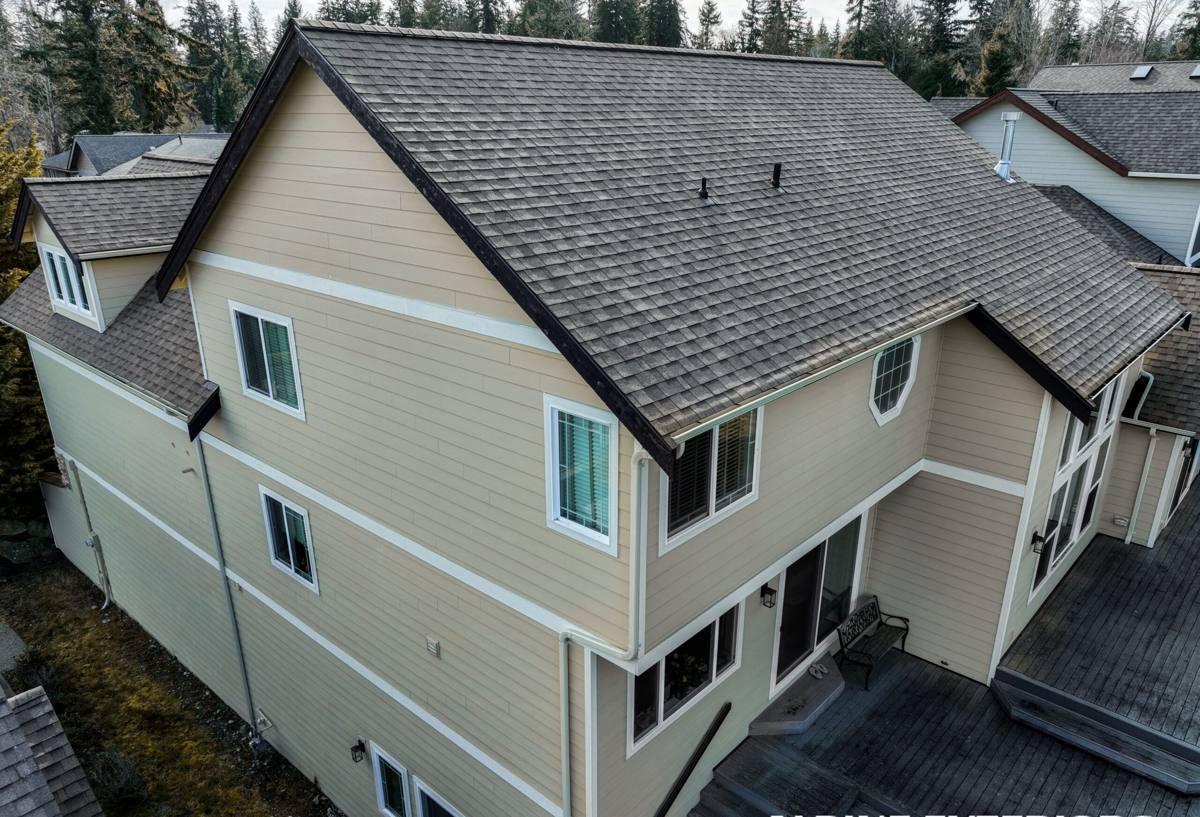
What Whatcom County Weather Does to a Deck Over Time
Three things drive most of the decking problems we see in this area:
Salt air
Even inland from the coastline, the air moving through Whatcom County carries enough salt content to accelerate corrosion on exposed metal fasteners, brackets, and railing hardware. Over years, that shows up as rust streaking, loosening screws, and weakened connections at the points that matter most structurally.
Driving rain
Rain here doesn't just fall straight down — wind-driven rain gets up under railings, into end grain, and into any gap where water can sit instead of shed. Wood decking absorbs that moisture and swells; if it can't dry out fully between storms, rot starts at the connections and fastener points long before it's visible on the surface.
Moss season
Shaded, damp decking surfaces in this climate can carry moss and algae growth for a good chunk of the year, not just a few weeks. On wood, that growth holds moisture against the board and makes the surface slick and slippery. On composite boards, it's a surface issue you can clean off — it doesn't work its way into the material the way it does with wood grain.
Composite vs. Wood vs. PVC Decking for This Climate
| Factor | Wood | Composite | PVC/Vinyl |
|---|---|---|---|
| Moisture behavior | Absorbs water, swells, can rot at fasteners | Resists moisture absorption, won't rot | Fully moisture-resistant |
| Moss/algae surface growth | Grows into grain, hard to fully remove | Grows on surface only, washes off | Grows on surface only, washes off |
| Annual maintenance | Staining or sealing most years | Periodic washing, no staining/sealing | Periodic washing, no staining/sealing |
| Upfront cost | Lowest | Mid-range | Highest |
| Feel underfoot | Natural wood texture | Wood-grain texture, warmer feel than PVC | Smoother, plastic feel |
| Fade resistance | Fades and grays without upkeep | Cap-stock formulas resist fading well | Very stable color, can look less natural |
We install composite for most Nooksack homeowners because it lands in the middle of this table where it matters most: it holds up to the moisture and moss cycle without the maintenance burden of wood, and it keeps a warmer, more natural look than straight PVC. That said, honest tradeoffs exist both directions — wood is cheaper up front if you're willing to stay on top of it, and PVC is worth discussing if you want the lowest possible long-term maintenance and don't mind the more uniform look. We'll walk through which makes sense for your project rather than push one material by default.
What a Correct Composite Deck Installation Involves
Framing and joist spacing
Composite boards flex differently than wood, and manufacturers specify tighter joist spacing than a lot of older wood decks were built to. Installing composite decking over framing that was spaced for wood — or over framing with existing rot — is one of the most common corner-cutting mistakes we see when we're asked to fix a problem deck. We check and correct framing before boards ever go down.
Drainage and airflow underneath
In a climate with this much rain, what happens under the deck matters as much as the surface. Standing water and trapped moisture underneath a deck accelerates joist rot even when the composite boards above look fine. Proper grading, gapping, and ventilation underneath keeps that area drying out between storms instead of staying saturated all winter.
Fastener choice and spacing
Given the salt-air corrosion issue, we use fasteners and hardware rated for coastal/marine-grade exposure, not standard-grade hardware that's cheaper but corrodes faster in this air. Board spacing also needs to account for composite's expansion and contraction with temperature swings — too tight, and boards can buckle; too loose, and you get an uneven surface and debris traps.
Railings and edge details
Railing posts and edge boards take the brunt of driving rain because they're the most exposed part of the structure. Flashing and sealing at these transition points is what actually keeps water from working its way into the structure over time — it's easy to skip and hard to notice until it's already a problem.
Our Process, Start to Finish
- On-site assessment — we look at your existing deck or build site, check framing condition, drainage, and sun/shade exposure to understand what the deck will actually be dealing with year-round.
- Material selection — we go over composite board and color options against your budget and how much sun or shade the deck gets, since shaded decks are the ones most affected by moss and algae buildup.
- Written estimate — a clear scope and price before any work starts, no surprises added mid-project.
- Framing and structural work — repair or build framing to current spacing standards, address any rot found in existing structures.
- Decking installation — boards, hidden or exposed fasteners depending on the product, railings, and edge detailing.
- Final walkthrough — we go over care and cleaning with you before we consider the job done.
Living With Composite Decking Through Moss Season
Composite decking is low-maintenance, not zero-maintenance. Homeowners who get the longest life and best look out of their deck do a few simple things on a regular basis:
- Rinse or sweep the deck surface regularly during the wet months to keep organic debris from sitting and feeding moss growth
- Wash the deck with a composite-safe cleaner (or mild soap and water) once or twice a year to remove surface algae and grime before it builds up
- Keep gutters and downspouts nearby clear so runoff isn't dumping extra water directly onto or under the deck
- Check railings and fastener points annually for any looseness, especially after a hard winter of driving rain
- Avoid pressure-washing at close range or high pressure, which can damage the cap-stock surface of some composite boards
- Keep planters and furniture with rubber feet elevated slightly or moved periodically so moisture and moss don't collect underneath them
Cost Factors on a Composite Deck Project
Every project is different, but the factors that move the price on a Nooksack composite deck job are consistent:
| Factor | Why It Affects Cost |
|---|---|
| Deck size and shape | More square footage and more corners/angles mean more material and labor |
| Existing framing condition | Rotted or undersized framing needs to be repaired or replaced before decking goes down |
| Composite board tier | Entry-level composite costs less than premium cap-stock lines with stronger fade and stain resistance |
| Height and railing requirements | Taller decks need more substantial railing systems and may require additional support |
| Site access | Difficult access for materials and equipment adds labor time |
| Site prep and removal | Tearing out an old wood deck adds cost before the new build starts |
We give straightforward, itemized estimates so you can see exactly where your budget is going rather than a single lump number.
Why Hire a Crew That Already Works in Nooksack
A composite deck built to a generic spec sheet and a composite deck built for what this specific area throws at it are not the same project. Fastener grade for salt-air exposure, framing spacing that accounts for our rain load, and drainage details that keep moisture from sitting under the structure all winter — these aren't things every installer thinks through the same way, especially crews that mostly work drier climates or unfamiliar building conditions. Working regularly in Lynden and the surrounding Whatcom County communities, including Nooksack, means we're not guessing at how a deck holds up here — we're building to what we've seen actually happen to decks in this climate over time.
We're also local enough to stand behind the work after the job is done. If something needs attention, we're not a crew that packed up and left the county.
Get a Straightforward Estimate
If you're weighing a new composite deck or replacing an aging wood deck in Nooksack, we're happy to take a look and walk you through your options honestly — including where composite makes sense and where it might not, for your specific site and budget. Use the form below to request a free, no-pressure estimate.