 Lynden Siding
 Siding That Actually Holds Up in Everson
Everson sits in one of the wetter corners of Whatcom County, tucked along the Nooksack River with the kind of low-lying, tree-shaded lots that stay damp long after a storm has passed. Homes here deal with driving rain off the water, a long moss-and-mildew season that can run from October through April, and enough humidity most weeks to keep wood trim and cheaper siding products perpetually damp at the seams. That combination is hard on a house's exterior, and it's exactly the kind of climate where the siding material you choose matters more than almost anywhere else in the state.
We install James Hardie fiber cement siding exclusively, and we've worked enough homes in the Lynden and Everson area to know what actually holds up here versus what looks fine for a few years and then starts showing problems. This page is about what a correct Hardie installation looks like for an Everson home specifically — not a generic overview of the product.
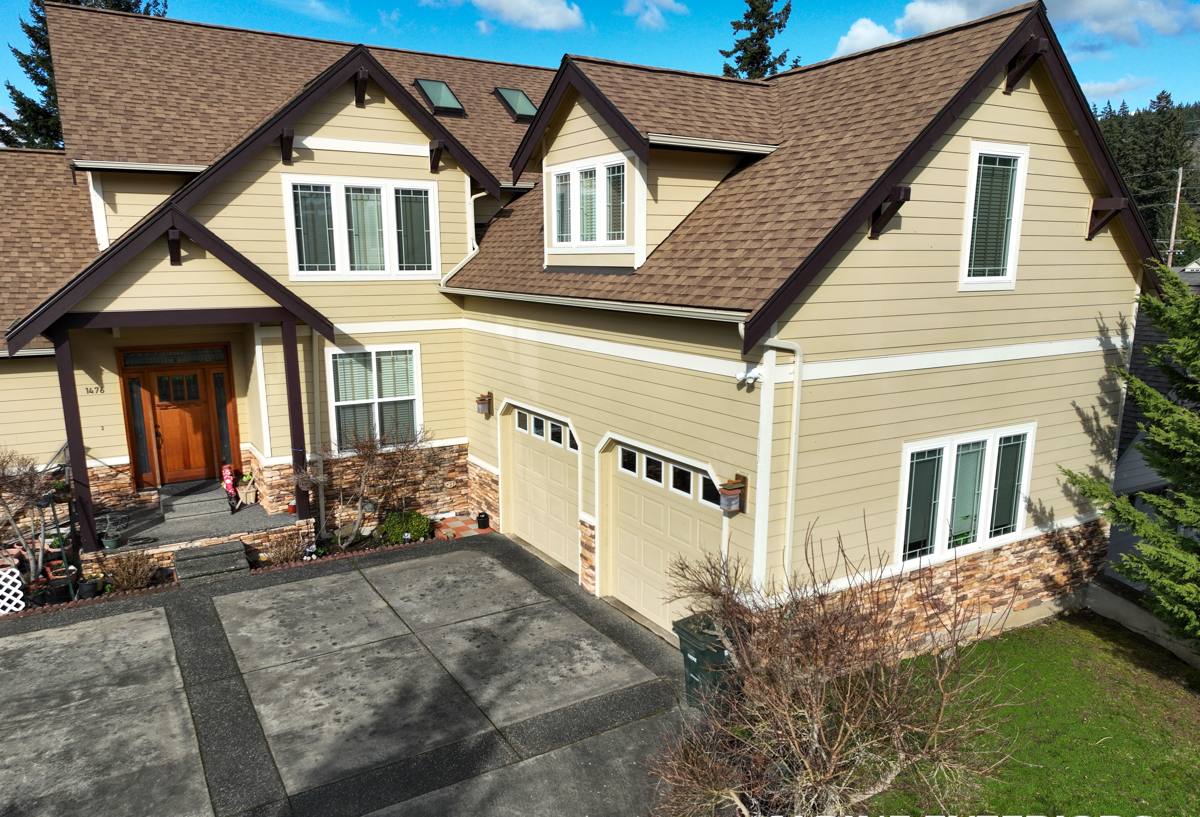
What Everson's Climate Does to a House Exterior
A few local realities shape every decision we make on an Everson siding job:
- Prolonged dampness: Low elevation, river proximity, and heavy tree cover mean siding and trim often don't get a full dry-out between rain events for weeks at a stretch.
- Moss and algae growth: North-facing walls and anything shaded by mature trees or fences will grow moss on porous or wood-based siding within a season or two if it isn't sealed and finished correctly.
- Driving rain and wind-blown moisture: Storms coming through the valley don't just fall straight down — they push moisture sideways into joints, corners, and anywhere flashing or caulking is weak.
- Temperature swings: Whatcom County winters bring freeze-thaw cycles that punish any siding material prone to soaking up water, since trapped moisture expands and contracts with the cold.
None of this is unique to Everson, but the combination is more concentrated here than in drier or higher-elevation parts of the county. It's why we don't treat every siding job the same way — an Everson install gets more attention to drainage detailing and joint sealing than a job on a well-drained slope.
Why This Rules Out Some Popular Siding Options
Wood-based composite siding, primed spruce, and cedar all share one weak point in this climate: they're organic materials that absorb moisture at cut edges, fastener holes, and any spot where the factory coating gets compromised. In a climate that doesn't dry out quickly, that moisture sits, and it eventually shows up as swelling, delamination, or soft spots — usually years after installation, once it's expensive to fix. Vinyl siding sheds water fine but flexes and gaps with temperature swings, which lets wind-driven rain work behind panels over time. James Hardie fiber cement doesn't share that vulnerability — it's cement, sand, and cellulose fiber, not wood, so it doesn't absorb and swell the same way.
Why We Install Only James Hardie
We made a decision early on to stop installing anything but James Hardie fiber cement siding, and it wasn't a marketing choice — it was a maintenance-call choice. We got tired of going back to homes with wood-based or vinyl siding a few years after installation to deal with problems that a different material simply wouldn't have had.
| Material | How It Handles Everson's Damp Climate | Long-Term Trade-Off |
|---|---|---|
| James Hardie fiber cement | Non-combustible, resists moisture absorption, factory-baked ColorPlus finish resists moss staining | Higher upfront installed cost than vinyl |
| Vinyl siding | Sheds surface water but flexes and gaps over time, letting moisture behind panels | Shorter realistic lifespan in wet climates, fades faster |
| Primed spruce / cedar | Absorbs moisture at joints and cut ends, prone to rot in shaded, damp areas | Ongoing repainting and caulking maintenance |
| LP SmartSide / engineered wood | Better than raw wood but still wood-based, vulnerable at unsealed edges | Edge sealing and caulk maintenance is critical and easy to neglect |
James Hardie isn't magic — it still needs to be installed correctly, with proper clearances, flashing, and joint treatment, to perform the way it's supposed to. But the material itself gives us a much wider margin for error against the kind of sustained moisture exposure Everson homes deal with.
The HZ5 Product Line: Built for This Climate
James Hardie engineers its siding in region-specific "HZ" (Hardie Zone) formulations, and the Pacific Northwest — including all of Whatcom County — falls into the HZ5 zone, engineered for wet, moderate climates with real freeze-thaw cycles. HZ5 panels are formulated to resist moisture-related damage and to hold their factory finish through repeated wet-dry cycles without the cracking or checking you'd see from a product engineered for a drier, hotter region.
For an Everson home specifically, this matters most on the north and west-facing walls that stay shaded and damp the longest, and on any wall facing the prevailing storm direction where wind-driven rain hits hardest. We plan panel selection and detailing around those exposures on every job.
ColorPlus Factory Finish vs. Field-Painted Siding
Most Hardie siding we install uses the ColorPlus finish — a factory-applied, baked-on finish that's more consistent and more moisture-resistant than a coat of paint applied on-site after installation. In a climate where field-applied paint has to cure in unpredictable weather windows, a factory finish that's already fully cured before it reaches the site is a real practical advantage, not just a convenience. It also comes with its own finish warranty separate from the substrate warranty.
What a Correct Installation Actually Involves
The material is only half the equation. A huge share of siding failures we get called out to inspect — regardless of brand — trace back to installation shortcuts, not the product itself. For an Everson home, here's what we treat as non-negotiable:
- Proper water-resistive barrier and rainscreen gap. Siding needs a drainage plane behind it so any moisture that does get past the surface can drain and evaporate instead of sitting against the sheathing.
- Correct fastener placement and spacing. Hardie specifies exact nailing patterns and clearances — get this wrong and you create stress points where cracking can start.
- Flashing at every horizontal joint, window, and door. This is where most water intrusion problems actually start, and it's the detail that gets rushed on lower-bid jobs.
- Minimum ground and roof clearances. Hardie siding needs clearance from grade, decks, and roof lines so it isn't sitting in standing water or snowmelt runoff — a real issue on some of the lower, flatter lots around Everson.
- Caulking only where Hardie's install guide calls for it. Over-caulking joints that are supposed to be able to shed water can actually trap moisture behind the panel.
None of this is exotic — it's James Hardie's own published installation specification. But skipping steps is how a good product ends up with a bad reputation, and it's the single biggest reason we're careful about crew training and job supervision on every project.
Our Process for an Everson Siding Job
1. On-Site Assessment
We walk the exterior with you, looking specifically at drainage, grading, shaded and moss-prone walls, and the condition of the existing siding and sheathing. This tells us whether there's hidden moisture damage that needs to be addressed before new siding goes up — putting new siding over a wet or rotted substrate just hides a problem instead of fixing it.
2. Sheathing and Moisture Barrier Check
Any soft or damaged sheathing gets replaced. We install a proper water-resistive barrier and rainscreen system suited to the wall assembly, which matters more here than in drier parts of the state.
3. Product and Color Selection
We walk you through the HZ5 panel and trim options and ColorPlus color selections, factoring in which walls get the most shade and moisture exposure on your specific lot.
4. Installation to Manufacturer Spec
Flashing, fastening, clearances, and joint treatment are all done to James Hardie's published specifications — not shortcuts, not "close enough."
5. Final Walkthrough
We go over the finished job with you, including basic care and what to watch for, before we consider the job done.
What to Ask Any Contractor Before Hiring Them
Whatcom County has plenty of exterior contractors, and not all of them specialize in fiber cement. Before hiring anyone for a siding job in Everson, it's worth asking:
- Are you a James Hardie-preferred or certified installer, and how many Hardie jobs have you completed in this county specifically?
- What water-resistive barrier and rainscreen approach do you use, and why?
- Will you inspect and address sheathing condition before installing new siding, not just over it?
- What does your flashing detail look like at windows, doors, and horizontal joints?
- What's covered under the manufacturer's warranty versus your own workmanship warranty, and is either transferable if you sell the home?
A contractor who can answer these clearly and specifically — not with a generic sales pitch — is one who actually understands the material and the climate.
Maintenance Expectations After Installation
One of the practical advantages of a correctly installed Hardie system in a climate like Everson's is how little ongoing maintenance it needs compared to wood-based siding. You're not repainting every few years or chasing caulk failures at every joint. That said, a periodic rinse-down to clear moss spores and organic buildup on shaded walls, and an annual visual check of caulking at penetrations, will keep the system performing the way it's designed to for the long haul.
Get a Straight Answer for Your Home
Every lot in Everson sits a little differently — tree cover, drainage, sun exposure, and proximity to the river all change what a siding job actually needs. We'd rather walk your property and give you a specific, honest assessment than quote a generic number over the phone. If you'd like a free, no-pressure estimate on James Hardie siding for your Everson home, the request form below gets you started.