 Lynden Siding
 Building a Deck That Actually Holds Up in Blaine
Blaine sits right where marine air off the Strait of Georgia meets the everyday wet of Whatcom County, and that combination is harder on a deck than most homeowners expect. It's not one dramatic storm that wrecks a deck out here — it's years of salt-laden air working into fasteners, driving rain finding its way into ledger connections, and a moss season that stretches longer than it does even a few miles inland in Lynden. A deck built to a generic spec sheet from a big-box supplier will show its age in Blaine faster than the same deck would in a drier part of the state. Building one that actually holds up means making different choices at almost every stage — material, framing, fasteners, and finish — with that specific exposure in mind.
We've built and repaired decks throughout this corner of Whatcom County long enough to know which shortcuts fail first here, and it's almost always the same handful: bare steel hardware, ledger boards without real flashing, and decking laid tight enough that moisture and debris have nowhere to go. None of that is unique to Blaine, but the salt air accelerates all of it.
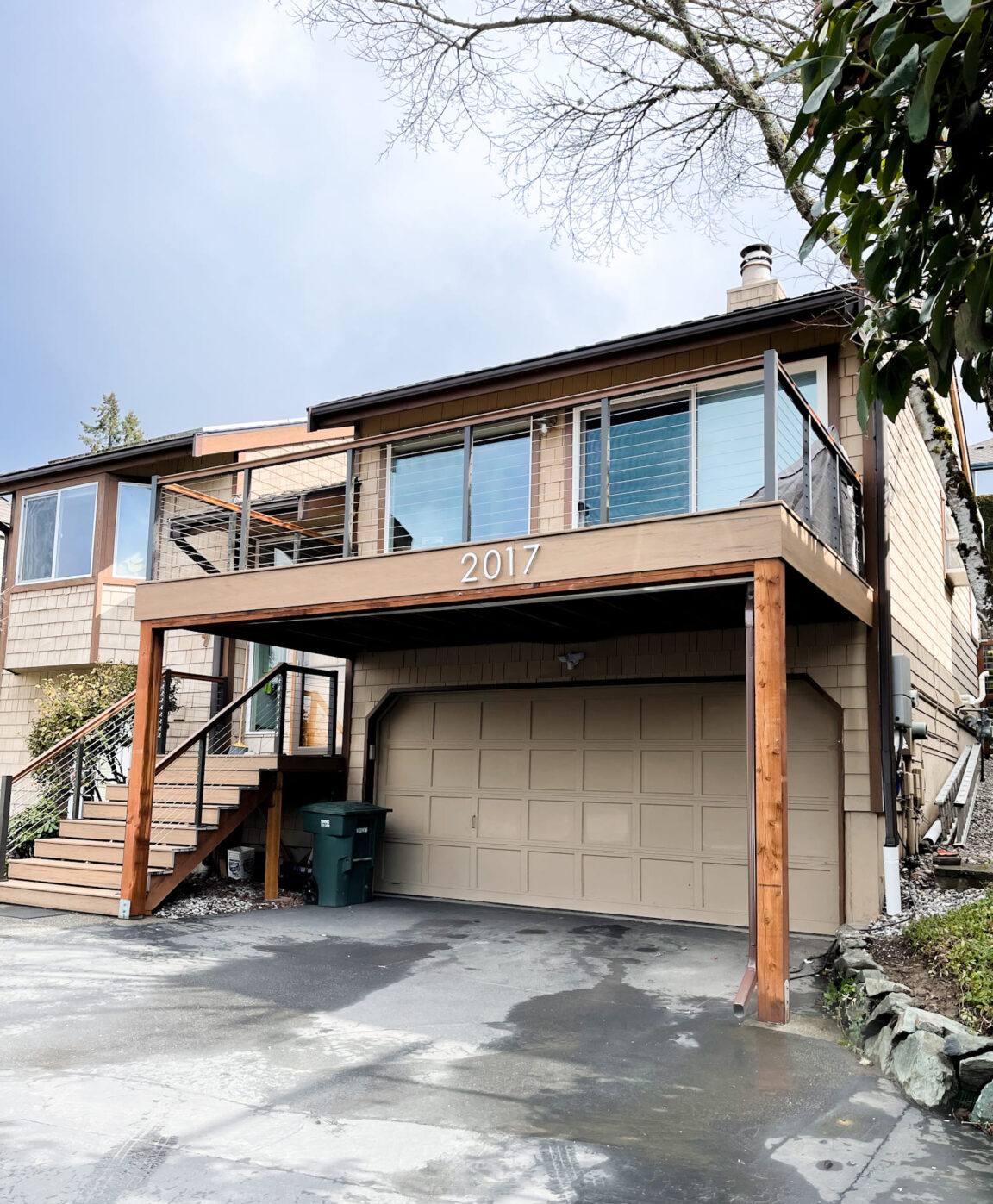
What Salt Air, Driving Rain, and Moss Do to a Deck
Salt air and corrosion
Coastal air carries fine salt particles that settle on every exposed surface, including the parts of a deck you don't see — joist hangers, structural screws, post bases. Standard zinc-coated fasteners and connectors corrode noticeably faster in this environment than they would 20 miles inland. Once a fastener starts to rust, it doesn't just look bad; it loses holding strength, and in a structural connection like a ledger bolt or hanger, that's a real safety issue, not a cosmetic one.
Driving rain and water intrusion
Wind-driven rain doesn't fall straight down — it gets pushed sideways into the house-to-deck connection, under poorly lapped flashing, and into any gap where board ends meet a rim joist. The ledger board connection, where the deck attaches to the house, is the single most common point of hidden rot we find on decks in this area. It's also the hardest to inspect once the decking is down, which is exactly why it has to be done right the first time.
Moss and organic buildup
Whatcom County's moss season runs long, and a deck with poor airflow underneath or boards laid without adequate drainage gaps becomes a moss magnet. Moss holds moisture directly against the wood or composite surface, keeps it from drying between rain events, and makes the surface genuinely slick — a real slip hazard on stairs and landings, not just a maintenance annoyance.
Decking Material Options for a Blaine Climate
There's no single "best" decking material — every option is a set of trade-offs, and the right call depends on your budget, how much upkeep you want to do, and how the deck will be used. Here's how the common choices stack up under Blaine's specific conditions:
| Material | How it handles salt air & rain | Moss/maintenance reality | General cost position |
|---|---|---|---|
| Pressure-treated wood | Good if fasteners and flashing are corrosion-resistant; the wood itself handles moisture reasonably well when sealed | Needs regular cleaning and re-sealing to resist moss and graying | Lowest upfront cost |
| Cedar | Naturally moisture- and rot-resistant, but still needs quality fasteners near the coast | Still susceptible to moss without airflow and periodic cleaning; needs finish maintenance to hold color | Mid-range |
| Capped composite | Excellent — the cap layer resists moisture absorption and won't rot at the surface | Lowest moss/maintenance burden; surface cleans easily and doesn't need sealing | Higher upfront, lower lifetime upkeep |
| Uncapped/lower-grade composite | More prone to moisture wicking at cut ends and fastener holes if not properly sealed | Can still hold moss in shaded, poorly ventilated areas | Mid-to-higher |
For a lot of Blaine homeowners, capped composite ends up being the practical answer simply because it removes the yearly sealing chore that salt air and long wet seasons make more urgent than in drier climates. That said, a well-built cedar or treated wood deck, maintained on schedule, is a completely legitimate choice — the framing and fastener decisions underneath matter more than the decking material on top.
What a Correct Job Involves Below the Surface
The decking boards are the part everyone sees, but the parts that determine whether a deck lasts 10 years or 25 are almost all hidden:
- Ledger flashing: A proper metal flashing detail, integrated with the house's water-resistive barrier, so wind-driven rain can't track behind the ledger board into the house framing.
- Corrosion-rated hardware: Stainless steel or heavy hot-dip galvanized joist hangers, structural screws, and post bases — not standard zinc coatings that were never rated for coastal exposure.
- Proper footings: Footings sized and set below frost depth and on undisturbed soil, which matters on the sites around Blaine where drainage and soil conditions vary block to block.
- Joist tape or butyl flashing: A protective membrane over the tops of joists so screw penetrations don't become a thousand tiny entry points for moisture over the years.
- Drainage gaps: Correct board spacing and airflow underneath the deck so water and debris don't sit and breed moss.
- Stair and railing hardware rated for exterior/coastal use: The connections that get the most repeated stress and the most direct rain exposure.
Railings, Stairs, and Hardware Details That Matter Here
Railing posts and stair stringers take a disproportionate amount of weather exposure because they're vertical and fully exposed on all sides, unlike decking that at least has some shelter from the house above. In a salt-air environment, we default to stainless steel fasteners at these connections specifically, even on projects where standard galvanized hardware is used elsewhere on the frame — the cost difference is small relative to the total project, and it's the difference between hardware that's still tight in ten years and hardware that's rust-streaked and loosening in three.
We also pay close attention to post-to-frame connections, which carry real structural load from people leaning on railings. A loose or corroded connection here isn't cosmetic — it's a safety issue, and it's one of the more common findings when we're called out to look at an older deck that "just needs some boards replaced."
Our Process for a Blaine Deck Project
- On-site assessment: We look at sun and wind exposure, existing drainage, soil conditions, and how the deck will actually be used before recommending materials.
- Design and material selection: We walk through the trade-offs in plain terms — upfront cost versus lifetime maintenance, wood versus composite, railing style — so the decision fits your budget and your tolerance for upkeep.
- Permitting: Deck projects generally require a permit; we handle the paperwork and inspections so nothing gets built out of code.
- Framing and flashing first: This is where we spend the extra care described above — ledger flashing, corrosion-rated hardware, joist protection — because it's the part that's invisible once the decking goes down.
- Decking, railing, and finish work: Installed with correct spacing for drainage and airflow underneath.
- Final walkthrough: We go over basic care specific to your material choice so you know what upkeep, if any, to expect.
Realistic Maintenance for a Coastal Deck
Every deck needs some maintenance in this climate — the question is how much. A simple seasonal routine catches most problems before they become expensive ones:
- Sweep debris out of gaps between boards regularly, especially in fall — trapped leaves hold moisture and feed moss growth.
- Clean the surface at least once or twice a year to remove early moss and algae growth before it establishes and gets slick.
- Check railing posts and stair connections annually for looseness — an early sign of hardware corrosion or wood movement.
- For wood or cedar decks, re-seal on the manufacturer's recommended schedule; salt air shortens the effective life of most sealants compared to drier climates.
- Keep an eye on the ledger area where the deck meets the house — staining or dark streaks there are worth a closer look, not something to ignore.
Why a Crew That Already Works Blaine Makes a Difference
A lot of deck problems we get called out to fix started with a design or fastener choice that would have been fine somewhere drier and less salty — but wasn't fine in Blaine. A contractor who builds mostly inland, or mostly in a different climate zone, doesn't always default to coastal-rated hardware or the flashing detail this exposure calls for, because it simply hasn't come up as often in their work. That's not a knock on their skill — it's just a different set of conditions than what Blaine's marine exposure demands day in and day out.
Working regularly in Blaine and the surrounding Whatcom County coastline means we've seen how decks age here specifically — which hardware holds up, which framing details keep water out, and where moss actually becomes a problem versus where it's just cosmetic. That's the kind of knowledge that shows up in the finished project, not on a spec sheet.
If you're planning a new deck or replacing one that's showing its age, we're happy to take a look and talk through what makes sense for your home and budget. Reach out for a free, no-pressure estimate using the form below.