 Lynden Siding
 Blaine's Marine Climate Is Uniquely Hard on Siding
Blaine sits right on the water at the northern edge of Whatcom County, and that location changes what siding has to survive compared to homes a few miles inland in Lynden. Salt-laden air moves off the harbor and the strait almost year-round, and it doesn't stay near the shoreline — wind carries it across yards, decks, and exterior walls, where it settles into every seam, fastener head, and coat of paint. Salt air is corrosive. It speeds up rust on exposed fasteners and hardware, and it breaks down cheaper paint finishes faster than a typical inland exposure would.
Add wind-driven rain to that mix and the problem compounds. Rain in Blaine rarely just falls straight down — it comes in sideways off the water, pushed by wind that has nothing to slow it down before it hits a house. That kind of rain finds every weak lap joint, every gap in flashing, and every spot where caulking has started to fail. It doesn't take a storm to cause damage; it takes years of ordinary weather finding the same weak points over and over.
Then there's moss. Whatcom County's long wet season, combined with the shade from mature trees on many Blaine lots and the extra humidity near the water, creates ideal conditions for moss and algae to take hold on north- and west-facing walls. Moss doesn't just look bad — it holds moisture directly against the siding surface for months at a time, which is exactly the kind of sustained dampness that rots wood-based products and stains porous finishes. A siding system that isn't built for this combination of salt, wind-driven rain, and prolonged moisture exposure will show its age here faster than it would almost anywhere else in the county.
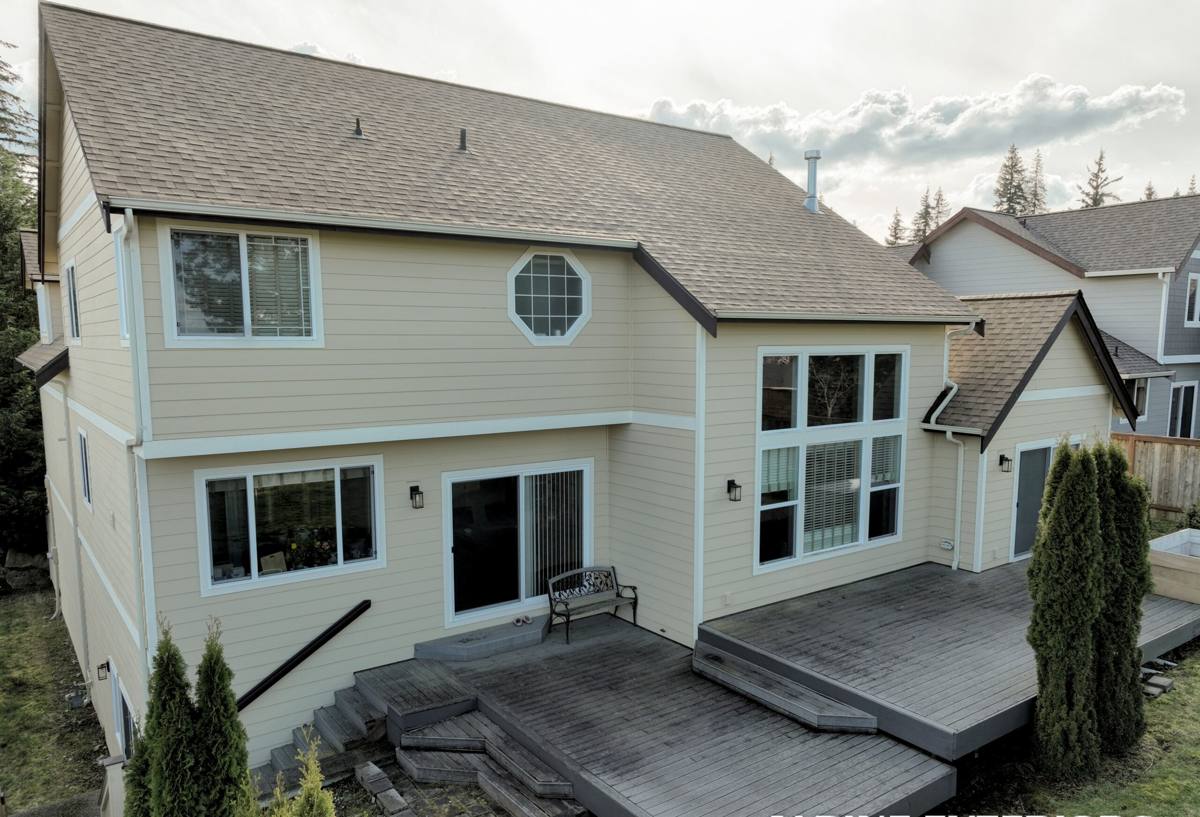
What Correct Siding Replacement Actually Involves
Siding replacement isn't just pulling old panels off and nailing new ones on. In a coastal environment like Blaine, the parts of the job you can't see after it's finished are the parts that determine whether it lasts.
Tear-Off and Sheathing Inspection
Once the old siding comes off, the sheathing underneath gets a real inspection — not a glance. Coastal moisture has a way of finding its way behind siding over the years, especially around old flashing, window trim, and butt joints. Any soft, delaminated, or water-stained sheathing needs to be identified and repaired before anything new goes up. Skipping this step is the single most common reason a "new" siding job fails early.
Weather-Resistive Barrier and Flashing
A properly lapped weather-resistive barrier, correctly integrated flashing at windows, doors, and roof-to-wall intersections, and proper kick-out flashing where a roofline meets a wall are what actually keep wind-driven rain out of the wall assembly. The siding itself is the second line of defense — the barrier and flashing behind it are the first.
Drainage Gap Behind the Siding
Any moisture that does get past the siding face needs a way out. A drainage gap (often called a rainscreen) between the siding and the weather-resistive barrier lets water drain and lets the wall assembly dry out instead of staying wet. In a climate as damp as Blaine's, this detail matters more than it would in a drier part of the state.
Fastening to Spec
Fiber cement siding has manufacturer-specified nailing patterns, fastener types, and edge clearances for a reason — get them wrong and you introduce cracking, buckling, or premature fastener failure, especially once salt air starts working on exposed metal. Correct fastening isn't optional detail work; it's what keeps the whole system performing for decades instead of years.
Why We Install Only James Hardie Fiber Cement in Blaine
We made the decision to install James Hardie fiber cement siding exclusively, and a coastal town like Blaine is exactly the kind of environment that decision was made for. Fiber cement is non-combustible, which matters given the dry-season wildfire smoke and ember exposure that has become a more regular concern across Washington in recent years. It doesn't rot the way wood-based products can when moisture gets past the surface, and it holds up to sustained damp conditions far better than products engineered primarily for drier climates.
James Hardie's ColorPlus factory finish is baked on under controlled conditions rather than field-applied, which gives it stronger resistance to fading and to the kind of finish breakdown that salt air accelerates. Hardie also engineers specific product lines — its HZ5 line, for example — for wetter, harsher climate zones, which is a meaningful difference from a one-size-fits-all siding product. Combined with a strong transferable warranty, that engineering is why we stopped installing anything else. We're not against every alternative product on principle — we just won't put something on a Blaine home that we don't believe will hold up to what this location does to a house.
Our Process, Start to Finish
- On-site inspection and moisture check. We look at your current siding, trim, and any visible problem areas, and check for moisture intrusion before we ever write an estimate.
- Written scope and product selection. You get a clear scope of work and help choosing the right Hardie product line, profile, and color for your home and its exposure.
- Tear-off and sheathing repair. Old siding comes off, sheathing gets inspected, and any damaged material is repaired or replaced before we move forward.
- Weather-resistive barrier and flashing installation. This is the step that actually keeps water out — done correctly, before a single piece of new siding goes up.
- Siding installation to manufacturer spec. Proper fastening, clearances, and joint treatment, following James Hardie's installation requirements rather than shortcuts.
- Caulking, trim, and touch-up. Seams and transitions get sealed correctly, and any factory-finish touch-up is done with the matched ColorPlus product.
- Final walkthrough and cleanup. We walk the job with you, address anything you flag, and leave the site clean.
Signs a Blaine Home Needs Siding Replacement Now
Some warning signs are easy to miss until they've become expensive problems. Watch for:
- Soft or spongy spots when you press on siding, especially near the bottom courses or window trim
- Persistent moss or algae staining that keeps returning after cleaning
- Paint or finish that's peeling, chalking, or fading unevenly, particularly on walls that face the water or prevailing wind
- Visible gaps, warping, or buckling in panels or lap joints
- Rust streaks running from fastener heads or trim hardware
- Rising energy bills that suggest the wall assembly behind the siding is no longer performing as insulation and a moisture barrier
- Interior signs like musty smells or discoloration on walls that back up to exterior siding
What Drives the Cost of a Siding Replacement in Blaine
Every home is different, so exact pricing depends on a site visit, but the factors below are what typically move the number up or down.
| Factor | Why It Matters |
|---|---|
| Home size and wall area | More square footage means more material, labor, and disposal |
| Tear-off and disposal of old siding | Removing and hauling away existing material adds labor and dump costs |
| Sheathing repair needed | Water-damaged sheathing found during tear-off has to be replaced before new siding goes up |
| Trim and detail complexity | Multiple gables, dormers, or intricate trim work take more time to flash and finish correctly |
| Number of stories and access | Taller walls and difficult access require more equipment and time |
| Product line selection | Hardie's climate-engineered HZ5 line and premium profiles cost more than standard options |
Fiber Cement vs. Other Siding Options for a Coastal Whatcom County Home
Homeowners often ask why we don't offer vinyl, wood-based, or engineered wood alternatives. It comes down to how each product actually performs in a marine environment like Blaine's over the long run.
| Consideration | James Hardie Fiber Cement | Vinyl | Wood-Based Products |
|---|---|---|---|
| Moisture and rot resistance | Cement-based, doesn't rot; engineered wet-climate lines available | Doesn't rot, but can warp or crack with temperature swings | Prone to swelling, delamination, and rot if moisture gets behind the finish |
| Salt air / coastal durability | Factory finish holds color and resists corrosion-related wear | Can fade and become brittle over time near the coast | Finish and substrate both vulnerable to sustained salt and moisture exposure |
| Fire resistance | Non-combustible | Combustible, can melt or deform near heat sources | Combustible |
| Maintenance burden | Occasional rinse and inspection; factory finish reduces repainting needs | Low maintenance but limited repair options if damaged | Regular repainting/resealing typically needed to protect against moisture |
| Warranty structure | Strong transferable manufacturer warranty | Varies widely by product | Varies; often shorter coverage on moisture-related failure |
None of these alternative products are inherently bad — vinyl and engineered wood have real uses elsewhere. But given what Blaine's climate does to a home's exterior year after year, we standardized on the product we believe gives homeowners here the best long-term outcome.
Why Hiring a Crew That Already Works Blaine Matters
Siding installation quality depends heavily on whether the crew understands the specific conditions they're building for. A crew that regularly works in Blaine knows which walls typically take the brunt of wind-driven rain, how much moss buildup to expect on shaded elevations, and where salt exposure tends to hit hardware hardest. That local knowledge shapes decisions on flashing details, drainage planning, and even scheduling around the wetter months so installation happens under conditions that let materials perform as intended.
There's also the practical side: permitting requirements and inspection processes through the City of Blaine and Whatcom County, and familiarity with the age and construction style of homes common in the area. A crew that's done this work locally, repeatedly, isn't guessing at any of it.
Maintenance After Installation
Correctly installed James Hardie siding is low-maintenance, not no-maintenance. A few simple habits keep it performing for the long haul in a marine climate:
- Rinse siding periodically to clear salt residue and organic buildup, especially on shaded or water-facing walls
- Keep gutters and downspouts clear so water isn't dumping directly onto siding or foundation areas
- Check caulking at trim, windows, and joints annually and re-seal any spots that have started to crack
- Trim back vegetation that's shading walls and keeping them damp, which slows moss and algae growth
- Address any moss growth early with an appropriate cleaning approach rather than letting it build up over a season
If you're weighing a siding replacement for a Blaine home, we're happy to take a look and walk you through what we're seeing — no pressure, no obligation. Fill out the form below and we'll set up a free estimate.