 Lynden Siding
 Windows in a Foothill Pocket of Whatcom County
Acme sits in the tree-shaded, damp side of Whatcom County, where moisture rolling in off the Salish Sea gets trapped by the surrounding foothills and the tree canopy holds onto it. Homes here don't get the same wind exposure as the open flats around Lynden, but they get more shade, more standing dampness, and a longer moss season than most of the county. That combination wears on windows in specific ways: sashes that don't fully dry out between rains, sills that stay damp for days at a stretch, and frames that sit under drip lines from overhanging trees. A window that's a fine choice on a sunny, exposed lot in town isn't automatically the right choice out here.
We work on homes throughout the greater Lynden service area, and the jobs in and around Acme tend to follow a pattern. Older wood windows are swollen shut or rotted at the bottom rail. Vinyl windows installed without real attention to flashing are fogging between the panes years before they should. Newer builds sometimes have the opposite problem — tight, well-sealed windows that trap indoor humidity because nobody accounted for how little sun and airflow this area gets to help a house dry out between storms. Custom window work here isn't just picking a product out of a catalog. It's matching the window, the glass package, and the installation method to how wet this particular pocket of the county stays.
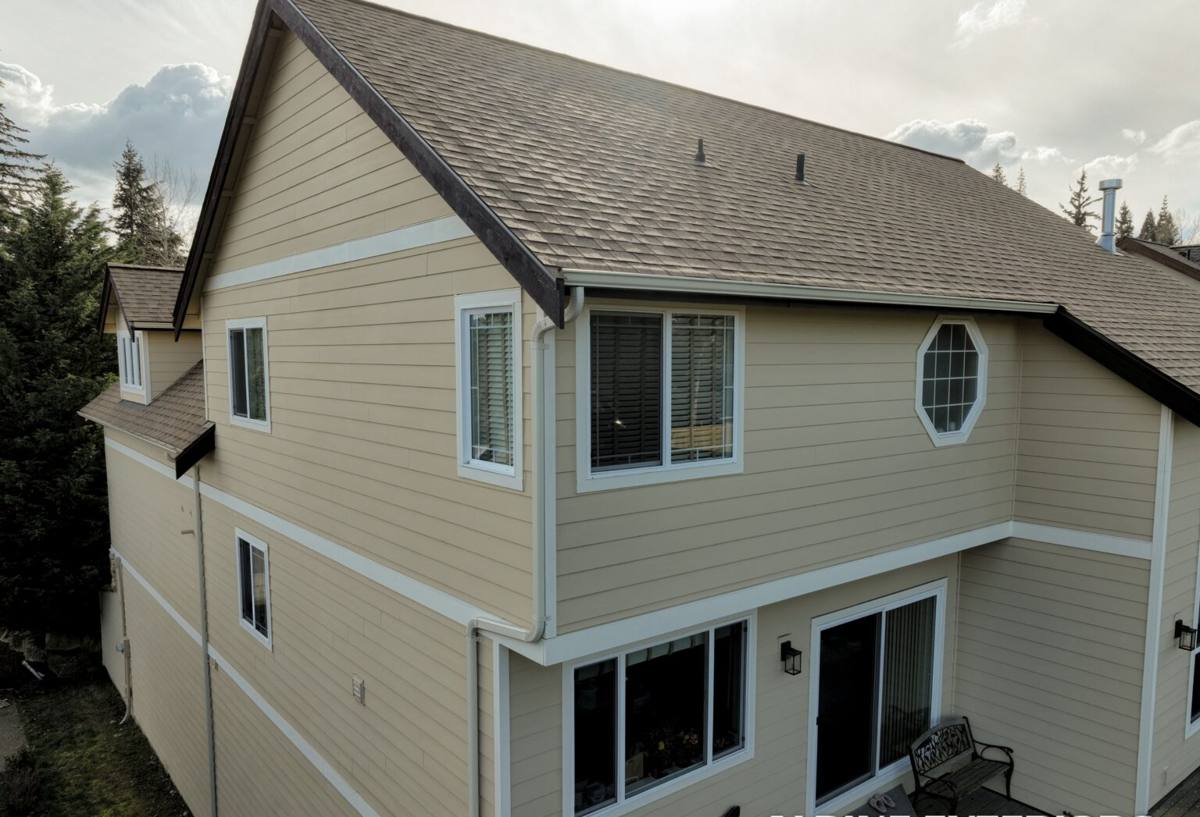
What Actually Wears Out a Window Out Here
Moss and Organic Growth
Moss doesn't just grow on roofs. On shaded lots it colonizes window sills, the top edges of trim, and any horizontal surface that stays damp. Left alone, it holds water against wood and painted surfaces far longer than rain alone would, which accelerates rot at exactly the joints — sill corners, trim miters — that are hardest to reach and hardest to reseal once they've failed.
Driving Rain and Wind-Driven Wet
Whatcom County storms don't just fall straight down. Weather pushing in off the water often arrives at an angle, and a window that relies on caulk alone rather than proper flashing will eventually let that wind-driven rain get behind the trim. By the time it shows up as a stain on an interior sill, the sheathing behind it has usually been wet for a while already.
Marine-Influenced Air and Condensation
The salt-tinged, humid air common to this part of the Pacific Northwest keeps relative humidity high for long stretches of the year. That's less about corrosion — modern window hardware is built to handle it — and more about condensation. Cool glass, damp indoor air, and low airflow through shaded rooms is a reliable recipe for moisture on the glass and, over time, inside the frame cavity if the window wasn't installed with a way for that incidental moisture to drain back out.
What a Correct Custom Window Installation Actually Involves
The Water Path, Not Just the Window
A window is only as good as the flashing and drainage plan built around it. That means a sloped sill pan that sheds water outward instead of holding it, a weather-resistant barrier lapped correctly with the flashing so water is always directed down and out, and a drip cap or head flashing that keeps water from running down behind the trim in the first place. None of this is visible once the job is finished — which is exactly why it's worth asking a contractor about before they start, not after.
Fit, Shimming, and Air Sealing
Custom sizing matters more on older homes, where rough openings are rarely square or consistent from window to window. A unit that's shimmed correctly sits plumb and level with even reveals, operates smoothly for years, and seals fully when locked. A unit forced into an out-of-square opening will bind, leak air at the corners, and put stress on the frame that shortens its life no matter how good the window itself is.
Matching the Frame to the House
Sightlines, trim profile, and grille pattern should match the age and style of the house, not just whatever happens to be in stock. On older Lynden-area farmhouses and foothill homes, we generally aim for a frame profile close to the original so the new windows read as part of the house rather than an obvious retrofit.
Choosing the Right Window for This Climate
There's no single "best" window — each frame material and glass option trades off differently once you factor in the shade, dampness, and moss exposure specific to this area.
| Frame Material | Moisture Behavior | Maintenance | Relative Cost |
|---|---|---|---|
| Vinyl | Won't rot; performs well in damp, shaded spots when installed with proper drainage | Low — occasional cleaning | $ |
| Fiberglass | Very stable in wet, low-sun conditions; resists warping through temperature swings better than vinyl | Low | $$ |
| Aluminum-Clad Wood | Wood interior under a weather-facing shell; needs correct flashing since any breach exposes the wood beneath | Moderate | $$$ |
| Bare Wood | Classic look but least forgiving of shade, moss, and prolonged dampness without upkeep | High — regular repainting and sealing | $$–$$$ |
For most Acme-area homes we lean toward vinyl or fiberglass on the shaded, moss-prone sides of the house, and reserve wood or wood-clad options for elevations that get real sun and airflow, where the upkeep is manageable. That's a judgment call we make wall by wall, not a blanket rule for the whole house.
Glass Matters as Much as the Frame
On shaded lots, solar heat gain isn't doing much work for you, so we tend to weight the glass package toward a strong U-factor — the measure of how well the window resists heat loss — over solar heat gain coefficient, which matters more on sun-exposed walls. A quality double-pane unit with a low-E coating and argon fill is usually the right baseline here; triple-pane is worth discussing on north-facing walls or rooms that run cold, but it's not automatically necessary everywhere on the house.
Our Process, Start to Finish
- Walkthrough and assessment. We look at existing window condition, sun and shade exposure on each elevation, and any signs of past water intrusion around openings.
- Measurement and product selection. Custom sizing for each opening, with frame material, glass package, and grille style chosen for that wall's specific exposure rather than one answer for the whole house.
- Removal and opening inspection. Once the old window is out, we check the sheathing and framing underneath for hidden rot before anything new goes in. This is the step that catches problems a homeowner would otherwise only discover after the new window is already in place.
- Flashing and drainage detail. Sill pan, weather-resistant barrier integration, and head flashing installed in the correct order so water always has a way out, not just a way in that's sealed shut.
- Setting, shimming, and sealing. The window is set plumb and level, shimmed to spec, and sealed at the right points — not everywhere, since over-sealing can trap moisture as easily as under-sealing lets it in.
- Interior and exterior trim. Finished to match the surrounding siding and trim so the new window looks original to the house rather than bolted on.
- Final walkthrough. Operation, locking, and seal check on every unit before we call the job done, plus a walk-through of care basics like keeping sills clear of debris and moss.
Why a Crew That Already Works This Area Matters
A contractor who mostly works drier, sunnier neighborhoods sizes up every window job the same way, wherever it happens to be. A crew that's used to the shaded, moss-heavy lots around Acme knows to look harder at north- and east-facing sills, to ask about tree cover and gutter runoff before recommending a frame material, and to plan flashing details around the fact that these walls may not fully dry out between storms the way a more exposed lot would. That also affects scheduling — sealants and some flashing tapes need a real dry window to cure properly, and a crew that knows this area's weather patterns plans around that instead of rushing a seal in marginal conditions.
It also means we're not guessing at how Whatcom County handles permitting or energy code requirements for window replacement in this area. We handle that as part of the job so it isn't a surprise partway through.
Signs Your Current Windows Are Already Losing the Battle
- Fogging or a visible haze between the panes of a double-pane window — the seal has failed and the insulating gas is gone
- Soft or spongy wood at the bottom corners of a sill, especially on shaded elevations
- Moss or dark staining building up on the sill or lower trim between cleanings
- Windows that are hard to open, don't stay up on their own, or won't latch fully
- Visible daylight or a draft around the frame when the window is closed and locked
- Condensation forming on the inside of the glass regularly, even in mild weather
- Paint peeling or bubbling on interior trim near a window — often a sign of moisture working its way in from outside
Windows and Siding: Better Done Together
Because we do siding work throughout the Lynden area, we're often looking at a window opening and the surrounding wall at the same time. That matters more here than in drier climates: if the siding around a window is already compromised, replacing the window alone just puts a new unit into an opening that's still going to take on water from the surrounding wall. When both are done together, we can tie the window flashing directly into the new weather-resistant barrier and siding installation, which is a stronger, more consistent water management system than treating the window as an isolated repair. It's not required — plenty of window jobs stand fine on their own — but on a home with aging siding, it's worth discussing before committing to windows alone.
If you're in the Acme area and dealing with drafty, foggy, or hard-to-operate windows — or just planning ahead before the wetter months roll back in — we're happy to come take a look. The estimate is free, there's no pressure to book anything on the spot, and you'll get a straight answer about what your specific windows and walls actually need.