 Lynden Siding
 Siding Replacement for Sumas Homes
Sumas sits out at the edge of Whatcom County, in the flat farmland near the Canadian border, a different setting than the town of Lynden itself but well within the reach of the same marine weather that shapes exterior work across this part of Washington. We work on homes throughout the county, and a siding replacement in Sumas gets planned around the same underlying conditions we account for everywhere else in our service area: salt-laden air moving in off the Sound and up the valleys, driving rain that hits walls sideways more often than it falls straight down, and a moss season that runs long on shaded, low-lying property. This page is about one job specifically — full siding replacement on a Sumas home — what the local climate demands from it, what a correct installation actually involves, and how our process runs from first call to finished wall.
We install James Hardie fiber cement siding exclusively. For homes in a low-lying, moisture-heavy part of the county like Sumas, it's the material we recommend without hesitation, and this page explains why alongside the practical details of the replacement itself.
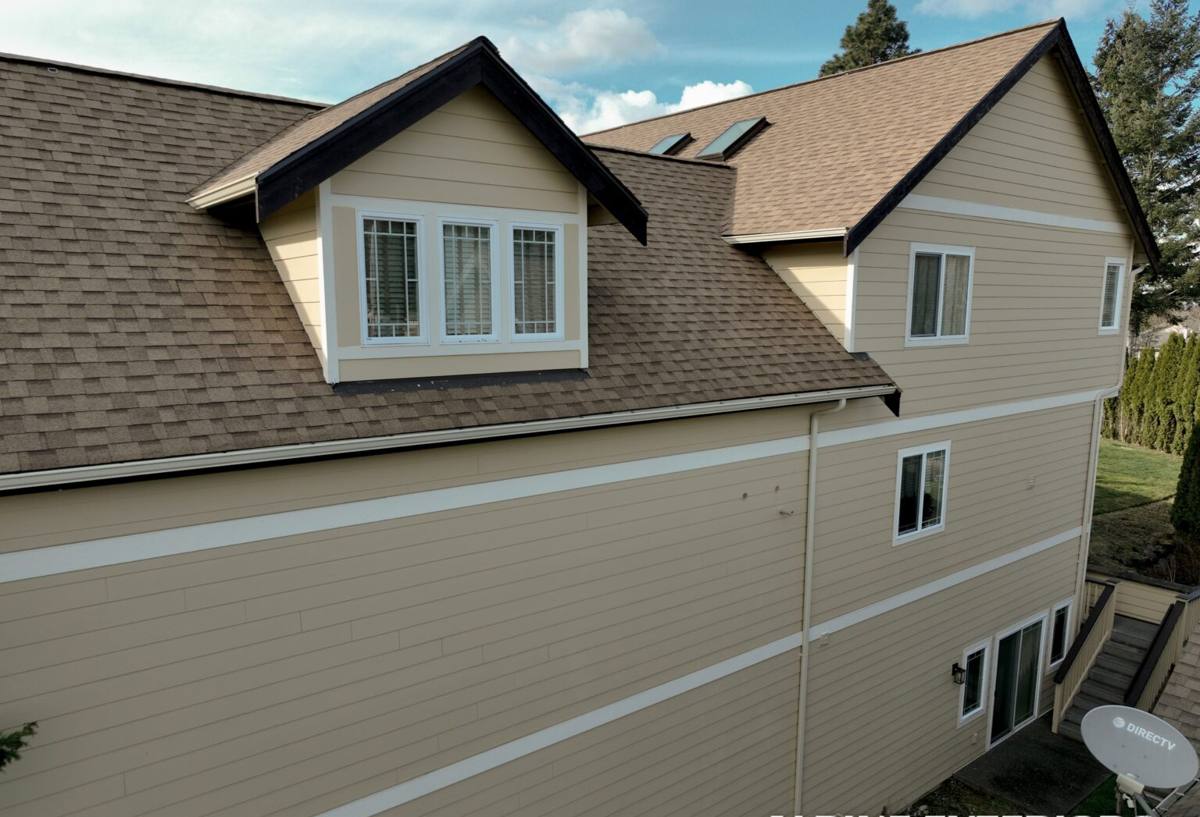
What Sumas's Climate Puts a Siding System Through
Salt Air, This Far Inland
Sumas is a fair distance from open saltwater, and it's easy to assume that puts a home outside the reach of marine air. It doesn't, entirely. Salt-laden moisture moves inland across Whatcom County over the course of a wet season, and while the effect is more gradual out toward the border than it is right on the shoreline, it still shows up over years as accelerated corrosion on fasteners, flashing, and lower-grade trim hardware. Material and hardware choices for a Sumas home shouldn't assume a dry, purely inland climate just because the coastline is a distance away.
Driving Rain on Flat, Low-Lying Ground
Sumas sits low, in open farmland near the Nooksack River system, and rain through fall and winter tends to arrive sideways rather than straight down. On a flat lot, that wind-driven rain doesn't run off a wall and drain away as fast as it does on a sloped or sheltered site — it lingers against siding, trim, and window flashing longer than homeowners often expect. Siding and trim details that aren't built to handle sideways rain, not just rainfall totals, tend to show water damage first at seams, corners, and wherever flashing is doing less than it should.
A Long Moss and Mildew Season
Sustained regional dampness and mild temperatures add up to a moss and mildew season that stretches across most of the year on shaded and north-facing walls in this part of the county. It starts as staining or green growth, and it's not just a cosmetic problem — moss and mildew hold moisture directly against the wall assembly, which is the exact condition that leads to hidden sheathing damage if it's left alone through more than one wet season.
Cold Snaps and Freeze-Thaw
Being further from the moderating effect of open water, Sumas sees more frequent hard frosts and occasional freezing conditions than milder parts of the county. That matters because water that's already worked its way into a porous or poorly sealed material and then freezes expands, accelerating cracking in a way that steady dampness alone wouldn't. A siding system for a Sumas property needs to hold up to wet and cold in the same season, not just one or the other.
Signs a Sumas Home Needs Full Replacement, Not a Patch
Not every siding problem calls for tearing the whole wall off. But on a property that's been taking on wind-driven rain and long moss seasons for years, certain signs usually mean the damage has already gone past what a patch or a repaint can fix.
- Soft or spongy siding when pressed, especially low on the wall or around window and door trim
- Moss or dark staining on shaded walls that comes back quickly after cleaning
- Visible warping, cupping, or peeling paint, most common on older wood-based or engineered wood siding
- Cracked, buckled, or missing panels after a windstorm
- Rust staining running down from fasteners or trim hardware
- Musty smells or staining on interior walls that back up to an exterior wall
- Siding that's original to a home 20-plus years old with no documented replacement
If you're seeing more than one of these, especially soft sheathing under an old wall, a full replacement is usually the honest answer rather than another round of caulk and paint. We'll tell you plainly which situation we're actually looking at when we walk the property.
What a Correct Siding Replacement Involves
Tear-Off and Substrate Check
Old siding comes off entirely so the sheathing underneath can be checked for rot or soft spots before anything new goes up. Covering damaged sheathing with new siding just hides a problem that keeps getting worse behind the wall — on a low-lying property that's been holding moisture for years, this step matters more than it does on a well-drained, sheltered lot.
Weather Barrier and Flashing
Most siding failures in this part of the county trace back to water getting behind the cladding, not through it. The house wrap, window flashing, and every wall penetration get careful, deliberate attention here — lapped correctly, sealed correctly, and not left to caulk to cover a gap that should have been flashed properly in the first place.
Fastening and Clearance
Fastener spacing and type need to account for the wind exposure a flat, open property like this can see, and siding needs correct clearance above grade so it isn't sitting close enough to wet ground to wick moisture up from below. Both are easy to get wrong on a rushed job and hard to catch once the siding is up.
Installation to Manufacturer Spec
James Hardie's warranty depends on installation following their published specifications for fastener spacing, clearances, and field-cutting practices. We treat that spec as the baseline for every job, not as an upsell over some looser standard.
Why We Install Only James Hardie
We used to work with a wider range of siding products before settling on one system. That decision came from watching, over repeated jobs across Whatcom County, which materials actually held up under sustained regional moisture, salt exposure, and freeze-thaw cycling, and which ones quietly turned into maintenance problems a few years in.
- Non-combustible core: Fiber cement doesn't feed a fire the way wood-based siding products can, which matters for household safety and insurance underwriting alike.
- Factory-applied ColorPlus finish: The color is baked on under controlled factory conditions rather than brushed on in the field, holding up far longer against fading and moisture than site-applied paint.
- Climate-engineered HZ product lines: Hardie's HZ5 formulation is built for regions with sustained moisture exposure and freeze-thaw cycling, which describes Sumas and the rest of northern Whatcom County closely.
- Dimensional stability: Fiber cement doesn't swell, cup, or warp the way engineered wood siding can after repeated wet-season cycles.
- A strong transferable warranty: Hardie backs the product with a solid warranty structure, provided installation follows spec, which is real protection rather than a marketing line.
We don't install LP SmartSide, vinyl siding, Cemplank, Allura, primed spruce, or cedar. Each has a place in the broader market, and plenty of homeowners elsewhere are satisfied with them. Our call was a professional one: we'd rather stand fully behind one system installed correctly than offer a cheaper alternative that quietly shifts maintenance risk onto the homeowner within a decade, especially on a property that sees this much sustained rain and cold.
Where Other Products Fall Short on a Property Like This
| Product | Common trade-off in this climate |
|---|---|
| Vinyl siding | Can warp or crack under sustained UV and temperature swings; panel seams give wind-driven rain an entry point |
| LP SmartSide / engineered wood | Wood-strand core is more moisture-sensitive at cut edges and fastener points than fiber cement |
| Primed spruce or cedar | Requires ongoing paint and moisture maintenance to avoid rot; a heavier long-term cost than the upfront price suggests |
| Other fiber cement brands | May lack a climate-specific HZ-style formulation or the same factory-finish warranty depth as James Hardie |
Choosing the Right Hardie Product for a Sumas Home
| Product Line | Best Use | Why It Fits This Property |
|---|---|---|
| HardiePlank lap siding | Most standard single-family homes | Traditional lap profile sheds wind-driven rain when installed with correct overlap and flashing |
| HardiePanel vertical siding | Accent walls, gables, and board-and-batten styling | Clean vertical lines that suit the farmhouse-style homes common on open, rural lots |
| HardieShingle siding | Craftsman-style homes and accent sections | Textured look without the moisture absorption and upkeep of real wood shingle |
| HardieTrim boards | Corners, window and door casing, fascia | Factory-finished trim resists the same moisture and freeze-thaw cycling as the field siding |
Profile and color come down to the individual home and the owner's preference, but the underlying approach stays consistent — we spec what fits a Sumas property's actual exposure, not whatever's easiest to install.
How the Replacement Process Runs
Inspection and Estimate
Every job starts with a real look at the house — current siding condition, any signs of trapped moisture, and how sun, shade, and wind exposure vary across the different walls of the property. That drives the estimate, rather than a flat per-square-foot guess.
Tear-Off and Repair
Old siding comes off, sheathing gets inspected, and any rot or soft spots get repaired before new material goes up. We'll show you what we find rather than covering it and moving on.
Weather Barrier, Flashing, and Installation
House wrap, flashing, and fastening go in to manufacturer spec, with the extra attention this climate calls for around every seam, corner, and penetration.
Final Walkthrough
We walk the finished job with the homeowner, cover basic care and maintenance expectations, and confirm everything matches what was estimated before calling it complete.
Cost Factors for a Sumas Siding Replacement
| Factor | What It Affects | Why It Matters Here |
|---|---|---|
| Total square footage and stories | Material and labor volume | Larger or multi-story homes take more time and staging on open, rural lots |
| Substrate condition under old siding | Repair costs before new siding goes on | Long-term trapped moisture on a low-lying lot can rot sheathing and framing |
| Trim and detail work | Labor time around windows, corners, and rooflines | More cut edges and joints mean more flashing detail to get right |
| Grade and drainage | Siding clearance and moisture management | Flat, low-lying ground holds moisture longer near the base of a wall |
| Site access | Labor time and equipment needs | Rural and agricultural properties can have longer driveways or wider staging needs than an in-town lot |
Exact costs depend on the specific property and its exposure, which is why we walk the home in person before giving a real number rather than quoting off a generic price sheet.
Why Hiring a Crew That Already Works Sumas Matters
A crew that's worked this part of Whatcom County repeatedly understands how salt air, sideways rain, and freeze-thaw cycling actually behave on real homes here over a full year, not just how a product performs on a spec sheet. That experience shapes practical decisions on install day — which wall orientations on a flat, open lot stay wet the longest, where extra flashing attention pays off, and which fastening details are worth the added time so a homeowner isn't dealing with a callback after the next storm. It also means that if a warranty question or maintenance issue comes up years later, it's a call to a crew still working in the same area, not one that's moved on to a different region.
Before You Hire: A Quick Checklist
- Confirm a valid Washington state contractor license and current insurance
- Ask what specific siding product they install and why, not just a price per square foot
- Ask how they handle sheathing repair if rot turns up during tear-off
- Ask whether they pull their own permits
- Ask how they detail flashing and weather barrier, not just what siding brand goes on top
- Get a written estimate, and be wary of pressure to sign the same day
If your Sumas home needs a full siding replacement, or you'd just like an honest second opinion on what's happening behind an aging wall, we're glad to take a look. Reach out using the form below to schedule a free, no-pressure estimate.