 Lynden Siding
 Building a Deck That Holds Up in Maple Falls' Wet, Wooded Climate
Maple Falls sits in the forested foothills of Whatcom County, and that setting shapes everything about how a deck should be built here. Heavy tree canopy keeps yards shaded for long stretches of the day, driving rain moves through the region for months at a time, and the combination of moisture and shade gives moss and algae exactly the conditions they need to take hold on wood and composite surfaces alike. A deck built to a generic spec sheet — the kind that works fine in a dry, open backyard elsewhere in the state — often struggles here. One built with this climate in mind holds its finish, sheds water where it needs to, and doesn't turn into a slip hazard by the second winter.
Whatcom County's marine-influenced climate means moisture is a near-constant factor, and in a shaded, tree-covered community like Maple Falls that moisture has fewer chances to dry out between storms than it would in an open, sun-exposed lot. That's the starting point for every decision we make on a custom deck build here — material selection, fastener choice, and how the substructure is framed and drained.
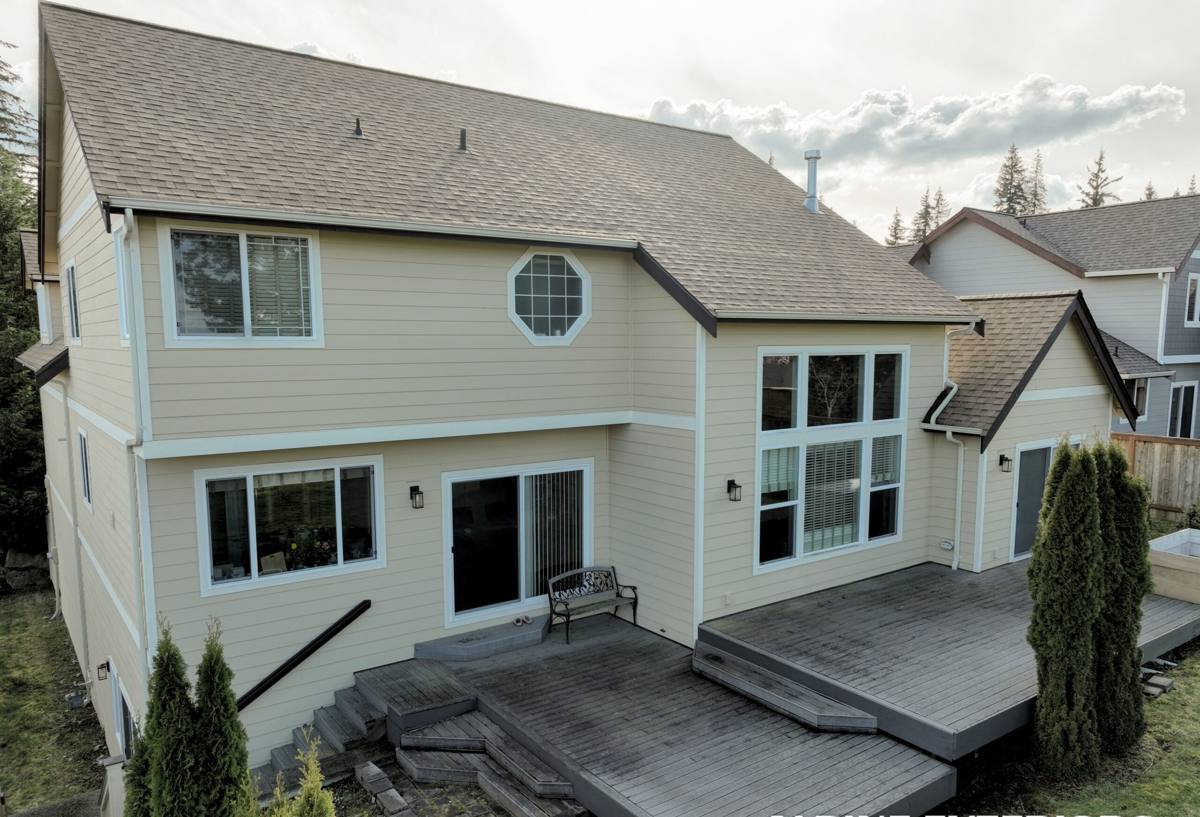
What Makes Maple Falls Decks Different from Decks Closer to Town
Sloped and Wooded Lots
Many properties around Maple Falls sit on sloped or partially wooded lots rather than flat, cleared yards. That changes how footings, beam spans, and stair layouts get planned, and it often means a deck needs to step down or wrap around grade changes instead of sitting on a single flat plane. It also means excavation and footing work has to account for root systems and drainage patterns that a flat suburban lot wouldn't have.
Shade and Slow Drying
A deck under full tree cover can stay damp for days after a storm passes, even once the sun is technically back out. That slow drying is the single biggest factor behind moss growth, slick decking, and premature wear on fasteners and coatings. It's also why gap spacing, board orientation, and airflow underneath the deck matter more here than they would on an open, sun-baked lot.
Elevation and Snow Load
Maple Falls sits at a higher elevation than Lynden proper, and it's not unusual for the area to pick up snow load that lower parts of the county rarely see. A deck's framing needs to be sized for that reality, not just for typical Pacific Northwest rain loads. We size joists, beams, and post spacing to the conditions the property actually experiences, not a one-size-fits-all minimum.
Where Deck Failures Start — the Details Most Contractors Skip
Ledger Board Flashing
The ledger board — where the deck attaches to the house — is the single most common point of failure on decks in wet climates. Without proper flashing and a drainage gap behind it, water tracks down the siding, gets trapped against the ledger, and starts rotting the rim joist and wall framing from the inside out, often for years before it's visible. Correct flashing detail here isn't optional; it's the difference between a deck that lasts decades and one that needs structural repair inside ten years.
Joist Protection and Hidden Rot
Cut ends, joist tops, and post bases are where treated lumber loses its protection fastest — every cut exposes untreated wood underneath. In a shaded, high-moisture setting like Maple Falls, an unprotected cut end can start absorbing water and rotting from the inside while the surface still looks fine. We seal cut ends and cap joist tops so water sheds off the frame instead of soaking into it.
Fasteners and Hardware
Standard galvanized fasteners corrode faster in persistently damp, shaded conditions, and corroding fasteners are a safety issue, not just a cosmetic one — they lose holding strength as they rust. We use stainless steel or heavy-coated fasteners and hardware rated for ground contact and long-term wet exposure, matched to whatever decking material is used so there's no reaction between dissimilar metals.
Choosing Decking Material for a Shaded, Wet Lot
There's no single "best" decking material — the right choice depends on how much sun and airflow the deck actually gets, how much upkeep the homeowner wants to do, and budget. Here's how the common options hold up specifically in a shaded, moss-prone setting like Maple Falls:
| Material | How It Handles Shade & Moisture | Maintenance |
|---|---|---|
| Pressure-treated wood | Affordable and strong, but needs consistent sealing to resist moss and graying in low-sun areas | Annual cleaning and re-sealing recommended |
| Cedar | Naturally rot-resistant and handles moisture well, but softer and more prone to surface staining under heavy shade | Periodic cleaning and refinishing to preserve color and grain |
| Composite decking | Resists rot and doesn't absorb water like wood, but can still grow surface algae/moss film in constant shade if not cleaned | Low — occasional washing, no sealing or staining |
| PVC decking | Fully moisture-resistant, best performer in deep shade and heavy rain exposure | Lowest — soap-and-water cleaning only |
For lots with heavy canopy and limited direct sun, we generally steer homeowners toward composite or PVC decking, not because wood is a bad product, but because wood's performance in that specific environment depends heavily on upkeep the homeowner has to stay on top of every year. If a homeowner wants the look and feel of real wood and is willing to commit to a cleaning and sealing schedule, cedar remains a solid, honest choice — we just make sure that trade-off is clear going in, rather than a surprise two years later.
Substructure, Footings, and Drainage on Foothill Lots
What's underneath a deck matters as much as what's on top of it. On sloped or wooded Maple Falls properties, footings need to be sized and placed for the actual soil and grade conditions on that lot, not a generic minimum. We grade and drain the area under and around the deck so water moves away from posts and footings instead of pooling against them, and we keep enough clearance and airflow underneath the frame so the substructure has a chance to dry out between storms instead of staying damp for weeks at a stretch. Skipping this step is one of the most common reasons a deck looks fine from the top while the frame underneath is quietly failing.
Our Process for a Maple Falls Deck Build
- On-site walkthrough of the lot, grade, and sun/shade exposure to plan layout, footing placement, and material recommendations specific to that property
- Design and material selection, with honest trade-offs laid out for wood, cedar, composite, and PVC based on how that spot actually gets sun and drainage
- Permitting and engineering as required by Whatcom County for the size, height, and structure of the deck
- Footings, framing, and ledger flashing built to shed water at every connection point, sized for the site's actual snow and span requirements
- Decking, railing, and stair installation with fasteners matched to the material and rated for sustained wet exposure
- Final walkthrough covering how to maintain the specific material installed, including realistic moss and moisture expectations for that lot
Permits, Code, and Guardrails
Custom decks in Whatcom County typically require a building permit once they exceed a certain height or size, and guardrail height, baluster spacing, and stair rise/run all need to meet current code — these aren't optional details, they're safety requirements that get inspected. We handle the permitting and inspection process as part of the build so homeowners aren't left navigating county requirements on their own, and so the finished deck is something that holds up to inspection now and to a home sale later, not just to a quick visual check.
Maintaining a Deck in a Moss-Prone, Shaded Yard
No deck material is fully maintenance-free in a shaded, high-moisture climate — some just need far less attention than others. A short seasonal routine keeps a deck safe and extends its life significantly:
- Sweep leaves and needles off the deck regularly — trapped debris holds moisture against the surface and speeds up moss growth
- Clean surface moss and algae with a deck-safe cleaner before it gets thick enough to become slippery, rather than waiting until it's a hazard
- Check and clear gaps between boards so water can drain through instead of pooling
- Inspect ledger flashing and railing connections once a year for signs of water tracking or loosening hardware
- Re-seal or re-stain wood and cedar decking on the schedule that material actually needs, not just when it starts looking gray
- Keep gutters and downspouts near the deck clear so roof runoff isn't dumping extra water directly onto or under the structure
Why Hire a Crew That Already Works Maple Falls
A deck built to handle a flat, sunny lot in a drier part of the state isn't automatically wrong for Maple Falls — but it's not automatically right either, and the difference shows up two or three winters later, not on installation day. A crew that already works this specific stretch of Whatcom County has seen how shade, slope, and driving rain actually play out on decks here over time: where moss forms first, which ledger details hold up and which ones don't, and how much snow load a given elevation really needs to be framed for. That familiarity shows up in the small decisions — flashing details, fastener choice, gap spacing — that a generic build often gets wrong.
If you're planning a custom deck in Maple Falls, we're happy to walk the property, talk through material options honestly, and put together a straightforward estimate — no pressure, no sales script. Use the form below to get started.