 Lynden Siding
 Kendall's Climate Is Harder on Siding Than It Looks
Kendall sits in the quieter, tree-covered country northeast of Lynden, and homes out here take a different kind of beating than a house closer to town might. The rural setting means more shade from surrounding trees, more standing moisture after a storm, and less direct sun to dry things out between rain events. Add in the marine-influenced weather that moves through this part of Whatcom County — driving rain that comes in sideways during winter storms, humid air off the Sound that carries salt-laden moisture inland, and a moss season that can run six months or longer on a shaded north wall — and you've got a climate that punishes any siding product with a weak spot for moisture.
Wood-based siding swells and rots where it stays wet too long. Vinyl can warp, fade, and crack in temperature swings and never really "breathes" the way a wall system needs to. Cheaper fiber cement products cut corners on the moisture barrier inside the board itself. None of that is a good match for a property that spends a lot of its year damp, shaded, and growing moss on anything that sits still. That's the reason we install James Hardie fiber cement exclusively — it's the one siding system engineered specifically for climates like this one.
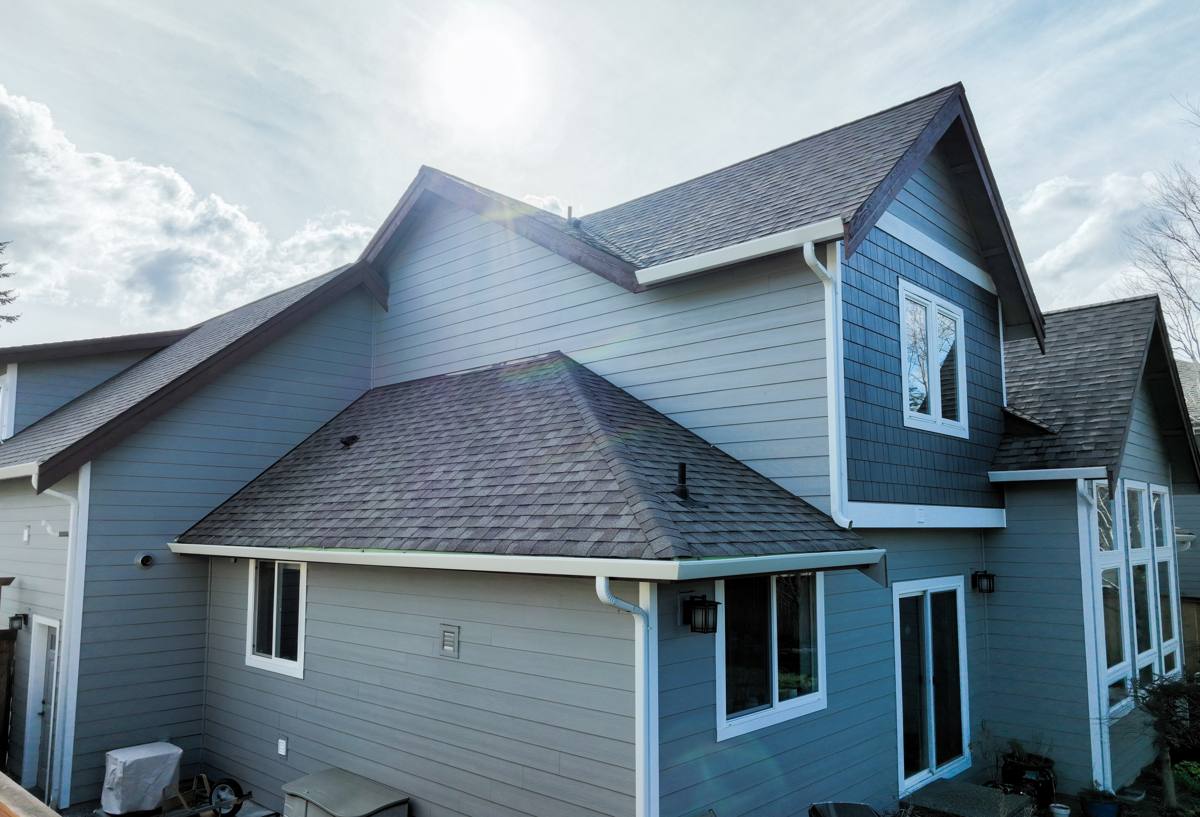
Why James Hardie Fits a Kendall Home
James Hardie siding is fiber cement — a mix of cellulose fiber, sand, and Portland cement, cured into boards that don't absorb moisture the way wood does and don't expand and contract the way vinyl does. A few properties matter more here than they would in a drier climate:
- Non-combustible core — relevant given how much wildfire smoke and dry-season risk has crept into this region in recent summers, even in a normally wet climate.
- Moisture-resistant composition — the board itself doesn't wick water the way primed wood or OSB-based products can, which matters when a wall gets rained on for days straight.
- ColorPlus factory finish — a baked-on finish applied under controlled conditions, holding color and resisting the kind of fade and chalking that field-applied paint struggles with under constant UV-and-rain cycling.
- Engineered for Pacific Northwest exposure — Hardie makes region-specific HZ product lines, and homes in this climate zone get the version built for high moisture, not the version built for dry heat.
We don't install LP SmartSide, vinyl, Cemplank, Allura, primed spruce, or cedar. Every one of those products has a legitimate use somewhere — but none of them holds up the same way, board for board, against a Kendall winter. We'd rather put one product on every home we touch and know exactly how it performs than juggle multiple systems and hope for the best.
What a Correct Hardie Install Actually Involves
The material is only half the equation. Most siding failures we get called out to inspect — on any brand — trace back to installation mistakes, not the product itself. In a climate that stays wet this long, the details matter more than usual:
Clearance and Drainage
Hardie's own installation instructions call for a minimum clearance above grade, roofing, decks, and walkways, and a rainscreen or drainage plane behind the siding on most wall assemblies. Skip that gap and water that gets behind the boards has nowhere to go — which is exactly how you get rot in the sheathing behind siding that looks fine from the driveway.
Fastening
Fasteners need to hit framing at the correct depth and spacing — not just close enough. Overdriven nails crack the fiber cement's outer face and create a path for water intrusion that won't show up for a year or two.
Caulking and Flashing
Every window, door, and penetration needs proper flashing integrated with a weather-resistant barrier, and joints need the right sealant applied correctly — not everywhere, and not nowhere. Over-caulking a butt joint that's supposed to allow drainage is as much of a mistake as leaving a real gap unsealed.
Cut Edges
Factory edges come primed and finished. Field cuts don't — they need to be sealed before installation, every time, or that cut edge becomes the first place moisture gets in.
This is the level of detail that separates a Hardie installation that lasts thirty-plus years from one that needs trim repairs in year six.
Matching the Right Hardie Product Line to This Property
Hardie makes several siding profiles, and the right pick depends on the home's style and exposure, not just preference:
| Product | Best Suited For | Why It Fits Kendall |
|---|---|---|
| HardiePlank lap siding | Traditional and farmhouse-style homes | Most common profile in this area; wide color range, proven track record in wet climates |
| HardiePanel vertical siding | Board-and-batten or modern accents | Sheds driving rain well on gable ends and accent walls |
| HardieShingle | Craftsman and cottage-style homes | Textured look without wood shingle's moisture and moss vulnerability |
| HardieTrim | Corner boards, fascia, window trim | Matches the field siding's moisture performance instead of mixing in wood trim that rots first |
Homes in this region should be specified with the HZ5 formulation — Hardie's version engineered for climates with higher moisture and freeze-thaw cycling, as opposed to the HZ10 version built for hot, dry regions. Using the wrong zone product is a mistake we see more often than you'd expect from suppliers who don't specialize in this area.
The Problems We Actually See on Kendall Homes
Most of what brings us out to look at existing siding in this area falls into a short list of recurring issues:
| What Homeowners Notice | Underlying Cause | What It Means |
|---|---|---|
| Green or black film on north- and shade-facing walls | Moss and mildew growth from prolonged dampness and limited sun exposure | Cosmetic on Hardie; a sign of active moisture retention on wood siding |
| Soft or crumbling trim boards | Wood trim that wasn't sealed or replaced along with the field siding | Common failure point even on homes with otherwise sound siding |
| Peeling or chalky paint | Field-applied finish breaking down under repeated wet-dry cycling | Doesn't happen with ColorPlus factory finish |
| Warped or bowed panels | Vinyl or engineered wood siding reacting to moisture and temperature swings | Not a failure mode fiber cement is prone to when installed correctly |
How We Approach a Job in Kendall
Our process doesn't change based on the neighborhood, but a few things get extra attention on properties out this way given the tree cover and moisture load:
- On-site assessment — we walk the whole exterior, check for existing moisture damage behind current siding, and note shaded areas that need extra drainage planning.
- Written estimate — product line, profile, color, and scope spelled out, no vague allowances.
- Tear-off and inspection — once old siding comes off, we check the sheathing underneath before anything new goes up. Hidden rot gets addressed, not covered.
- Weather barrier and drainage plane — installed to spec, not skipped to save a step.
- Hardie installation — correct fastening, clearances, flashing, and sealed cut edges throughout.
- Final walkthrough — we go over the finished work with the homeowner before calling the job done.
What Drives Cost on a Kendall Siding Project
| Factor | Why It Matters |
|---|---|
| Home size and wall complexity | More corners, gables, and cutouts mean more labor and material waste |
| Existing siding removal | Tear-off and disposal of old material adds time versus a bare-wall install |
| Sheathing repair | Rot found behind old siding has to be fixed before new siding goes on — this is the most common source of surprises |
| Product line and profile | Lap, panel, and shingle profiles carry different material and labor costs |
| Trim and accent work | HardieTrim corner boards and window trim add scope beyond the field siding |
| Site access | Rural lots with more tree cover or limited driveway access can affect staging and labor time |
We give a firm written number after the site visit — not a phone estimate — because the sheathing condition underneath old siding is the biggest variable, and we won't guess at that.
Why It Matters That We Already Work This Area
A crew that's worked in Kendall and the surrounding country knows what to expect before the tear-off even starts: which wall orientations tend to hide moisture damage, how much drainage planning a shaded elevation needs, and what this climate does to a job that gets rushed. That's not something you get from a crew that mostly works subdivisions closer to town and treats every property the same.
A short checklist worth running through with any contractor before you sign anything, for this kind of work in this kind of climate:
- Are they installing manufacturer-specified clearances and a drainage plane, or skipping it to save time?
- Do they seal every field-cut edge, not just the ones that show?
- Are they using the HZ5 climate-zone product, not a generic or leftover-stock formulation?
- Will they inspect and address sheathing condition before re-siding, not just cover it up?
- Can they show you their fastening and flashing approach in plain language, not just a brand name?
- Do they carry manufacturer certification or documented Hardie installation experience?
Maintaining Hardie Siding in a Wet, Shaded Climate
Correctly installed Hardie siding is low-maintenance, not zero-maintenance. In a climate like Kendall's, a little seasonal attention goes a long way:
- Rinse moss and algae off shaded walls once or twice a year with a garden hose — a low-pressure rinse, not a pressure washer aimed directly at seams or fasteners.
- Keep landscaping and tree limbs trimmed back from the siding so walls get airflow and sun exposure to dry out between storms.
- Check caulking at windows, doors, and trim joints annually — sealant is the one component that wears out before the siding does.
- Clear debris out of gutters and off horizontal trim ledges before winter, since trapped organic matter holds moisture against the wall.
- Watch for any soft spots on wood trim components — even paired with Hardie field siding, wood trim is the first thing to show wear.
If you're planning a siding project in Kendall and want it done with a product built for this climate and installed the way the manufacturer actually specifies, we're happy to walk your property and put together a free, no-pressure estimate.