 Lynden Siding
 Why Custer's Climate Is Hard on a Deck
Custer sits close enough to salt water and open exposure that homes here deal with a slightly different set of problems than decks built further inland in Whatcom County. Salt-laden air speeds up corrosion on anything metal — fasteners, hidden clips, railing brackets — long before the wood or composite itself shows wear. Add in driving rain that comes sideways during winter storms, and water finds its way into joints and ledger connections that would stay dry in a calmer climate. Then there's the moss. Whatcom County's long, wet, mild winters give moss and algae months to establish themselves on any horizontal surface that doesn't get much sun or airflow, and a deck tucked under trees or on a north-facing side of the house is exactly the kind of spot moss prefers.
None of this means a deck can't last in Custer — it means the build has to account for these three things specifically, rather than following a generic decking spec sheet written for a drier region.
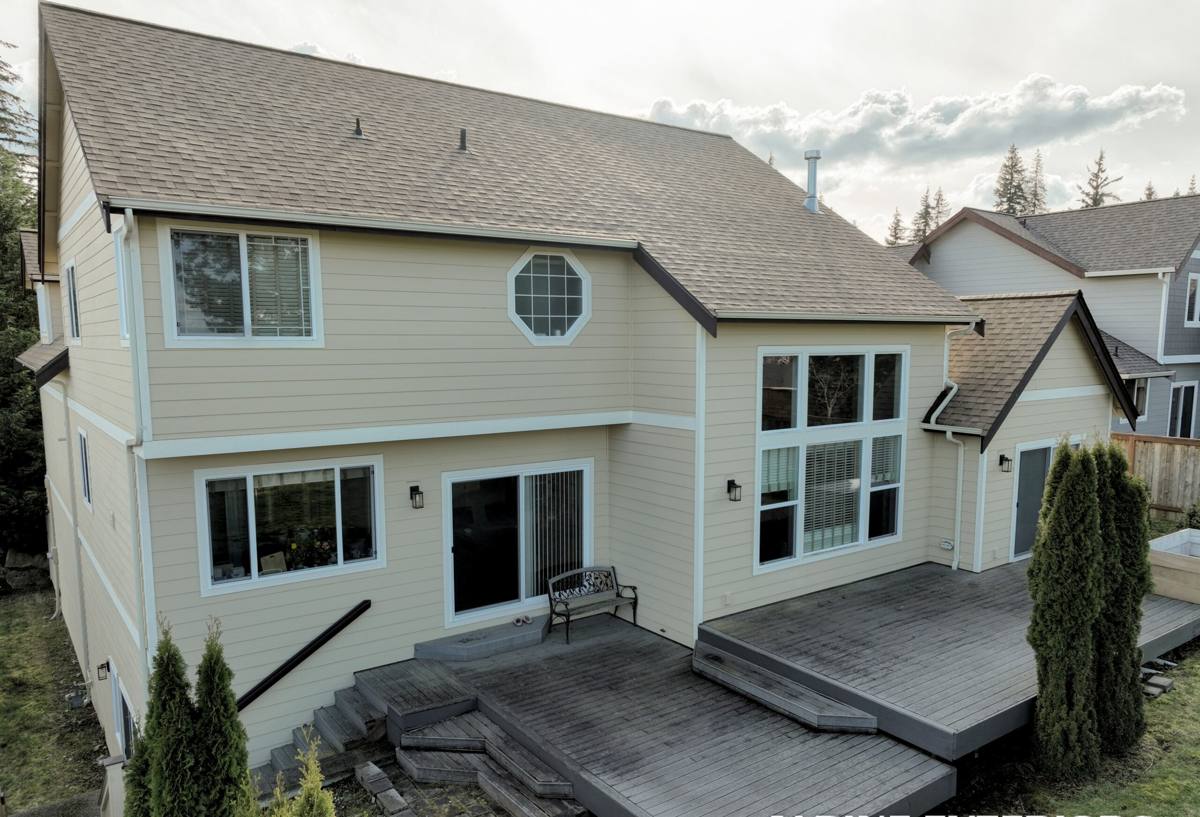
What "Composite Decking" Actually Means
Composite decking is a broad category, and the differences between products matter more than most homeowners realize going in.
Capped Composite vs. Traditional Composite
Older-style composite boards are a wood-fiber-and-plastic blend with no protective outer layer, which means the wood fiber inside can still absorb moisture at cut ends and exposed surfaces over time. Capped composite boards wrap that core in a solid polymer shell on all sides, which is what actually gives composite decking its resistance to moisture, staining, and mold growth. In a climate like Custer's, we treat capping as close to a requirement rather than an upgrade — an uncapped board in a moss-prone, high-moisture yard is fighting an uphill battle from day one.
PVC Decking
Some homeowners ask about full PVC boards instead of wood-composite blends. PVC has no wood fiber at all, so it handles constant moisture exposure differently and tends to run lighter and slightly more flexible than composite. It's a reasonable option for very shaded, damp sites, but it comes with its own installation tolerances around fastening and thermal movement that need to be respected — it's not a drop-in swap for composite framing specs.
What a Correct Build Involves Here
A composite deck that holds up in Custer isn't just "composite boards on a standard frame." The details underneath and around the boards matter as much as the decking material itself.
Framing and Ledger Flashing
Where the deck attaches to the house, water management at the ledger board is the single most important detail on the whole project. Correct flashing — installed in the right order relative to the house's own water-resistive barrier — keeps driving rain from working its way behind the siding at the ledger connection. This is also where a lot of shortcut installs fail years later, usually invisibly, until there's rot in the rim joist behind the siding.
Fasteners and Hardware
Given the salt air exposure in this area, we don't treat fastener choice as a minor line item. Stainless steel or a coating rated for coastal/corrosive environments on structural hardware — joist hangers, ledger bolts, post bases — buys years of extra life compared to standard galvanized hardware that starts showing rust streaks on light-colored composite boards within a few seasons.
Airflow, Drainage, and Moss Prevention
Moss and algae need moisture and low airflow to take hold. Proper joist spacing, a slight slope built into the frame for drainage, and keeping the underside of low decks ventilated rather than sealed all reduce the damp, still conditions moss thrives in. On grade-level or low-clearance decks, this is often the difference between a deck that stays clean with normal rinsing and one that grows a green film every winter regardless of how it's cleaned.
Expansion Gaps and Board Layout
Composite boards expand and contract with temperature more than wood does. Gapping between boards, at picture-frame borders, and around fixed obstacles like posts has to follow the manufacturer's spec, not a "looks tight enough" eyeball measurement — too tight and boards can buckle; too loose and debris and moisture collect in the gaps.
Composite vs. Wood: A Straight Comparison for This Climate
| Factor | Composite (capped) | Wood (cedar/treated) |
|---|---|---|
| Moss/algae resistance | Better — solid cap sheds moisture, less porous surface for growth to grip | Weaker — grain and checking give moss and algae more surface to hold onto |
| Refinishing needs | None — no staining or sealing required | Sealing/staining every 1-3 years to keep water out |
| Fastener corrosion risk | Same risk as any deck — hardware choice matters equally | Same risk as any deck — hardware choice matters equally |
| Upfront material cost | Higher | Lower |
| Typical lifespan in wet coastal climates | Long, with minimal upkeep beyond cleaning | Shorter without consistent maintenance |
| Warranty structure | Manufacturer warranties often 25+ years on capped products | Typically limited to the wood treatment itself, not the finished deck |
Wood isn't a bad choice — some homeowners prefer the look and are willing to keep up with sealing on a schedule. But for anyone who wants to spend their weekends off the deck instead of maintaining it, composite is the more forgiving material for this specific climate.
Our Process, Start to Finish
- On-site assessment — we look at drainage, sun exposure, existing structure (if replacing an old deck), and how the site handles rain runoff.
- Design and material selection — board style, color, railing type, and layout, sized to the footprint and how the space will actually be used.
- Permitting — we handle the permit application through the applicable local jurisdiction before any demo or framing begins.
- Demolition (if replacing an existing deck) — removal of old decking, and an inspection of the framing underneath before we decide what gets reused versus rebuilt.
- Framing — ledger flashing, joists, and footings built to span and spacing requirements for the composite product being installed.
- Decking and railing installation — hidden fastener systems where the product allows, correct gapping, and railing set to code height and spacing.
- Final walkthrough — checking fastener finish, gap consistency, railing rigidity, and site cleanup before we call it done.
Permits and Local Considerations
Deck projects in and around Custer typically fall under Whatcom County's permitting process unless the property is inside Lynden city limits, in which case city permitting applies instead. Requirements vary by deck height, size, and whether it's attached to the house, so we confirm which jurisdiction and permit path applies before pulling any permit — this isn't something to guess on, since an unpermitted deck attachment can become a real problem at resale.
Maintenance Checklist for a Custer Composite Deck
- Rinse boards a few times a year, more often in shaded or low-airflow areas prone to moss
- Keep gutters and downspouts near the deck clear so runoff isn't draining directly onto boards
- Sweep debris out from between boards before it holds moisture against the material
- Check that under-deck airflow paths (on low or grade-level decks) aren't blocked by stored items or overgrown plants
- Inspect visible fasteners and railing hardware annually for corrosion, especially after winter storm seasons
- Trim back vegetation that shades the deck or blocks airflow across the surface
- Have ledger flashing and any deck-to-house connection points checked periodically, since this is the spot most likely to hide a slow leak
Why Hire a Crew That Already Works in Custer
A lot of decking problems in this area trace back to a build that followed a generic spec sheet instead of accounting for local conditions — flashing details that work fine in a dry climate but fail here, hardware that wasn't rated for the salt air, or framing that didn't drain well enough to keep moss from taking over by the second winter. A crew that already works in Custer and the surrounding Lynden area has already seen which details actually matter in this specific climate, knows which jurisdiction's permit process applies to a given property, and isn't learning the region's quirks on your project. That local track record shows up less in what's visible on day one and more in how the deck holds up five and ten winters later.
If you're weighing composite decking for a home in Custer, we're happy to walk the site, talk through what your yard's exposure and drainage actually call for, and give you a straightforward estimate — no pressure, no upsell script. Use the form below to get a free estimate started.