 Lynden Siding
 Why Blaine Homes Take a Different Kind of Beating
Blaine sits right where Whatcom County meets the water, and that location comes with a climate profile that's noticeably tougher on exterior siding than what you'll find even a few miles inland. Homes near Semiahmoo Bay deal with salt-laden air moving off the water almost year-round, wind-driven rain that hits siding at an angle instead of falling straight down, and a moss and algae season that can run eight or nine months out of the year in shaded, damp spots. None of these things destroy siding overnight. They work slowly, which is exactly why so many repair calls we get in Blaine involve damage that's been building for a year or two before anyone noticed it.
Salt air is corrosive to exposed metal fasteners, flashing, and trim hardware. Driving rain finds every gap in caulking, every under-caulked joint, and every spot where flashing wasn't lapped correctly, and pushes water behind the siding plane instead of letting it run off the face. And moss doesn't just look bad — it holds moisture against the siding surface far longer than open air ever would, which accelerates whatever rot or delamination is already starting underneath. A siding repair in Blaine has to account for all three of these forces at once, not just patch what's visible.
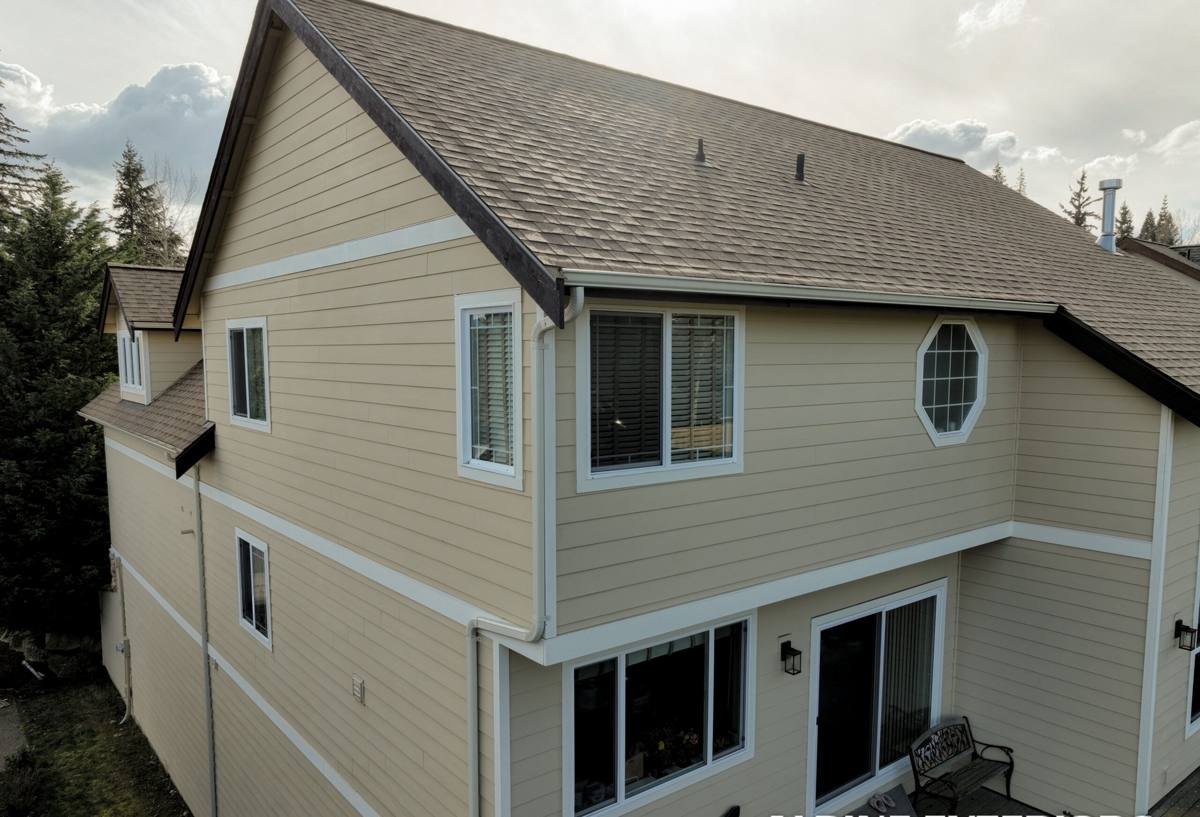
Signs Your Siding Needs Attention
Most homeowners catch siding problems late because the early signs are subtle and easy to write off as cosmetic. Here's what we tell Blaine homeowners to watch for, especially on north- and west-facing walls that catch the worst of the weather:
- Soft or spongy spots when you press on the siding, particularly near the bottom courses and around window trim
- Cracked, peeling, or missing caulk at butt joints, corners, and window and door trim
- Visible moss, algae, or dark streaking that keeps returning even after cleaning
- Rust staining below fastener heads or along metal flashing
- Siding panels that feel loose or have started to bow away from the wall
- Paint or factory finish that's bubbling, flaking, or wearing unevenly in patches
- A musty smell near exterior walls inside the home, which often points to moisture already behind the siding
Any one of these on its own might be minor. Two or three together, especially on the same wall, usually means water has been getting behind the siding for a while and the repair needs to address the cause, not just the symptom.
What Actually Causes Most Repair Calls Here
Failed Caulking and Sealant Joints
Caulk is the first line of defense at every seam, and it's also the first thing to fail. In a climate with this much driving rain, a caulk joint that's cracked or shrunk back from the surface becomes a direct path for water to get behind the siding. This is the single most common repair trigger we see, and it's also the cheapest to fix correctly — as long as it's caught before water has done secondary damage.
Fastener and Flashing Corrosion
Salt air accelerates corrosion on any exposed metal, including nail heads, screws, and flashing that wasn't fully protected. Once a fastener corrodes, it can back out slightly, crack the surrounding siding, or leave a rust trail down the face of the panel. Flashing that's corroded or was installed with insufficient overlap is a bigger issue, because it's usually hidden until water damage shows up somewhere else on the wall.
Moss and Trapped Moisture
Moss doesn't damage fiber cement siding the way it can damage wood, but it does hold moisture against the surface, against trim, and in butt joints where water is already trying to get in. Left alone through a long wet season, that trapped moisture finds every existing weak point — a hairline crack, a nail hole, a gap in caulking — and makes it worse.
Impact and Settling Damage
Cracked panels from impact, or gaps that open up as a house settles, are less climate-specific but still common. The difference in Blaine is that any crack or gap becomes a moisture entry point almost immediately, so what would be a cosmetic fix elsewhere becomes a time-sensitive one here.
Why a Correct Repair Is More Than a Patch
A lot of siding "repairs" amount to caulking over a crack, painting over a stain, or nailing a loose panel back down without checking what's underneath it. That approach might look fine for a season, but in a coastal climate it usually just delays the real problem and lets water damage spread further before anyone deals with it properly.
A correct repair starts with figuring out why the damage happened, not just where it's visible. That means checking the flashing and drainage plane behind the siding, confirming water isn't pooling somewhere it shouldn't, and making sure any replacement material is properly primed, fastened to spec, and sealed at every seam — not just the one that's cracked. It also means matching the replacement siding correctly, both in profile and in finish, so the repair doesn't stand out as an obvious patch job for the next fifteen years.
Our Repair Process
- Inspection and diagnosis. We look at the damaged area and the surrounding wall, including trim, flashing, and any interior signs of moisture, to identify the actual cause rather than just the visible symptom.
- Moisture check. Where there's any indication water has been getting behind the siding, we check how far it's traveled before deciding what needs to come off and what can stay.
- Scope and explanation. We tell you plainly what we found, what needs to be repaired versus what's still sound, and why — no upselling a full re-side when a targeted repair will hold up.
- Removal and prep. Damaged panels, trim, and compromised flashing or sealant come out cleanly, and we check the water-resistive barrier underneath before closing anything back up.
- Repair and refinish. New material goes in fastened and flashed to manufacturer spec, seams are properly sealed, and the finish is matched as closely as the product line allows.
- Final walkthrough. We check the repaired area and the surrounding siding together so you know it's not just patched, it's actually protected going forward.
Repair or Replace? How We Help You Decide
Not every damaged wall needs a full re-side, but sometimes a repair is just delaying an inevitable replacement. Here's the general framework we use when we walk a Blaine property:
| Situation | Usually Points To | Why |
|---|---|---|
| Isolated crack, loose panel, or failed caulk on an otherwise sound wall | Targeted repair | The damage is contained and the surrounding siding and structure are still performing correctly |
| Damage concentrated on one exposed elevation, rest of the home is sound | Repair or partial re-side of that wall | No reason to replace siding that's still doing its job on sheltered sides |
| Repeated moisture damage in the same spots over multiple years | Repair plus a look at the underlying flashing or drainage detail | Recurring failure usually means the root cause was never fixed, not that the material is bad |
| Widespread soft spots, delamination, or corrosion across most of the home | Full replacement | At that point, patch repairs cost more over time than doing it right once |
| Siding is an older product line no longer manufactured or matched | Replacement of the affected section, sometimes a full wall | Mismatched patches age visibly differently and rarely blend well long-term |
Why We Only Repair and Install James Hardie Fiber Cement
We standardized on James Hardie fiber cement because it holds up to exactly the conditions Blaine deals with: salt air, sustained damp, and repeated wet-dry cycling. It's non-combustible, it doesn't rot the way wood-based products can, and the ColorPlus factory finish resists fading and moisture intrusion far better than field-applied paint on other materials. Hardie's HZ5 product line is engineered for the kind of cold, wet Pacific Northwest exposure this region sees, which matters when you're repairing or replacing siding on a home that sits close to the water.
When we do a repair, we're matching into a product system we know inside and out — the fastening pattern, the joint treatment, the finish characteristics — instead of guessing at how a patch will behave against an unfamiliar material. That consistency is a big part of why our repairs hold up instead of becoming next year's callback.
Why a Crew That Already Works Blaine Matters
Siding repair isn't just about swapping bad panels for good ones. It's about understanding which walls on a given property take the worst weather, how moisture tends to travel behind siding in this specific climate, and what a repair actually needs to withstand over the next twenty years, not just the next dry season. A crew that regularly works Blaine and the surrounding Whatcom County coastline has already seen how salt air, driving rain, and moss behave on homes like yours, and that experience shows up in fewer callbacks and repairs that actually last.
It also means we're not learning the local permitting and code requirements on your project. We know what's expected for exterior work in this area, and we handle that groundwork so you don't have to.
What a Quality Repair Should Include
Whoever you hire for siding repair, the work should include a few non-negotiables:
- Diagnosis of the underlying cause, not just replacement of the visible damage
- Inspection of flashing and the water-resistive barrier in the repaired area
- Fasteners and materials rated for coastal exposure
- Properly sealed joints at every seam touched during the repair, not just the original problem spot
- A finish match that won't stand out as an obvious patch
- A clear explanation of what was found and why the repair was scoped the way it was
If you're seeing signs of siding damage on your Blaine home — soft spots, failed caulking, recurring moss, or rust staining — it's worth having it looked at before the next wet season adds to the problem. We offer free, no-pressure estimates and can tell you honestly whether you're looking at a simple repair or something more. Use the form below to get started.