 Lynden Siding
 Birch Bay's Waterfront Setting Puts Real Stress on Siding
Birch Bay sits right on the water in northwest Whatcom County, close enough to the Strait of Georgia that salt-laden air, storm-driven rain, and a shoreline microclimate are part of daily life for most homes here, not just the ones with a direct water view. A lot of the housing stock in Birch Bay started out as beach cottages and summer places built decades ago, later converted into full-time residences, so the siding on many of these homes has already been through years of steady coastal exposure with whatever level of upkeep the previous owner managed. Add in the newer homes going up closer to Birch Bay State Park and along the shoreline, and you get a small community where exterior materials genuinely work harder than they do on a typical inland Whatcom County lot.
We're based in Lynden, and Birch Bay is regular territory for our crew — close enough that we're out here often, and different enough climate-wise from our home base that we've built our James Hardie installation practices around what this specific coastline does to a house, not a generic inland approach.
Salt Air Off the Strait
Air moving in off the Strait of Georgia carries a steady mineral load that settles on everything facing the water — siding, trim, fasteners, and any exposed metal. Salt speeds up corrosion on lower-grade hardware and breaks down cheaper paints and coatings faster than a dry inland climate ever would. On a house this close to the shoreline, finish quality and fastener choice matter more than they would forty minutes inland, because there's less margin for a cut corner.
Driving Rain Off the Water
Storms coming across open water don't fall straight down — wind pushes the rain sideways into wall assemblies, window and door flashing, and every seam where two materials meet. That sideways-driven moisture is harder on a house than the same rainfall total would be somewhere sheltered, and it's exactly the kind of exposure that finds any gap a rushed installation leaves behind. Birch Bay's open, waterfront position means this pattern shows up more often, and with more force, than it does on lots set further back from the shoreline.
A Long Moss Season
Mild temperatures and near-constant moisture add up to a moss and algae season in Birch Bay that can run most of the year on shaded or north-facing walls. Surfaces that hold moisture at the surface instead of shedding it give moss more time to establish before the next dry stretch arrives, and that shows up earliest on tree-shaded lots and walls that don't get much direct winter sun.
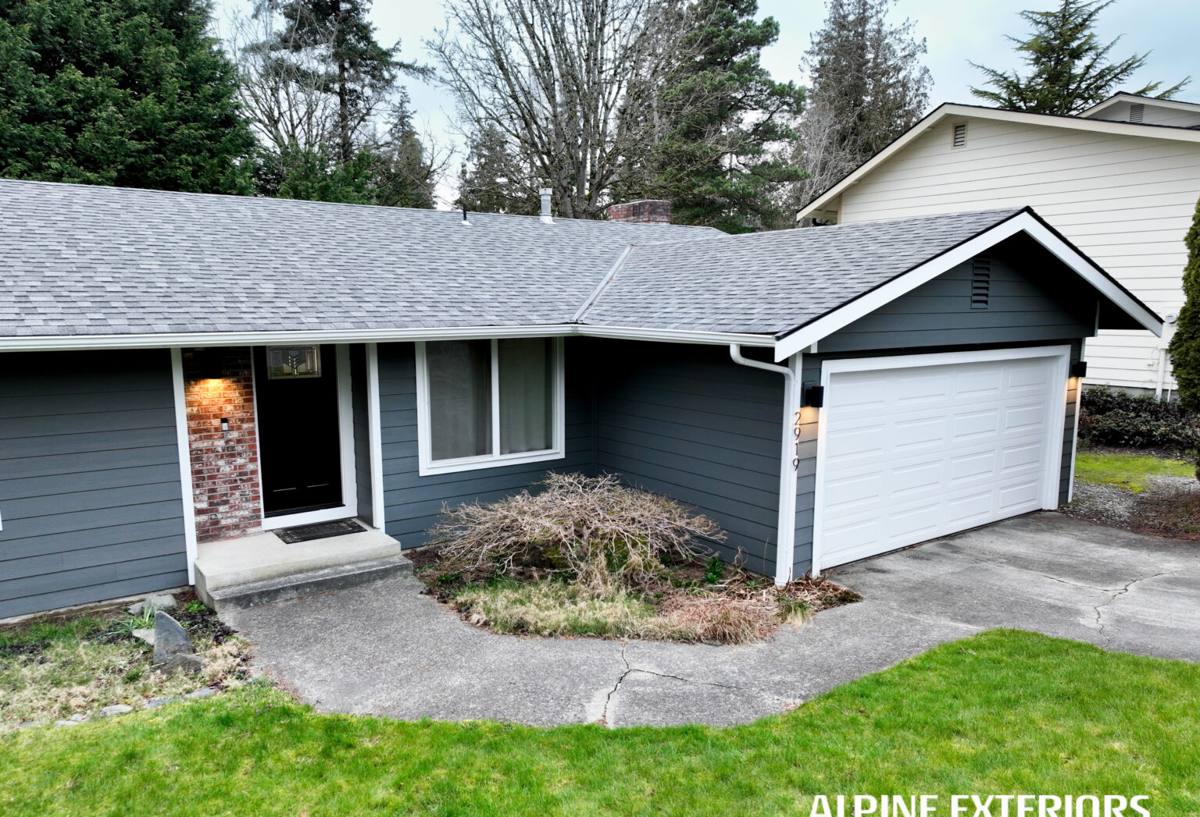
Why James Hardie Fiber Cement Is the Right Fit for This Coastline
We install James Hardie fiber cement siding exclusively — not LP SmartSide, not vinyl, not Cemplank, Allura, primed spruce, or cedar. That's a professional standard we hold to everywhere we work, and it makes even more sense in a place like Birch Bay, where the combination of salt air, driving rain, and a long wet season puts real, sustained pressure on whatever material ends up on the wall.
- Non-combustible core: Fiber cement doesn't feed a fire the way wood-based siding products can, which matters for both safety and, in many cases, insurance considerations.
- Factory-applied ColorPlus finish: The color is baked on under controlled factory conditions rather than brushed on in the field, which holds up better against salt exposure, UV, and repeated wet-dry cycling than site-applied paint.
- Climate-engineered HZ5 formulation: Hardie's HZ product lines are built for regions with sustained moisture and freeze-thaw cycling — a close match for a shoreline community like Birch Bay.
- Dimensional stability: Fiber cement doesn't swell, cup, or warp the way engineered wood products can after repeated exposure to wind-driven, waterfront rain.
- Strong transferable warranty: Hardie backs correctly installed siding with one of the more substantial warranty structures in the industry.
Each of the products we don't install has a place in the broader market, and plenty of homeowners elsewhere are satisfied with them. But on a stretch of coastline that sees this much direct salt and moisture exposure, we'd rather stand fully behind one system than offer a cheaper option that quietly shifts long-term maintenance and moisture risk back onto the homeowner.
What a Correct James Hardie Installation Involves in Birch Bay
Fiber cement only performs the way it's engineered to when it goes on correctly, and on a waterfront lot, the installation details carry more weight than they would in a sheltered inland setting. A few of the basics we won't skip on a Birch Bay job:
- Rain screen drainage gap: A small cavity behind the siding lets any moisture that gets past the exterior surface drain and evaporate instead of sitting against the wall sheathing.
- Correct fastener type and spacing: Hardie's spec calls for corrosion-resistant fasteners placed at specific intervals — loose spacing or the wrong fastener is one of the more common causes of early siding failure we find on tear-offs.
- Properly lapped water-resistive barrier and flashing: Every seam and penetration needs to shed water downward and outward, especially on walls that catch wind-driven rain straight off the water.
- Sealed cut edges and butt joints: Any cut edge that isn't primed and sealed becomes a point where moisture can wick into the board over time — a bigger issue here than in a drier climate.
- Correct clearance from grade and roofline: Siding installed too close to the ground or a roof surface stays damp longer and is more likely to develop problems, regardless of the material.
Shortcuts That Fail Faster Near Salt Air
We see the same handful of shortcuts turn up on tear-offs and service calls in coastal towns: unsealed cut ends, fasteners driven too tight or spaced wrong, house wrap lapped the wrong direction, and caulk used to cover a flashing gap instead of correcting it. None of those mistakes are visible from the curb once a job is finished, and none of them cause a problem right away — which is exactly why they're easy to get away with inland and why they show up faster on a home taking direct salt air and driving rain.
Choosing the Right Hardie Product and Finish for a Birch Bay Home
Hardie's product lines aren't one-size-fits-all, and the right choice depends on the home's style and how much of the coastline weather it takes on directly.
| Hardie Product | Best Fit | Coastal Consideration |
|---|---|---|
| HardiePlank lap siding | Traditional and craftsman-style homes | Most common choice; needs correct lap and fastener spacing on wind-exposed walls |
| HardiePanel vertical siding | Modern builds, accent walls, gable ends | Fewer horizontal laps for water to catch on, useful on the most exposed elevations |
| HardieShingle | Cottage and beach-style homes | More seams overall, so flashing and underlayment detail matters more on a waterfront wall |
| ColorPlus factory finish | Any product line, most homeowners | Holds color and resists salt-driven fading far longer than field-applied paint |
For a lot of the older beach cottages in Birch Bay, HardieShingle or HardiePlank in a factory ColorPlus finish gets closest to the look homeowners want to keep while giving up nothing on moisture performance. On newer builds with cleaner, more modern lines, HardiePanel is often a better match. We walk through these options on-site rather than defaulting to whatever's fastest to install, since the wrong product for a home's style ends up either an eyesore or an unnecessary upcharge.
Living With Hardie Siding in a Wet, Salt-Air Climate
Correctly installed Hardie siding is genuinely low-maintenance compared to wood-based alternatives, but low-maintenance doesn't mean no maintenance in a place like Birch Bay. A simple routine keeps it performing the way it's supposed to:
- Rinse siding down once or twice a year to clear salt residue, especially on walls facing the water directly
- Keep gutters and downspouts clear so water isn't overflowing down the siding face
- Trim back vegetation and tree limbs that keep a wall shaded and damp longer than it needs to be
- Check caulking at trim, window, and door transitions annually and re-seal anything cracked or pulled away
- Address moss or algae buildup early with a gentle wash rather than letting it establish and spread
- Watch for soft spots, staining, or fastener corrosion and have them looked at before they spread
Our Process for a Birch Bay James Hardie Installation
We start with an on-site walk of the home, paying attention to how exposure varies wall by wall — a straight water-facing elevation and a shaded, tree-covered side of the same house can be dealing with very different moisture loads, even though they're on the same roof. From there we put together a clear, written scope covering the product line, finish, and installation details before any work begins. Tear-off of existing siding includes a look at the sheathing underneath for moisture damage that needs addressing before new siding goes up — a step we don't skip just to keep a schedule. Installation follows Hardie's published spec on fastener type and spacing, flashing, drainage, and clearance, and we walk the finished job with the homeowner before calling it complete.
Why Local Birch Bay Experience Matters When Choosing a Crew
Birch Bay isn't a uniform stretch of coastline — a home sitting low and close to the water takes on very different exposure than one set back a few streets with more tree cover, even though both are technically in the same small community. A crew that works this shoreline regularly already knows that difference and adjusts drainage detailing, flashing laps, and fastener choices house by house instead of applying one generic approach to every job. That kind of judgment is what separates a siding job that looks fine for a season from one that's still performing decades out, and it only comes from working this specific coastline repeatedly, not from a spec sheet.
A Short Checklist Before Hiring for Siding Work in Birch Bay
- Confirm current Washington contractor licensing and active liability insurance
- Ask what siding product they install and why, and whether it carries a written, transferable warranty
- Ask specifically about their experience with salt air and wind-driven rain, not just general remodeling experience
- Get a written scope of work covering fastener type, flashing details, and drainage before signing anything
- Ask how they handle moisture or sheathing damage found once old siding comes off
Cost Factors for James Hardie Siding in Birch Bay
| Factor | What Drives It | Coastal Consideration |
|---|---|---|
| Home size and complexity | Square footage, number of gables, trim detail | More seams and transitions mean more flashing work on exposed elevations |
| Tear-off vs. new construction | Removal and disposal of existing siding | Sheathing repair if moisture has already gotten behind the old siding |
| Product line and finish | Lap, panel, or shingle profile; ColorPlus vs. field-applied paint | ColorPlus adds upfront cost but reduces repainting need in salt air |
| Site access and exposure | Waterfront setback, elevation, scaffolding needs | Direct water-facing walls often need more careful, slower installation |
These are general cost drivers, not a quote. Two homes on the same street in Birch Bay can need very different scopes once we're actually pulling old siding or looking at the sheathing underneath, which is why we walk every property in person before putting a real number on the work.
If your Birch Bay home needs new siding, or you're weighing whether to repair what's there or replace it with something built for this coastline, we're glad to take a look and give you a straightforward, honest read on what it actually needs. Reach out using the form below to schedule a free, no-pressure estimate.