 Lynden Siding
 Building a Deck That Can Actually Handle Birch Bay
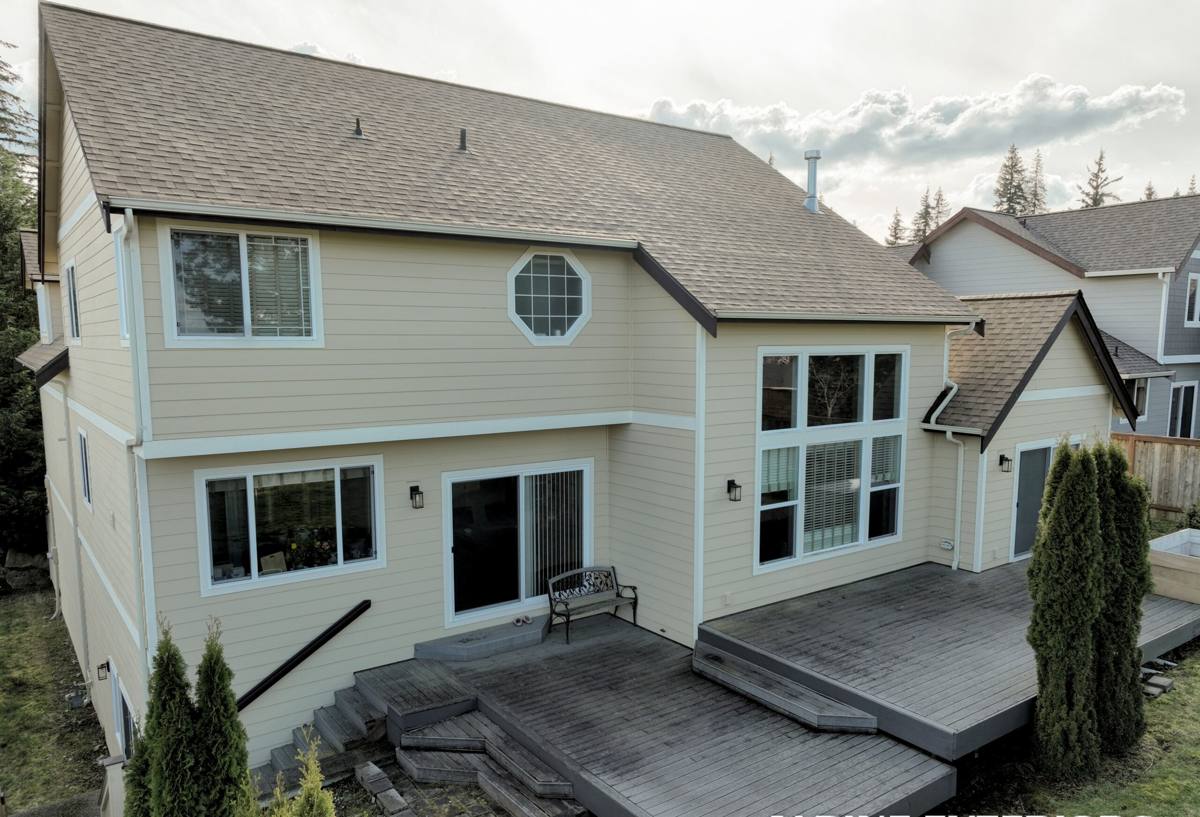
Birch Bay sits right on the water, and that changes what a deck has to survive. Homes a few miles inland in Lynden deal with plenty of Pacific Northwest rain, but Birch Bay adds salt-laden air, wind-driven spray, and a longer stretch of damp, shaded months where moss and algae get a real foothold. A deck built to a generic spec sheet, without accounting for that coastal exposure, tends to show its age fast — corroding fasteners, swollen edges, slick green boards by late winter. A deck built for the actual conditions holds its look and its structure for decades instead of years.
This page is specifically about composite decking for Birch Bay properties: what the climate demands, what a correct install actually involves below the surface, and why the details matter more here than they do a few miles away.
Why Birch Bay's Coastal Climate Is Hard on Decks
A few things stack up against outdoor structures near the water in Whatcom County:
- Salt air accelerates corrosion. Metal fasteners, hidden clips, and hardware that would last decades inland can start rusting and staining within a few seasons if they're not rated for coastal exposure.
- Driving rain gets pushed sideways. Wind off the water doesn't just fall on a deck — it drives into seams, ledger connections, and any gap that isn't properly flashed or sealed.
- Moss season runs long. Shaded, north-facing, or tree-covered sections of a deck can stay damp for months at a stretch, which is exactly what moss and algae need to establish.
- UV exposure is real too. Summer sun off open water can fade lower-grade composite faster than the same board would fade under tree cover a few miles inland.
None of this means a deck near Birch Bay can't last — it means the material choice, the fastener choice, and the substructure details all need to account for it up front, rather than getting patched later.
Composite vs. Wood: What Actually Holds Up on the Coast
Wood decking can absolutely work in this climate if it's maintained aggressively, but that maintenance burden is heavier near the water than it is inland. Composite decking shifts the equation — not because wood is a bad product, but because a capped composite board simply doesn't absorb moisture the way wood fiber does, which matters when a deck spends half the year damp.
| Factor | Pressure-Treated Wood | Capped Composite |
|---|---|---|
| Moisture absorption | Absorbs and releases moisture, leading to cupping and splitting over time | Minimal absorption at the cap layer; core is engineered to resist swelling |
| Moss/algae growth | Rougher grain holds spores and moisture, especially in shaded areas | Smoother, capped surface sheds moisture faster and is easier to clean |
| Maintenance | Annual sealing/staining recommended, especially near salt air | Periodic washing; no sealing or staining required |
| Fastener corrosion risk | High if standard hardware is used near the water | Same risk unless coastal-rated hardware is specified — material choice alone doesn't solve this |
| Upfront cost | Lower material cost | Higher material cost, generally offset by lower maintenance over the deck's life |
| Typical lifespan (coastal exposure) | Shorter if maintenance lapses | Longer, provided the substructure and fasteners are also coastal-appropriate |
The honest caveat: composite decking is not maintenance-free just because it's composite. If the framing underneath and the fasteners holding it down aren't suited to salt air, the surface can look fine while the structure underneath is corroding. That's the part that gets skipped by installers who don't work this area regularly.
Choosing the Right Composite Board for a Salt-Air Environment
Capped composite vs. capped PVC
Most quality composite decking today is "capped" — a wood-plastic composite core wrapped in a protective polymer shell that resists staining, fading, and moisture intrusion at the cut edges and surface. Fully capped PVC decking takes this a step further with no wood fiber in the core at all, which can be worth the extra cost directly on the waterfront where moisture exposure is most constant. For most Birch Bay homes set back from the shoreline, a good capped composite is the right balance of performance and cost; for homes with direct, constant salt spray exposure, we'll talk through whether capped PVC makes more sense for your specific site.
Board profile and venting
Solid-core boards handle foot traffic well but can trap moisture underneath if ventilation is poor. Grooved-edge boards paired with a proper gapping system let air move and water drain between boards instead of pooling — a detail that matters more in a climate where the deck surface may not fully dry out for days at a time in winter.
Color and heat considerations
Darker composite colors can run noticeably hotter in direct summer sun, which is worth factoring in for open, unshaded decks near the water. Lighter and mid-tone colors also tend to show less chalking and fading over time under sustained UV exposure off open water.
The Substructure Is Where Coastal Decks Actually Fail
The decking surface gets all the attention, but the framing underneath is what actually determines whether a deck lasts. This is also where corner-cutting is hardest to spot after the fact — and most expensive to fix once boards are down.
- Ledger flashing: Where the deck attaches to the house needs a properly flashed, sealed connection. This is the single most common source of hidden water damage on any deck, and driving rain off the bay makes it worse if it's done wrong.
- Fastener and hardware grade: Standard galvanized hardware can corrode faster than expected in salt air. Stainless steel or coastal-rated coated fasteners cost more up front and are worth it here.
- Joist protection: Joist tape or an equivalent moisture barrier over the top of framing lumber keeps water from sitting in fastener holes, which is where rot typically starts first.
- Post bases and footings: Keeping structural wood off direct concrete or grade contact with proper post bases prevents wicking moisture into the post ends year-round.
- Beam and joist spacing: Composite decking has its own span-rating requirements, different from wood — spacing that's fine for a wood deck can be undersized for composite and lead to a bouncy, sagging deck over time.
Drainage, Airflow, and Keeping Moss From Taking Over
Moss doesn't grow because a deck is "old" — it grows because a surface stays wet longer than it should. A well-designed deck fights that with a few compounding details rather than one big fix.
Correct slope away from the house keeps water moving instead of pooling against siding or door thresholds. Consistent board gapping lets water drop through rather than sheeting across the surface. Under-deck ventilation — especially for taller or multi-level decks — keeps air moving beneath the structure so the underside of boards and the tops of joists actually get a chance to dry between rain events, which in Whatcom County's wetter months can otherwise be a rare occurrence. Where a deck sits under trees or in a shaded corner of the yard, we'll also flag that as a spot that'll need more frequent surface cleaning regardless of material, since shade and moisture are the two ingredients moss needs most.
How We Approach a Birch Bay Composite Deck Install
1. Site and exposure assessment
Before any material gets ordered, we look at the property's actual exposure — how close to the water, prevailing wind direction, how much shade, existing drainage patterns around the house. A deck on an open bluff facing the water gets specified differently than one tucked into a wooded lot a few blocks back.
2. Framing and flashing
We build or reinforce the substructure with coastal-appropriate hardware and proper ledger flashing before a single deck board goes down. This is the part of the job that isn't visible once it's finished, which is exactly why it shouldn't be rushed.
3. Decking installation
Boards go down with a hidden fastener system where the product allows it, keeping the surface clean and reducing the number of exposed fastener points where corrosion or water intrusion could start.
4. Railings and edge details
Railing systems and picture-frame edge boards get the same hardware standard as the rest of the deck — it's a common place for mismatched, lower-grade fasteners to sneak in on a rushed job.
5. Final walkthrough
We walk the finished deck with the homeowner, cover basic care, and point out anything site-specific — a shaded corner that'll need extra cleaning, a downspout that should be redirected, that kind of thing.
What Affects the Cost of a Composite Deck in Birch Bay
Every deck is priced from the actual site conditions, but these are the factors that move the number most, in rough order of impact:
| Factor | Why It Matters |
|---|---|
| Deck size and layout | Square footage and shape (straight run vs. multiple levels or angles) drive material and labor directly |
| Existing structure condition | Replacing decking on solid framing costs less than a full tear-off and rebuild of a failing substructure |
| Height and railing requirements | Elevated decks need more substantial framing, stairs, and code-compliant railing systems |
| Board tier | Entry-level capped composite vs. premium capped PVC changes material cost meaningfully |
| Fastener and hardware spec | Coastal-rated stainless hardware costs more than standard galvanized but avoids early corrosion |
| Site access | Waterfront lots with limited access or steep grades can add labor time |
We'd rather walk your specific deck and give you a real number than quote a broad range that doesn't mean much for your situation — every one of these factors can move a project meaningfully in either direction.
Maintenance Checklist for Coastal Composite Decking
Composite cuts the maintenance load compared to wood, but "low-maintenance" isn't "no-maintenance," especially this close to the water. A simple seasonal routine keeps a Birch Bay deck looking right and catches small issues before they become expensive ones.
- Rinse or sweep the deck surface regularly to clear salt residue, pollen, and organic debris before it builds up in board grooves.
- Wash with a mild soap and soft-bristle brush a couple of times a year — pressure washing on the lowest safe setting is fine for most composite, but avoid aggressive nozzles that can strip the cap layer.
- Check shaded and low-airflow sections more often for early moss or algae growth, and treat with a composite-safe cleaner before it spreads.
- Keep gutters and downspouts near the deck clear so runoff isn't dumping directly onto or under the structure.
- Inspect railing posts and stair connections annually for any looseness — hardware is the first place coastal exposure shows up.
- Trim back overhanging branches or shrubs that keep sections of the deck shaded and damp longer than the rest.
Why Hiring a Crew That Already Works Birch Bay Matters
A lot of what separates a Birch Bay deck that lasts twenty-plus years from one that needs hardware replaced in five comes down to decisions made before decking is even ordered — fastener grade, flashing detail, board spacing, ventilation. Those are easy to get wrong if a crew's regular experience is inland projects where salt air simply isn't a factor. A crew that already builds decks along this stretch of the Whatcom County coast has already seen which details matter here and doesn't need to learn that lesson on your project.
There's also a practical side to hiring local: faster response if a warranty question comes up, familiarity with the county permitting process for the area, and a crew that isn't stretched thin driving long distances between jobs. Lynden Siding Company works throughout Whatcom County, including Birch Bay, and we build every deck with the coastal exposure in mind from the framing up — not as an upgrade option, but as the standard for the area.
If you're considering a composite deck for a Birch Bay property, we're glad to walk the site, look at your existing structure if you have one, and put together a straightforward, no-pressure estimate. Use the form below to get started.