 Lynden Siding
 Roofing in Acme's Wet, Shaded Climate
Acme sits in a pocket of Whatcom County where the Nooksack valley funnels moisture-heavy air off the Puget Sound lowlands and holds it against the foothills. Homes here deal with more standing dampness than a typical suburban lot: tree cover is heavier, driveways stay shaded longer into the morning, and roofs go weeks at a stretch without a real drying window during the fall and winter. That combination is exactly what asphalt shingles struggle with when they're installed without the local climate in mind.
Salt-tinged, moisture-laden air moving through the county accelerates the breakdown of cheap granule coatings, and the long stretch of driving rain from October through April keeps roof decks wetter, longer, than manufacturers assume in their national warranty language. Add in a moss season that can run eight or nine months out of the year under tree canopy, and you have a climate that punishes shortcuts in underlayment, ventilation, and flashing detail work far faster than it would in a drier part of the state.
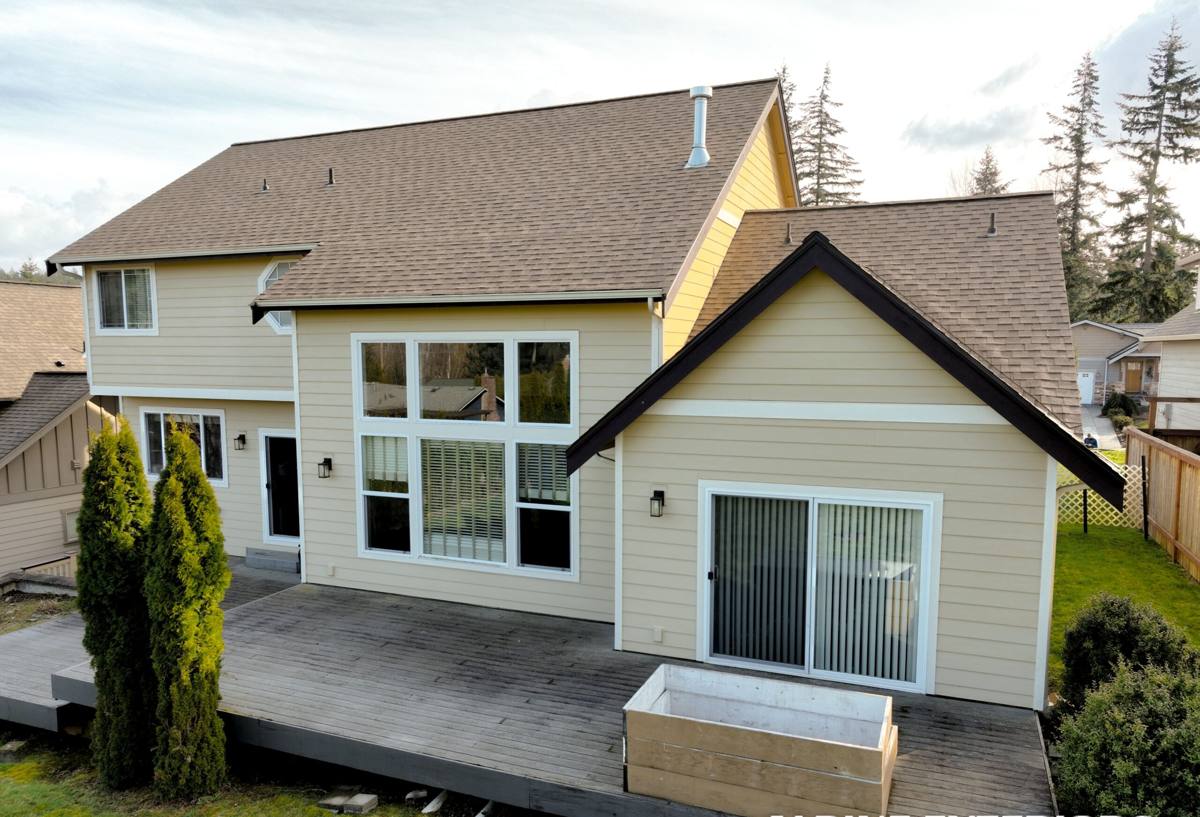
What Moss and Rain Actually Do to a Shingle Roof
Moss isn't just cosmetic. Once it establishes on a shingle, its root structure lifts granules and holds water directly against the mat underneath. That trapped moisture works into fastener lines and shingle laps, and over a few seasons it turns a roof that should have had 20-plus years of service life into one that's failing at the edges and in the valleys after 10 or 12. Driving rain compounds the problem by pushing water sideways under poorly lapped shingles and around flashing that wasn't detailed for wind-driven exposure.
The result we see on older Acme roofs is rarely a total failure. It's usually localized: soft decking under a moss mat on the north slope, staining and granule loss around a chimney or skylight where flashing was undersized, or soffit and fascia rot from a roof that was never properly vented. A correct installation addresses all of that up front instead of leaving it for a homeowner to discover during the next atmospheric river event.
Where Failures Start First
- North- and shade-facing slopes that stay damp longest and grow moss fastest
- Valleys and low-slope transitions where water concentrates and moves slowest
- Chimney, skylight, and vent flashing that wasn't rebuilt during the last re-roof
- Eaves without proper ice-and-water protection, where wind-driven rain backs up under the shingle course
- Attic spaces with blocked or undersized ventilation, which cooks shingles from below and traps moisture above
What a Correctly Installed Roof Looks Like Here
A roofing job done right for this part of Whatcom County starts before the first shingle ever goes down. The deck gets inspected for soft spots and re-nailed or replaced as needed — not just covered over. A self-adhering ice-and-water membrane goes down at the eaves, valleys, and around every penetration, not just where code requires the bare minimum. That membrane is what actually stops wind-driven rain from backing up under the shingle field during a hard storm.
Synthetic underlayment across the rest of the deck gives a second line of defense that won't degrade the way old felt paper does when it sits damp for extended periods. Starter strips at the eaves and rakes get installed correctly so the first course has proper adhesive contact and wind resistance, and every shingle course is nailed per the manufacturer's pattern — not gunned in fast with high nails that miss the reinforced strip, which is one of the most common corner-cuts we find on older roofs.
Flashing Gets Rebuilt, Not Reused
Step flashing at walls, counterflashing at chimneys, and pipe boots all get replaced during a re-roof rather than tucked back under new shingles. Old flashing has already flexed and corroded through seasons of freeze-thaw and rain; reusing it is a false economy that shows up as a leak within a few years. This is one of the details that separates a roof that performs in this climate from one that just looks new for a season.
Choosing a Shingle for Acme's Conditions
Not every asphalt shingle handles a mossy, wet climate the same way. Algae-resistant (AR) shingles use copper-infused granules that slow biological growth, which matters a lot more here than in a drier region. Architectural (dimensional) shingles also shed water more effectively than flat three-tab styles because of their layered profile, and they hold up better to the wind gusts that come through the valley during winter storms.
| Shingle Type | Typical Lifespan Here | Moss/Algae Resistance | Wind Performance |
|---|---|---|---|
| 3-Tab Asphalt | 15–18 years | Standard granules; moss-prone without AR coating | Adequate in sheltered areas |
| Architectural (AR) | 25–30 years | Copper-infused granules resist algae/moss growth | Stronger seal, better in exposed or windy lots |
| Premium/Designer | 30+ years | Highest-grade AR granules, longer warranty | Heaviest profile, best storm performance |
We steer most Acme homeowners toward an AR-rated architectural shingle unless there's a specific budget or historical-match reason not to. It's not that a standard three-tab is a bad product — it's that in a climate with this much shade and moisture, the moss-resistant coating and heavier profile earn their cost difference within the first decade through reduced cleaning, fewer granule losses, and a longer real-world service life.
Ventilation: The Detail Homeowners Rarely See
A shingle roof is only as good as the attic underneath it. Proper intake ventilation at the soffits paired with exhaust at the ridge keeps the underside of the deck dry and temperature-stable, which does two things: it prevents the trapped moisture that leads to deck rot and premature shingle failure from underneath, and it keeps the attic from overheating in the rare stretch of summer sun, which otherwise ages shingles faster than the weather on top ever would.
On a lot of older Acme homes we find soffit vents that were painted over, blocked with insulation, or never installed to begin with. We check and correct ventilation as a standard part of every re-roof estimate — not as an upsell, but because skipping it undermines everything else in the installation.
Our Process, Start to Finish
- On-site inspection. We walk the roof and the attic, check the deck condition, flashing, and ventilation, and take photos of anything relevant to the estimate.
- Written estimate. A clear, itemized proposal covering tear-off, deck repair allowance, underlayment, flashing, shingle selection, and ventilation — no vague lump-sum guessing.
- Scheduling around the weather. Given how much rain moves through this area, we plan installs for realistic dry windows and won't leave a deck exposed overnight without protection.
- Tear-off and deck inspection. Old shingles come off down to bare decking so we can actually see and repair what's underneath.
- Installation. Ice-and-water membrane, underlayment, new flashing, and shingles installed to manufacturer spec for the wind and moisture load this area sees.
- Cleanup and walk-through. Magnetic sweep for nails, hauled debris, and a final walk-through so you know exactly what was done and why.
Maintenance That Actually Extends Roof Life Here
A correctly installed roof still needs some seasonal attention in a climate like this one. None of it is complicated, but skipping it is how a 25-year shingle turns into a 15-year shingle.
- Clear overhanging branches to cut down on shade, debris buildup, and moss establishment
- Keep gutters clear so water isn't backing up under the eave line during heavy rain
- Have moss treated or gently removed before it takes root, rather than after it's established
- Check attic ventilation isn't blocked by insulation or storage after any attic work
- Schedule a visual roof check every couple of years, especially after a hard windstorm
What Affects the Cost of a Re-Roof in This Area
| Factor | Why It Matters |
|---|---|
| Roof pitch and access | Steeper slopes and tight lot access take longer and require more safety setup |
| Deck condition | Rot or soft sheathing found during tear-off adds repair scope beyond the base estimate |
| Shingle grade chosen | Standard vs. architectural vs. premium AR products carry different material costs |
| Flashing and penetrations | More chimneys, skylights, and vents mean more detail work and material |
| Ventilation corrections | Adding or fixing soffit and ridge venting is often needed on older homes |
We'd rather walk a roof in person and give an honest number than quote a range that doesn't reflect what your specific home needs. Every estimate breaks out these factors so you can see exactly where the cost is coming from.
Why a Crew That Knows Acme Makes a Difference
Roofing crews that mostly work drier, more exposed parts of the state don't always build in the margin this valley needs — the extra membrane at eaves, the heavier ventilation correction, the shingle grade that actually resists moss instead of just looking clean at handoff. Working this pocket of Whatcom County regularly means we've seen how these roofs age over real winters, not just how they look the day the crew leaves.
It also means faster response if something needs a look after a storm, and a crew that's already familiar with the permitting and inspection expectations Whatcom County applies to residential roofing work. That local familiarity saves time and avoids the back-and-forth that can slow down an out-of-area contractor.
If your roof is showing moss, granule loss, or you're just planning ahead before the wet season sets in, we're happy to take a look. Use the form below to request a free, no-pressure estimate — we'll walk the roof, tell you honestly what it needs, and give you a clear number to work with.