 Lynden Siding
 Roof Repair in Maple Falls: A Different Set of Problems Than a Lynden Rooftop
Maple Falls sits up in the forested foothill country east of Lynden, along the corridor that climbs toward Mount Baker, and roofs out here deal with a heavier, wetter, shadier version of the weather that shapes roofing across all of Whatcom County. The same marine storm systems that bring salt-laden air and driving rain across the lowlands still reach these foothills, just filtered through a lot more tree canopy on the way in. That canopy is the real story for roof repair here: more shade, more falling debris, slower drying, and a moss season that can run longer on a tree-lined lot than on an open one closer to town.
This page is specifically about roof repair for homes in and around Maple Falls — not a full re-roof, not a general overview of roofing materials, but the actual work of diagnosing a leak, a damaged section, or a failing detail on an existing roof and fixing it correctly. A repair job done right in this setting looks different from a repair job in a more open, sun-exposed part of the county, and it's worth understanding why before you hire anyone to go up on your roof.
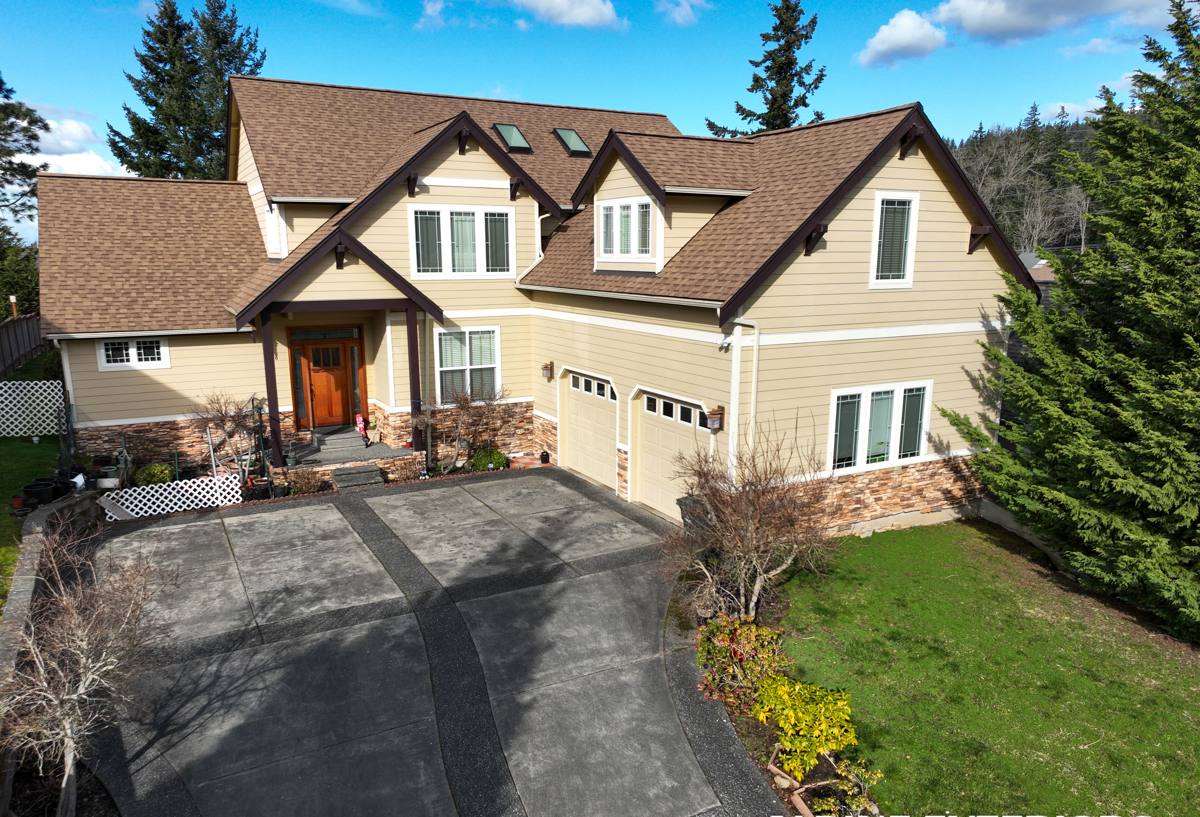
What Makes a Maple Falls Roof Different
Heavier Tree Cover, Longer Moss Season
Homes tucked into wooded lots around Maple Falls often sit under more continuous shade than a typical in-town Lynden property. Less direct sun means roof surfaces stay damp longer after every rain, and that extends the window for moss, lichen, and organic buildup to take hold. Needles, cones, and leaf litter also collect in valleys and against roof-to-wall transitions faster on a heavily wooded lot, and that debris holds moisture right against the roofing material instead of letting it shed off.
Foothill Rainfall and Drainage
Precipitation tends to run heavier the further you move up into the foothills toward Mount Baker compared to the valley floor. That's more total water hitting the roof, more water moving through gutters and downspouts, and more opportunity for a marginal flashing detail or an undersized gutter run to become an actual leak. Wind-driven rain still plays a role too — it doesn't always fall straight down, and it finds its way sideways into valleys and around vent pipes and chimneys just as it does everywhere else in the county.
Occasional Snow and Cold Snaps
Maple Falls sits at a higher elevation than Lynden, and in some winters that means real snow accumulation, not just a passing dusting. A roof that handles constant rain fine can still be caught off guard by an ice dam forming at the eaves during a cold snap, especially if attic insulation or ventilation isn't quite right. It's not an every-year event, but it's common enough here that we plan repairs with it in mind rather than treating this as a rain-only climate.
Common Roof Repair Issues We See Around Maple Falls
Repair calls out here tend to follow a few consistent patterns, driven mostly by tree cover, shade, and the extra moisture that comes with both.
| Issue | What's Driving It Here | Typical Fix | Urgency |
|---|---|---|---|
| Moss lifting shingle edges | Long-shaded roof planes under mature trees | Careful moss removal and treatment, replace lifted or damaged shingles | Moderate — worsens each wet season |
| Clogged valleys and gutters | Needle and leaf debris from surrounding trees | Clear debris, inspect underlying material, repair damage found | Moderate to high depending on backup |
| Flashing leaks at chimneys/vents | Wind-driven rain and repeated wet-dry cycling | Re-flash with correct lap and sealant, not just caulk over old metal | High — active leak path |
| Impact damage from limbs or debris | Dense tree cover close to the roofline | Replace damaged decking/shingles, inspect surrounding area for hidden damage | High if decking is exposed |
| Ice-related edge damage | Higher elevation, occasional hard freezes | Repair damaged eave sections, address underlying ventilation/insulation issue | Moderate — seasonal but recurring |
Signs Your Maple Falls Roof Needs Repair Now
- Moss or dark streaking that comes back quickly after cleaning
- Standing debris in valleys or gutters that doesn't clear on its own between rains
- Water stains on ceilings or walls, especially near chimneys, vents, or exterior corners
- A section of roof that looks visibly different in texture or color from the rest
- Daylight or damp insulation visible from inside the attic
- Granules building up at downspout outlets or on the ground below the roofline
- Any spot where a tree limb has recently come down near or on the roof
None of these automatically means a full re-roof. Most of them are exactly the kind of thing an honest repair addresses, provided the underlying deck and structure are still sound.
What a Correct Repair Actually Involves
A lot of what gets called "roof repair" is really just surface patching — a bead of sealant over a leak, a shingle laid over a soft spot, done without ever finding out why the problem started. That kind of fix tends to fail again within a season or two, especially in a climate that gives a roof this little chance to dry out between rains. A repair that's actually going to hold needs a few things in place:
- A real diagnosis, tracing water back to its actual entry point rather than patching where it happens to show up inside
- Removal of the damaged material down to sound decking, not layering new material over compromised roofing
- Flashing rebuilt with correct laps and fasteners at valleys, chimneys, and vent penetrations — not just resealed
- Underlayment and, where needed, ice-and-water protection matched to the actual exposure of that section of roof
- Replacement material that matches the existing roof closely enough in profile and, where possible, color and wear
- A check of the attic and surrounding area for hidden moisture damage the visible leak may have caused before it was found
None of that requires a full tear-off in most cases. It does require treating a repair as a real construction task with its own standards, not a stopgap.
Repair or Replace: How We Help You Decide
Not every call to fix a roof problem should end in a repair, and not every aging roof needs to come off entirely. We look at how much of the total roof surface is affected, whether the deck underneath has moisture damage beyond the immediate problem area, how many times the roof has already been patched, and the roof's overall age relative to its expected life in this climate. A single flashing failure or a localized patch of moss damage on an otherwise sound roof is almost always a straightforward, reasonably priced repair — often a few hundred dollars for a contained issue. A roof with damage spread across several sections, a soft or rotted deck in multiple spots, or a long history of deferred patchwork is a different conversation, and pretending otherwise with another round of small repairs usually just delays a bigger bill and adds water damage to the list. We'll walk you through what we actually find, in plain terms, before recommending either path.
How a Maple Falls Roof Repair Works With Us
Inspection and Diagnosis
We start by physically inspecting the affected area — inside the attic if accessible, and on the roof itself — to trace the actual source of the problem rather than guessing from ground level. On a tree-covered lot, that also means checking nearby limbs and canopy for future risk, not just the damage that's already happened.
A Clear, Written Estimate
Before any work starts, you get a plain-language explanation of what we found, what the repair involves, and what it costs. No pressure to upgrade to a full replacement if the roof doesn't call for one, and no vague verbal quotes.
The Repair Itself
Work is done down to sound material, with flashing, underlayment, and shingles handled to the same standard we'd use on a new install — because a repair that's built to code-minimum standards in this climate tends to become a callback.
A Look at What's Around It
Before we leave, we check gutters, valleys, and nearby roof sections for early signs of the same issue developing elsewhere, particularly moss and debris buildup that tends to spread across a shaded roof over time.
Why a Crew That Already Works Maple Falls Matters
Maple Falls is far enough out from the main population centers in Whatcom County that a lot of contractors treat it as an afterthought — a longer drive for a smaller job, worth doing only if nothing closer is on the schedule. A crew that already routes through the area regularly doesn't have that problem, and that shows up in practical ways: faster response for an active leak, and a working knowledge of how heavily wooded lots, foothill rainfall, and occasional snow actually affect a roof out here versus one down in town. It also means someone who's already seen how moss and debris behave differently on a shaded, tree-lined property than on an open lot, and who repairs accordingly instead of applying a one-size-fits-all approach to every roof in the county.
We handle roofing, siding, windows, and decks, and on a fair number of Maple Falls repair calls, a roof leak turns out to be connected to a siding or trim issue at the same wall — something worth flagging honestly rather than treating as a separate problem for a separate contractor to find later.
Get a Free, No-Pressure Estimate
If you're dealing with a leak, storm damage, or a roof section that just doesn't look right anymore, we're glad to come take an honest look. Use the form below to schedule a free estimate for your Maple Falls home — no pressure, and no push toward a bigger job than the roof actually needs.