 Lynden Siding
 Siding Built for Acme's Damp, Shaded Climate
Acme sits in the kind of Whatcom County terrain that's hard on exterior building materials — tree-covered lots, low winter sun angles, and long stretches where a wall simply doesn't dry out between rain events. Add in the region's driving rain, moisture that rolls in off the Salish Sea, and a moss season that can stretch from October through May in shaded spots, and you've got an environment that punishes any siding material with a weak point in its moisture management. This isn't a page about siding in general. It's about what actually holds up on homes in and around Acme, and what a correctly installed James Hardie fiber cement system does that lesser products and lesser installs don't.
We install James Hardie exclusively. Not because it's the only decent siding on the market, but because after years of tearing old siding off Whatcom County homes, it's the product we trust to still look right and perform correctly fifteen and twenty years down the road — especially on lots like the ones common around Acme, where shade, moisture, and organic growth are working against the wall year-round.
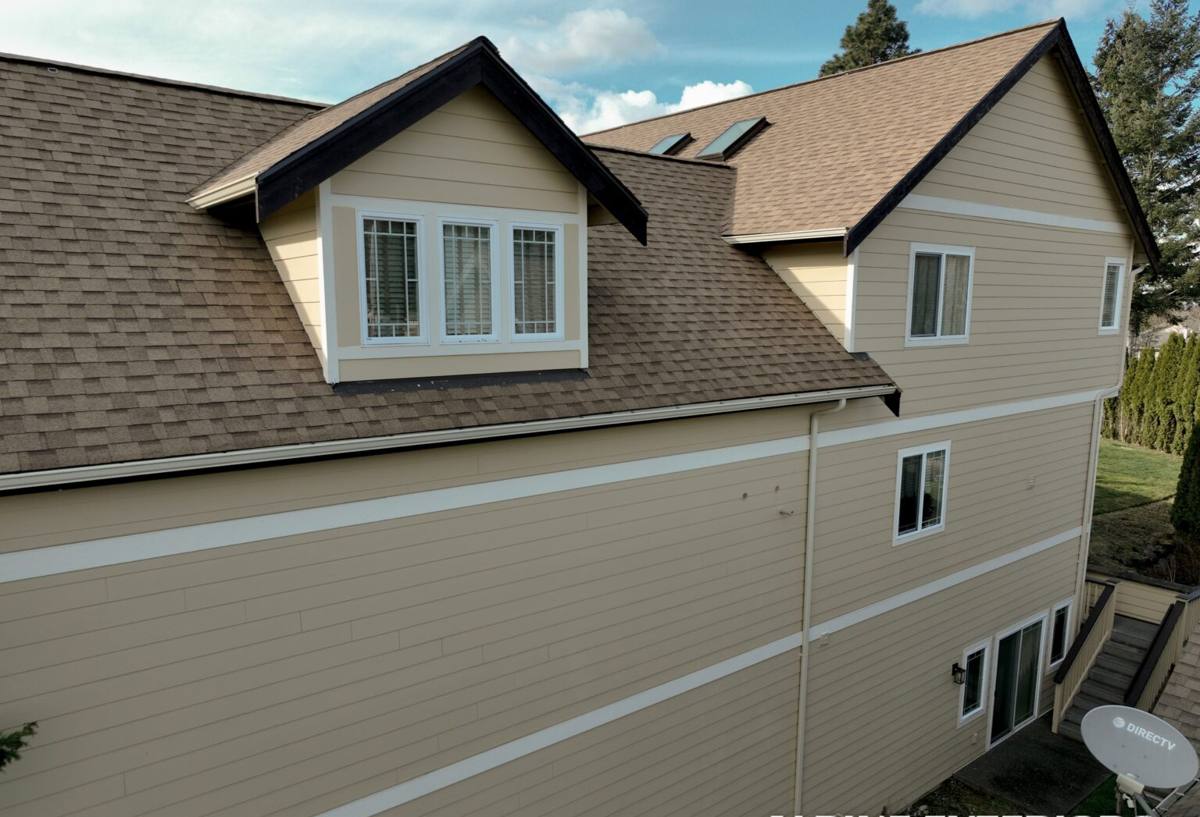
What Acme's Climate Actually Does to a Wall
Moisture that doesn't leave
A lot of Acme-area properties back up to trees, creeks, or open pasture with minimal direct afternoon sun on at least one elevation. That shade is nice for the house in August and brutal for siding the rest of the year — walls stay damp longer, paint film breaks down faster, and any material that swells when wet (or that depends on field-applied paint to stay sealed) starts failing from the inside of the board out.
Driving rain and wind-driven moisture
Storms moving through Whatcom County don't always fall straight down. Wind-driven rain gets pushed sideways into lap joints, trim edges, and butt seams — the exact spots where a siding system either sheds water because it was engineered and installed to do so, or traps it because it wasn't.
Moss, algae, and organic growth
Shaded, damp wall sections in this part of the county grow moss and algae the same way a north-facing roof does. On absorbent or poorly sealed siding, that growth holds moisture directly against the substrate. On a factory-finished, non-absorbent surface, it stays a cosmetic issue you can wash off instead of a structural one.
Why We Only Install James Hardie
James Hardie fiber cement is engineered specifically for problems like these. It's a cement, sand, and cellulose fiber composite — non-combustible, dimensionally stable, and manufactured with a factory-applied ColorPlus finish that's baked on rather than rolled on at the jobsite. For a climate like Acme's, three things matter most:
- It doesn't rot. Fiber cement has no organic wood content to break down when it stays wet for weeks at a time under tree cover.
- The finish is factory-cured, not field-applied. ColorPlus coating goes through a baking process at the plant that field-painted products can't replicate, so it resists fading, chipping, and moisture intrusion at the surface far longer.
- It's built for this specific region. James Hardie engineers products by climate zone, and the HZ5 line used throughout the Pacific Northwest accounts for freeze-thaw cycling and sustained moisture exposure — not just generic weather.
We don't install LP SmartSide, vinyl, Cemplank, Allura, primed spruce, or cedar. Each of those has a legitimate use case somewhere, but for the moisture load and shade conditions typical around Acme, we've made a standard: if it isn't James Hardie, we're not putting our name on the install.
What a Correct Installation Actually Involves
Fiber cement siding is only as good as the water management system behind it. James Hardie's product performance depends entirely on installation details that are easy to shortcut and hard to inspect once the wall is closed up.
Before the siding goes on
- Full inspection and repair of sheathing — any soft or water-damaged sections get replaced, not covered up
- Correctly lapped weather-resistive barrier, sealed at every seam and penetration
- Proper flashing at windows, doors, and roof-to-wall transitions — this is where most siding failures actually start
- A minimum ground clearance and drainage gap so the bottom edge of the siding never sits in standing moisture
During installation
- Correct fastener type, spacing, and penetration depth per James Hardie's published specs — over-driven or under-driven nails void warranty coverage and cause premature failure
- Proper joint treatment at butt seams, with the factory-primed or ColorPlus-finished edges sealed as specified
- Rain-screen or drainage-gap detailing appropriate to the wall assembly, especially on shaded or low-sun elevations
- Trim, corners, and penetrations sealed with the right materials — not generic caulk applied as an afterthought
None of this is exotic. It's James Hardie's own published installation standard. The problem in this industry isn't a lack of good specs — it's crews who skip steps because the wall looks fine on install day and the consequences don't show up for five or ten years.
How We Approach Acme Projects
- On-site assessment. We walk the whole exterior, checking sun exposure by elevation, existing moisture damage, and drainage around the foundation — details that shift the plan for a shaded, tree-lined lot versus an open one.
- Tear-off and substrate check. Old siding comes off and sheathing gets inspected, not just re-covered. This is the point where hidden rot from a previous poor install usually surfaces.
- Weather barrier and flashing. This is the step that determines whether the siding lasts twenty years or leaks in five, and it's the one step a homeowner can't see once the job is finished — so we don't rush it.
- James Hardie installation to spec. Correct fastening, gapping, and joint treatment, following the manufacturer's climate-specific guidelines for the HZ5 zone.
- Final walkthrough. We review the finished work with the homeowner and go over what maintenance — if any — is actually needed going forward.
James Hardie vs. Other Siding Materials
| Material | How It Handles Sustained Moisture & Shade | Finish Durability | Fire Resistance |
|---|---|---|---|
| James Hardie fiber cement | Non-organic, doesn't rot or swell from prolonged dampness | Factory-baked ColorPlus finish, long fade resistance | Non-combustible |
| Vinyl | Won't rot, but can warp, and seams allow moisture behind panels with no rigid drainage path | Color molded in but fades and chalks over time; can't be effectively repainted | Combustible, can deform in heat |
| LP SmartSide (engineered wood) | Treated wood strand product — performs reasonably when perfectly maintained, but wood-based core is vulnerable if the finish or caulking fails | Field or factory finish depending on product; edges are a known vulnerability point | Combustible |
| Cedar / primed spruce | Natural wood — absorbs moisture, prone to rot and pest issues in prolonged damp shade | Requires regular repainting or restaining; finish life is the shortest of the group | Combustible |
This isn't a knock on every homeowner who has one of these products on their house today — plenty perform fine in the right conditions with diligent upkeep. It's why, for the moisture load and shade patterns typical around Acme, we standardized on the one material that needs the least from the homeowner to keep performing.
What Drives Cost on an Acme Project
| Factor | Why It Matters |
|---|---|
| Home size and wall complexity | More corners, dormers, and trim details mean more cutting, flashing, and labor time |
| Siding profile chosen | Lap siding, shingle-style panels, and board-and-batten all have different material and labor costs |
| Existing substrate condition | Rot repair or sheathing replacement found during tear-off adds time before new siding can go on |
| Site access | Rural lots with longer driveways, slopes, or limited staging area can affect crew logistics |
| Trim and accessory work | Window trim, corner boards, and fascia work are often bundled with a siding project |
We don't quote a number without seeing the house — every Acme property is different, and giving a figure before an on-site look would just be a guess. What we can say honestly is that a correctly installed James Hardie system costs more upfront than vinyl and is competitive with a properly finished wood or engineered-wood job, once you account for the repainting and maintenance those materials require over time.
Why a Crew That Already Works Acme Matters
Acme isn't downtown Lynden. Rural lots, longer driveways, septic systems and wells to work around, and tree-heavy properties all change how a siding job gets staged and scheduled. A crew that's already worked this part of Whatcom County knows to check drainage patterns around older rural foundations, plan material staging around limited access, and recognize the shade-driven moss and moisture patterns specific to wooded lots before they become bigger problems during tear-off. That local familiarity isn't a sales pitch — it's fewer surprises mid-project and a more accurate assessment before the first board comes off the wall.
Simple Maintenance Once James Hardie Is Installed
Fiber cement is genuinely low-maintenance compared to wood or vinyl, but "low" doesn't mean "none." A short annual routine keeps it performing as designed:
- Rinse siding annually, focusing on shaded, moss-prone elevations
- Keep gutters clear so overflow doesn't run down the wall face
- Trim back branches and vegetation touching the siding to reduce trapped moisture and shade
- Inspect caulking at trim and penetrations every year or two and re-seal if it's cracking
- Address any impact damage promptly rather than letting it sit exposed
If your Acme-area home is due for new siding, or you're dealing with an older product that's struggling with the moss and moisture this area is known for, we're happy to take a look and give you a straightforward, no-pressure estimate — just fill out the form below.