 Lynden Siding
 Asphalt Shingle Roofing Built for Maple Falls
Maple Falls sits up in the foothills of Whatcom County, on the way toward Mount Baker, and it's a different roofing environment than the flatter, more open parts of the county. Heavy tree cover, higher elevation, and closer proximity to the mountains mean more shade, more standing moisture, and a longer stretch of the year where a roof simply doesn't get the chance to dry out fully between storms. Add in the driving rain and salt-tinged marine air that reaches even the foothill communities off the Salish Sound, and you've got a climate that's genuinely tough on asphalt shingles if the roof underneath them wasn't built with that in mind.
We install and repair asphalt shingle roofs, and Maple Falls is regular territory for us. This page is specifically about that one service in that one area — what the local climate does to a shingle roof out here, what a correct install actually involves, and why it matters to hire a crew that already knows how Maple Falls roofs age instead of one applying a generic approach built for a drier, more sheltered part of the state.
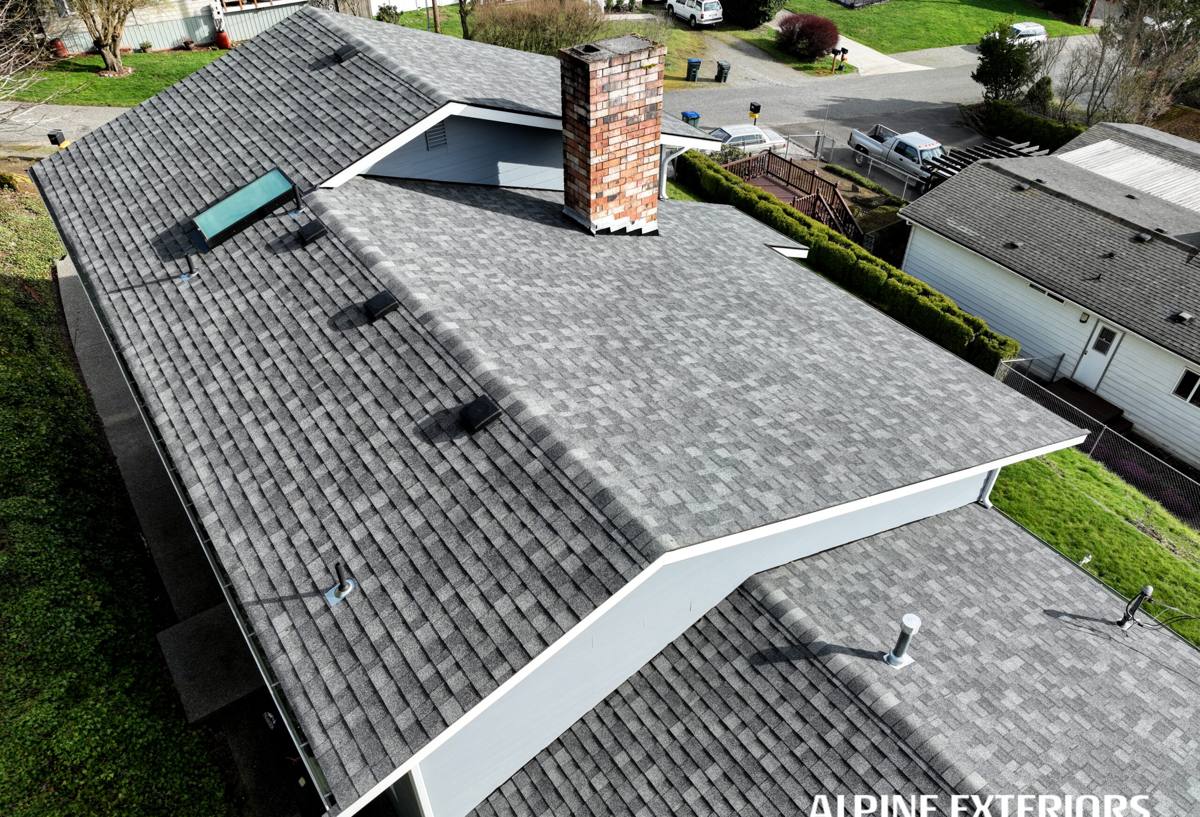
What the Maple Falls Climate Does to a Shingle Roof
Heavy Tree Cover and a Long Moss Season
Maple Falls homes tend to sit closer to timber than houses in the more open, agricultural parts of the county. That tree cover is part of what makes the area what it is, but it also means more shade on the roof, more falling needles and debris collecting in valleys, and a moss and algae season that can run most of the year on north-facing slopes or anywhere the sun doesn't reach directly. Moss does more than look bad on a shingle roof — it holds moisture against the granule surface, works its way under shingle tabs, and over a few seasons can lift edges enough to let water underneath.
Driving Rain and Elevation
Storms moving inland off the Sound gain force as they push up into the foothills, and rain out here often arrives sideways rather than straight down. That wind-driven pattern gets rain into valleys, around chimneys and vent pipes, and under any flashing that isn't lapped correctly. It's a heavier moisture load than the county's average rainfall numbers suggest, and it's exactly where a shingle roof with weak flashing details or aging underlayment starts to leak first — usually well before the shingles themselves look worn out.
Salt Air and Long-Term Wear
Maple Falls isn't a waterfront community, but marine air off the Sound still reaches up through the county's valleys and foothills, carrying a light but steady dose of salt-laden moisture. It's a smaller factor here than it is in our coastal service areas, but it still plays into how fasteners, flashing, and metal roof components hold up over the decades, and it's one more reason a roof built with corrosion-resistant hardware outperforms one that wasn't.
Temperature Swings and Shingle Fatigue
The foothills see a wider daily and seasonal temperature range than lower-elevation parts of the county — cooler nights, occasional frost, and more variation between damp mild stretches and sharp cold snaps. Asphalt shingles that stay saturated more often than they get to fully dry age faster than the same product would in a drier climate, and that expansion-and-contraction cycle is harder on fasteners and seals than most homeowners realize until a roof is a decade in.
Why Asphalt Shingles Still Make Sense in This Climate
Asphalt shingle roofing remains one of the most practical choices for Maple Falls homes, and not because it's the cheapest option on the table. Modern architectural (dimensional) shingles, installed correctly with the right underlayment and ventilation behind them, hold up well against sustained moisture and moss when they're paired with algae-resistant granules and a properly ventilated attic. The trade-off with any asphalt shingle roof is that the product is only as good as what's underneath it — the underlayment, the flashing, and the airflow all matter as much as the shingle brand printed on the wrapper.
We steer most Maple Falls homeowners toward algae-resistant architectural shingles rather than basic three-tab product. The upfront cost difference is usually modest relative to the total job, and the added wind rating, thicker profile, and copper- or zinc-infused granules that resist algae growth make a real difference in a climate with this much shade and standing moisture. That's a professional recommendation based on what we see holding up out here over time, not a push toward the most expensive line on a price sheet.
Choosing a Shingle for a Maple Falls Roof
| Shingle Type | Moss & Moisture Behavior | Wind Rating | Realistic Lifespan Here |
|---|---|---|---|
| Three-tab asphalt | Thinner profile; algae and moss take hold faster without treated granules | Lower; edges more prone to lifting in gusts | 15-20 years |
| Architectural (dimensional) asphalt | Good with algae-resistant granules and proper attic ventilation | Higher, laminated construction resists uplift better | 25-30 years |
| Premium/designer asphalt | Heaviest asphalt option; strong moss and algae resistance | Highest asphalt-tier rating | 30+ years |
| Standing seam metal (for comparison) | Sheds moss and water best due to smooth surface | Very high | 40-60 years |
Metal is worth a mention because we get asked about it often, especially from homeowners planning to stay in their Maple Falls home long-term. It outperforms asphalt on lifespan and moss resistance, but it comes at a meaningfully higher upfront cost and a different look. For most Maple Falls roofs, a well-installed architectural asphalt shingle is a solid, honest middle ground — and it's the product we spend most of our time installing out here for exactly that reason.
What a Correct Asphalt Shingle Install Involves
Most shingle roof failures we get called out to repair in this part of the county don't start with bad shingles. They start with shortcuts underneath the shingles that don't show up as a problem until years later, once moisture has already found its way into the roof deck. On every Maple Falls job, that means:
- Underlayment rated for sustained moisture, not a bare minimum-code product, given how long roof surfaces stay damp under tree cover out here
- Ice-and-water shield at eaves, valleys, and around penetrations, where water and debris naturally collect in a shaded, foothill setting
- Properly lapped and sealed flashing at every valley, chimney, vent pipe, and roof-to-wall transition, since that's where wind-driven rain finds its way in first
- Balanced attic and roof deck ventilation that lets moisture escape instead of getting trapped under the shingles from below
- Corrosion-resistant fasteners and metal components, accounting for the salt-tinged marine air that still reaches this part of the county
- Correct nailing pattern and shingle exposure per manufacturer spec, which is what the wind rating on the shingle package actually depends on
None of this adds much to the overall cost of a job relative to the shingles themselves. Skipping it is what turns a twenty-five-year roof into a fifteen-year roof, and it's usually invisible from the ground until the first leak shows up on an interior ceiling.
Our Process for a Maple Falls Roofing Project
Inspection and Honest Assessment
We start with a walk of the roof, not just a look from the driveway. That means checking shingle condition slope by slope, looking at flashing around every penetration, checking the attic for ventilation and any signs of moisture, and noting how much shade and debris buildup each section of the roof deals with. Two houses on the same road in Maple Falls can need very different scopes once we're actually up there, especially depending on tree cover and roof orientation.
A Straightforward Scope and Estimate
Once we know what the roof actually needs, we walk you through it in plain terms — what's a repair, what genuinely needs replacement, and why. We'd rather explain the real trade-offs than push toward whichever option is more profitable for us.
Tear-Off and Deck Inspection
On a full replacement, removing the old shingles is also when we get our clearest look at the roof deck itself. Soft spots, prior water damage, or inadequate ventilation often only become visible once the old roofing is off, and we'll flag anything we find before moving forward rather than covering it up with new shingles.
Installation to Manufacturer Spec
Underlayment, ice-and-water shield, flashing, and shingles go on in that order, following the manufacturer's published installation spec rather than a shortcut version of it. That's what keeps the shingle's wind and weather rating — and its warranty — intact.
Final Walkthrough
We finish with a walkthrough so you can see the completed work and ask questions before we consider the job done, not after an invoice has already gone out.
Repair or Replace? How We Help You Decide
Not every roofing problem on a Maple Falls home calls for full replacement, and we don't default to recommending one. We look at the age of the existing roof, how much of the surface is affected, whether the deck underneath has moisture damage, and how many prior repairs it's already had. A localized leak on a roof that's otherwise sound and reasonably young is usually a straightforward repair. A roof nearing the end of its rated life, with moss-related damage spread across multiple slopes or a deck showing soft spots from long-term moisture, is more honestly addressed with a replacement rather than another round of patchwork that won't hold through the next wet season.
Signs a Maple Falls Roof Needs Attention
- Moss buildup in valleys or shaded slopes that comes back quickly after cleaning
- Granules collecting in gutters or at the base of downspouts
- Curling, cupping, or missing shingles, especially after a windstorm
- Water staining on interior ceilings near exterior walls, chimneys, or skylights
- Daylight visible through the roof deck when viewed from inside the attic
- Sagging in the roofline or soft spots when walked on
- Flashing that looks lifted, rusted, or missing sealant
- Heavier-than-usual needle and debris buildup that never fully clears between rains
Any one of these is worth a professional look. Caught early, most are a repair. Left through another wet season under Maple Falls' tree cover, several of them turn into a full tear-off.
Timing a Roofing Project Around Maple Falls Weather
The wettest, windiest stretch of the year in the foothills typically runs from late fall through winter, and elevation tends to stretch that window a little longer here than it does closer to the valley floor. Spring and summer generally offer the driest, most stable conditions for a shingle install, since underlayment and shingles both perform better going down on a dry deck rather than between storm systems. That said, an active leak or a roof already shedding granules and shingles doesn't wait for good weather — it's worth addressing on its own timeline rather than holding out for the ideal season and risking more deck damage in the meantime.
Why a Crew That Already Works Maple Falls Matters
A roofing crew that works this part of the county regularly knows how tree cover, elevation, and driving rain actually behave on real Maple Falls houses over a full year — not just how a shingle performs on a manufacturer's spec sheet. That local familiarity shows up in the details on install day: which slopes need extra ice-and-water shield because of how long they stay shaded, where ventilation needs adjusting because of a tight attic or added insulation, and which flashing details are worth the extra time so you're not dealing with a callback two winters later. Maple Falls isn't identical to the more open, lower-elevation parts of Whatcom County, and a crew that understands the difference builds accordingly instead of applying a one-size-fits-all approach to every roof on the schedule.
If your Maple Falls home needs a roof inspection, a repair, or you're weighing a full asphalt shingle replacement, we're glad to take a look and give you a straightforward, honest read on what it actually needs. Reach out using the form below to schedule a free, no-pressure estimate.