 Lynden Siding
 Why Laurel Homes Need More From Their Siding
Laurel sits in the part of Whatcom County where weather doesn't do subtle. Homes here take a steady diet of driving rain, damp marine air that carries salt inland, and long gray stretches where moisture just sits against exterior walls instead of drying off. Add in the shade from mature trees on a lot of Laurel and Lynden properties, and you get a textbook moss season that can run most of the year on a north-facing wall.
Siding in this environment isn't just a look. It's a barrier that has to shed water, resist the organic growth that thrives in constant dampness, and hold its finish through repeated wet-dry cycles without cupping, swelling, or rotting at the edges. Wood-based and wood-adjacent products struggle here in specific, predictable ways. That's the backdrop for every recommendation on this page.
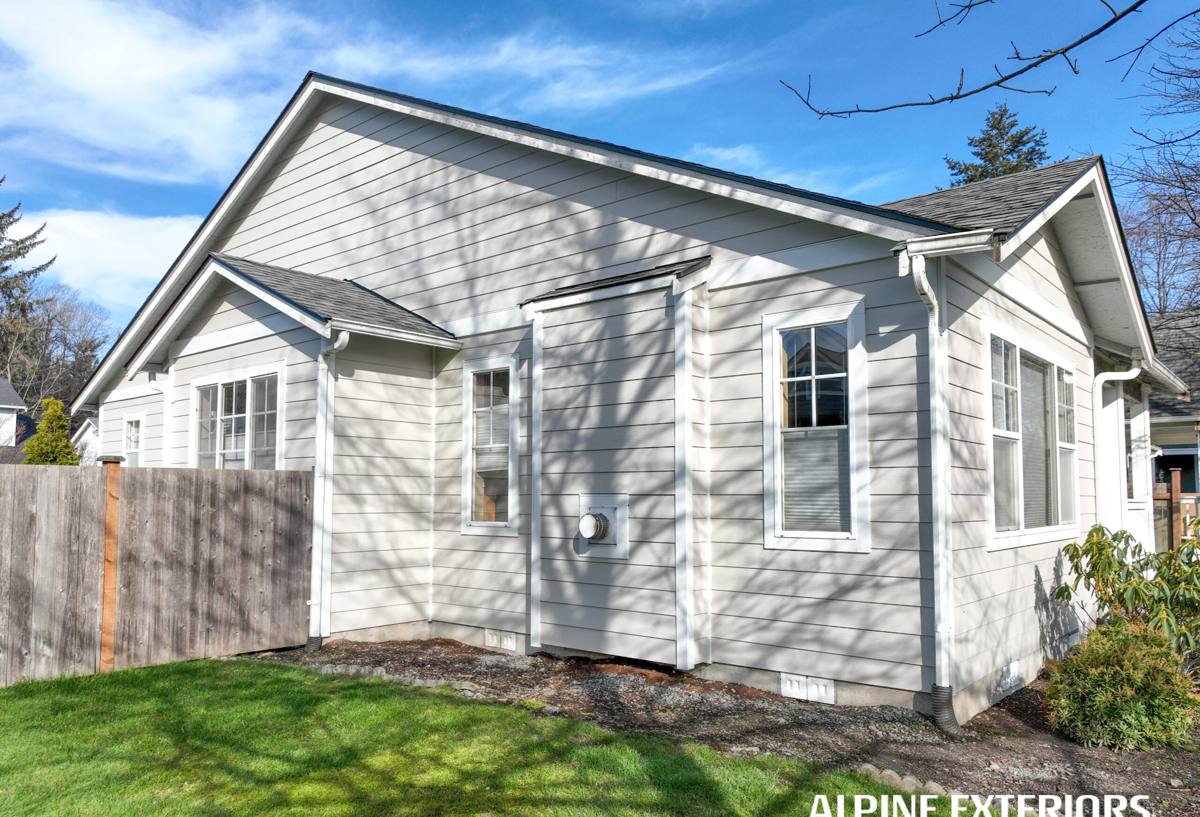
What We Install — And Why We Don't Install Anything Else
We install James Hardie fiber cement siding exclusively. We don't offer LP SmartSide, vinyl, Cemplank, Allura, primed spruce, or cedar as alternatives, and that's a deliberate standard, not a supply limitation. Each of those products has real strengths, but they also carry moisture-management or maintenance trade-offs that don't hold up well against the specific combination of salt air, driving rain, and moss pressure a Laurel property deals with year-round.
James Hardie fiber cement is cement, sand, and cellulose fiber. It doesn't absorb water the way wood-based products do, it won't feed moss and mildew growth the way organic building materials can, and it carries a factory-applied ColorPlus finish that's baked on and warranted rather than field-painted. For our climate, that combination of dimensional stability and finish durability is what actually keeps a house looking good ten and twenty years out — not just on install day.
The Right Hardie Product for This Climate
James Hardie makes climate-engineered product lines, and the HZ5 formulation is built for regions like ours — cold, wet, and humid for long stretches of the year. It's engineered to resist moisture intrusion and cracking in freeze-thaw and high-humidity conditions better than a generic, one-size-fits-all fiber cement product would. On a Laurel job, we spec HZ5 as the baseline, then choose the board profile based on the home's style and exposure.
| Product Line | Best Use | Why It Fits Laurel |
|---|---|---|
| HardiePlank lap siding | Most home styles, primary wall coverage | Traditional profile, sheds water well when lapped and flashed correctly |
| HardieShingle | Accent gables, Craftsman and cottage styles | Textured look without the moisture absorption of real wood shingles |
| HardiePanel | Modern facades, board-and-batten accents | Clean vertical lines, works well paired with trim on shaded elevations |
| HardieTrim | Corners, fascia, window and door surrounds | Won't rot or wick moisture at the joints where wood trim typically fails first |
Color and Finish
ColorPlus finishes come factory-cured, which matters more here than in a drier climate. A field-applied paint job has to fully cure before it faces weather, and in a place where dry stretches are short, that window can close before the paint is ready. Factory finishing removes that risk entirely and comes backed by its own finish warranty separate from the substrate warranty.
What a Correct Installation Actually Involves
Fiber cement siding is only as good as the installation behind it. Most of the problems we get called out to look at on older homes in this area trace back to installation shortcuts, not the siding material itself. A correct job on a Laurel home includes:
- A weather-resistive barrier installed and lapped correctly before any siding goes up, with all penetrations sealed
- Rainscreen or proper drainage gap where the wall assembly calls for it, so water that gets behind the siding can actually drain and dry
- Correct clearances at grade, decks, and roof lines — Hardie's own installation instructions specify minimum gaps, and skipping them is the single most common cause of premature failure we see
- Flashing at every window, door, and horizontal trim transition, installed to shed water down and out, not into the wall cavity
- Hardie-approved fasteners driven at the correct depth and spacing — overdriven or underdriven nails are a common, avoidable defect
- Factory-cut edges sealed on site, since any exposed raw edge is a moisture entry point
- Caulking only where Hardie's specifications call for it — over-caulking traps moisture just as badly as gaps do
None of this is exotic. It's a checklist, and it's the same checklist whether the home is on a busy street in Lynden or a quiet stretch out toward Laurel. The difference between a siding job that lasts thirty years and one that needs partial replacement in ten usually comes down to whether that checklist was actually followed.
Common Problems We Find on Existing Siding in This Area
When we're called out to look at siding trouble on homes in and around Laurel, a few patterns show up repeatedly.
Moss and mildew staining on shaded walls
North-facing and tree-shaded elevations hold moisture longer, and any siding material with an organic component gives moss something to grip and feed on. Fiber cement doesn't eliminate the need to keep gutters clean and vegetation trimmed back, but it removes the food source that lets moss establish itself in the material rather than just sitting on the surface.
Soft or swelling siding near grade and decks
This is almost always a clearance problem — siding installed too close to soil, a deck surface, or a roofline where splash-back and standing moisture get constant contact with the bottom edge of the board. It's one of the most common and most preventable defects we find, and it's usually invisible until the damage is already done underneath.
Peeling or chalking paint on field-painted siding
Homes with field-applied paint over wood or older fiber cement often need repainting on a cycle far shorter than what a ColorPlus factory finish is warranted for. In a climate with a short paint-curing window, field finishes tend to fail from the inside out — moisture gets under the film before it's fully cured or as it ages.
Our Process for a Laurel Siding Project
We keep the process straightforward and the same for every home, because consistency is what prevents the shortcuts described above.
- On-site assessment. We look at wall assemblies, existing moisture damage, roofline and grade clearances, and shade exposure specific to the property before quoting anything.
- Scope and product selection. We confirm HZ5 as the baseline and select board profiles and colors based on the home's style and which elevations take the worst weather.
- Tear-off and substrate check. Old siding comes off and we inspect sheathing underneath for rot or moisture damage before anything new goes up — this is where problems from a prior installation usually surface.
- Weather barrier and drainage plan. House wrap, flashing, and drainage gap go in per manufacturer spec, not shortcuts.
- Installation to spec. Fastening, clearance, and joint work follow Hardie's published requirements — the stage that determines whether the job lasts.
- Final walk-through. We review the finished work with the homeowner and confirm clearances, caulking, and trim details before calling the job done.
Cost Factors on a Laurel Project
Every home is different, so we quote after a site visit rather than off a phone estimate. That said, a few factors consistently move the number up or down on jobs in this area.
| Factor | Effect on Cost |
|---|---|
| Extent of substrate repair needed under old siding | Moisture or rot damage found during tear-off adds labor and material before new siding can go up |
| Board profile mix (lap vs. shingle vs. panel accents) | Multiple profiles and trim details add labor time versus a single lap-siding elevation |
| Home height and roofline complexity | Steep pitches, multiple stories, and cut-up rooflines increase access and flashing work |
| Color and finish selection | Standard ColorPlus color range is priced differently than premium or custom-match finishes |
| Shaded or moisture-prone elevations | May call for added drainage detailing, which adds labor but reduces long-term moss and moisture issues |
Why Hiring a Crew That Already Works in Laurel Matters
Siding is a local trade in a way a lot of homeowners don't expect until something goes wrong. A crew that already works Laurel and the surrounding Lynden area knows which elevations and lot orientations take the worst weather, understands the permitting and inspection expectations for Whatcom County, and has already worked out the clearance and drainage details this specific climate demands — not a generic national spec sheet.
That local familiarity shows up in small decisions that add up: where to add extra flashing attention, which wall assemblies need a drainage gap versus which don't, and how aggressive to be about clearance issues at grade before they become moisture problems. It also means a crew that's accountable in the same community it works in — not a traveling outfit that's hard to reach if a warranty question comes up two years later.
What to Ask Before You Hire
Whoever you choose for a siding project in this area, a few questions will tell you a lot about whether the crew understands what this climate demands:
- Are you installing to James Hardie's published fastening, clearance, and flashing specifications, or a generic approach?
- Will you inspect the sheathing underneath before installing new siding, and what happens if you find moisture damage?
- What clearance will you maintain at grade, decks, and roof transitions?
- Is the product line you're specifying rated for this region's humidity and freeze-thaw conditions?
- Who handles a warranty claim, and how long have you done this work in this specific area?
If you're weighing a siding replacement or repair on a Laurel property, we're happy to walk the exterior with you, point out what we see, and put together a straightforward, no-pressure estimate. There's a form below — reach out and we'll get a look scheduled.