 Lynden Siding
 Ferndale's Climate Is Harder on Decking Than It Looks
Ferndale sits close enough to the water that homes here deal with a different mix of weather than you'll find further inland. Salt-laden marine air, long stretches of driving rain off the Strait, and a moss season that can run from October well into spring all put real stress on an outdoor deck. A lot of that damage happens slowly, underneath the surface, long before a homeowner notices anything wrong on top.
Composite decking was designed to handle exactly this kind of exposure better than wood, but only when it's installed correctly for the site. A composite deck built the same way you'd build one in a dry inland climate will still fail early here — not because the material is wrong, but because the build didn't account for what Whatcom County weather actually does to a structure over years, not months.
Salt Air and Marine Moisture
Airborne salt doesn't just affect metal fasteners and hardware near the coast — it also accelerates corrosion on anything that isn't rated for it, and it settles into porous surfaces where it holds moisture longer than it would inland. Over time, this shows up as premature rust on screws, brackets, and railing hardware, and as a grimy film on decking surfaces that traps moisture against the board.
Driving Rain and Standing Water
Rain here rarely falls straight down. Wind-driven rain gets pushed sideways into railing posts, ledger connections, and any gap where water can collect instead of shed. A deck built without enough slope, or with fasteners that trap water at the joint, will hold moisture in exactly the spots where rot and hardware failure start.
The Long Moss Season
Whatcom County's wet, mild fall-through-spring stretch is ideal moss and algae weather. Shaded decks, north-facing decks, and decks with poor airflow underneath stay damp for days at a time, which is all moss needs to take hold. On composite boards, moss and algae growth is mostly a maintenance issue rather than a structural one — but on the substructure and any wood components underneath, sustained dampness is a real problem.
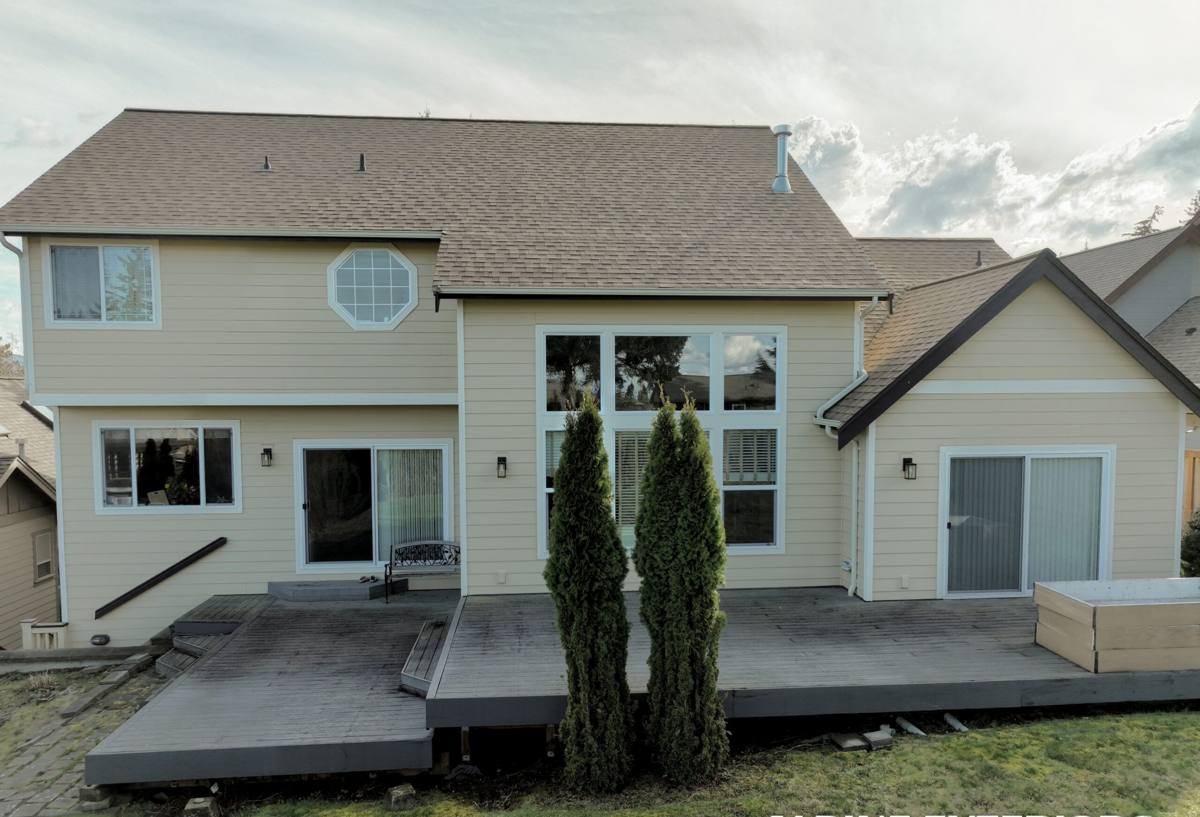
What a Correct Composite Deck Build Requires Here
Composite decking itself resists rot, but a deck is a system — framing, fasteners, flashing, and drainage all have to work together. Cutting corners on any of those pieces will undercut the durability that composite decking is supposed to provide.
Substructure and Ledger Attachment
The framing underneath a composite deck still needs to be protected from moisture, even though the decking boards themselves won't rot. That means proper flashing where the deck ledger attaches to the house, joist tape or flashing tape on top of framing members, and hardware rated for exterior and coastal-adjacent use. This is the part of the job that's invisible once the deck is finished, and it's also the part that determines whether the deck is still solid in fifteen years.
Drainage and Airflow Under the Deck
Standing water and stagnant, damp air underneath a deck are what drive moss growth and slow rot in the framing. A correct build accounts for grading underneath the deck so water has somewhere to go, keeps the underside ventilated rather than sealed off, and avoids low spots where debris and moisture collect against structural members.
Fastening and Board Spacing for Wet-Dry Cycling
Composite boards expand and contract with temperature and moisture, more so through Whatcom County's wet-to-dry seasonal swings than in a drier climate. Gapping and fastening need to be set for that movement, not just for how the deck looks on installation day. Get this wrong and boards can buckle, gap unevenly, or put stress on fastener points over a few seasons.
Composite vs. Other Decking Materials in This Climate
Homeowners in Ferndale usually narrow it down to a few options. Here's how they generally compare for this specific climate — heavy moisture exposure, salt air, and a long moss season.
| Material | Moisture & Rot Resistance | Moss/Algae Resistance | Maintenance | Typical Lifespan |
|---|---|---|---|---|
| Pressure-treated wood | Good if maintained, vulnerable if not | Low — porous surface holds moisture | Annual sealing/staining recommended | 10–15 years before major repair |
| Cedar | Naturally decent, degrades with age | Low to moderate | Regular sealing to keep resistance | 15–20 years with upkeep |
| Uncapped composite | Good — won't rot | Moderate — surface can still stain | Periodic cleaning | 20–25 years |
| Capped composite | Very good — sealed outer layer | Good — easier to clean, resists staining | Occasional rinsing/cleaning | 25–30+ years |
In a climate with this much sustained moisture, the deciding factor usually isn't upfront cost — it's how much ongoing maintenance a homeowner actually wants to keep up with, and how the material holds up to repeated wet-dry cycling without warping or opening up seams.
Choosing the Right Composite Board
Not all composite decking is built the same way, and the differences matter more in a wet, salt-exposed climate than they would somewhere drier.
Capped vs. Uncapped
Capped composite boards have a protective polymer shell wrapped around a wood-plastic core. That cap is what keeps moisture, salt residue, and UV out of the core material, and it's what makes the board easier to clean when moss or algae does start to grow. Uncapped composite is more exposed to staining and surface moisture absorption over time. For a Ferndale project, capped boards are generally the more sensible long-term choice given the moisture load the deck will see.
Color and Surface Texture
Darker composite boards absorb more heat, which can help boards dry faster after rain, but they also show pollen, dust, and salt film more readily. Lighter and mid-tone colors with a textured, grooved surface tend to hide surface residue better and provide more slip resistance when the deck is damp — a real consideration given how often decks here are wet.
Hardware and Fasteners
The board is only as good as what's holding it down. Stainless steel or coated fasteners rated for coastal and marine-adjacent exposure resist the corrosion that standard hardware runs into here. This is a small line item on a quote that has an outsized effect on how the deck ages.
Our Installation Process
The steps themselves aren't unusual — what matters is doing each one with this climate in mind rather than treating every deck the same regardless of where it sits.
- On-site assessment of the deck's exposure — sun, shade, wind direction, and drainage path — before design decisions are made.
- Framing and ledger work with proper flashing and hardware rated for sustained moisture and salt exposure.
- Grading and airflow planning underneath the deck to keep the substructure dry between rain events.
- Board installation with fastening and gapping set for seasonal expansion and contraction.
- Railing, stairs, and trim details finished with hardware that matches the durability of the decking itself.
- Final walkthrough covering how the specific boards installed should be cleaned and maintained going forward.
Maintenance a Ferndale Composite Deck Actually Needs
Composite decking is lower-maintenance than wood, not maintenance-free. In this climate, a little seasonal attention goes a long way toward keeping the deck looking and performing the way it should.
- Rinse or sweep the deck periodically to keep salt film, pollen, and organic debris from building up on the surface.
- Clean shaded or north-facing sections more often, since they stay damp longer and are more prone to moss and algae.
- Keep gutters and downspouts near the deck clear so runoff isn't dumping extra water onto or under the structure.
- Check railing posts and stair connections once a year for loose hardware or early corrosion.
- Keep planters, rugs, and furniture legs from sitting in one spot too long, since trapped moisture underneath them is a common spot for staining.
- Clear leaves and debris from between boards and off the substructure before the wet season sets in.
Permits, Railings, and Local Code Considerations
Deck height, railing requirements, and guard spacing are governed by building code, and requirements can shift depending on deck height and attachment to the home. Composite decking doesn't change these requirements, but it does affect railing hardware choices, since railing posts and connections need to handle the same moisture and salt exposure as the decking itself. We handle the permitting and inspection process as part of the build, so homeowners aren't left figuring out requirements on their own.
Why a Crew That Already Works Ferndale Matters
A deck built by a crew that hasn't worked this specific stretch of Whatcom County coastline tends to make the same mistakes: standard fastener specs instead of corrosion-resistant hardware, drainage details sized for a drier climate, and gapping set without accounting for how much these boards actually move here through the wet season. None of those mistakes show up on installation day — they show up two or three years later.
Working in and around Ferndale regularly means knowing which sides of a property catch the worst wind-driven rain, which yards stay shaded long enough to grow moss fast, and which details actually matter for a deck that's going to sit through Whatcom County winters for the next two decades. That's the difference between a deck that looks right at handoff and one that's still solid well after the crew has moved on to the next job.
If you're considering a composite deck for your Ferndale home, we're happy to walk the site, talk through what your specific yard and exposure call for, and give you a straightforward, no-pressure estimate. There's a form below to get started.