 Lynden Siding
 Siding Repair Built for Custer's Coastal Climate
Custer sits in one of the harder-working climate zones in Whatcom County. It's close enough to the water to catch salt-laden air off the Strait of Georgia and Birch Bay, open enough to take driving, wind-pushed rain straight into wall assemblies, and shaded and damp enough in the wet months to grow moss on siding faster than most homeowners expect. None of that is unusual for this part of Washington — but it does mean siding here fails in specific, predictable ways, and a repair that doesn't account for those ways tends to fail again within a year or two.
We repair siding in Custer regularly, and the calls we get are rarely random. They cluster around the same handful of causes: fasteners and trim corroding faster than the siding field itself, moisture working into laps and seams during sideways rain, and moss holding water against the surface long enough to soften what's underneath. Understanding those patterns is the difference between a repair that lasts and one that's really just a patch.
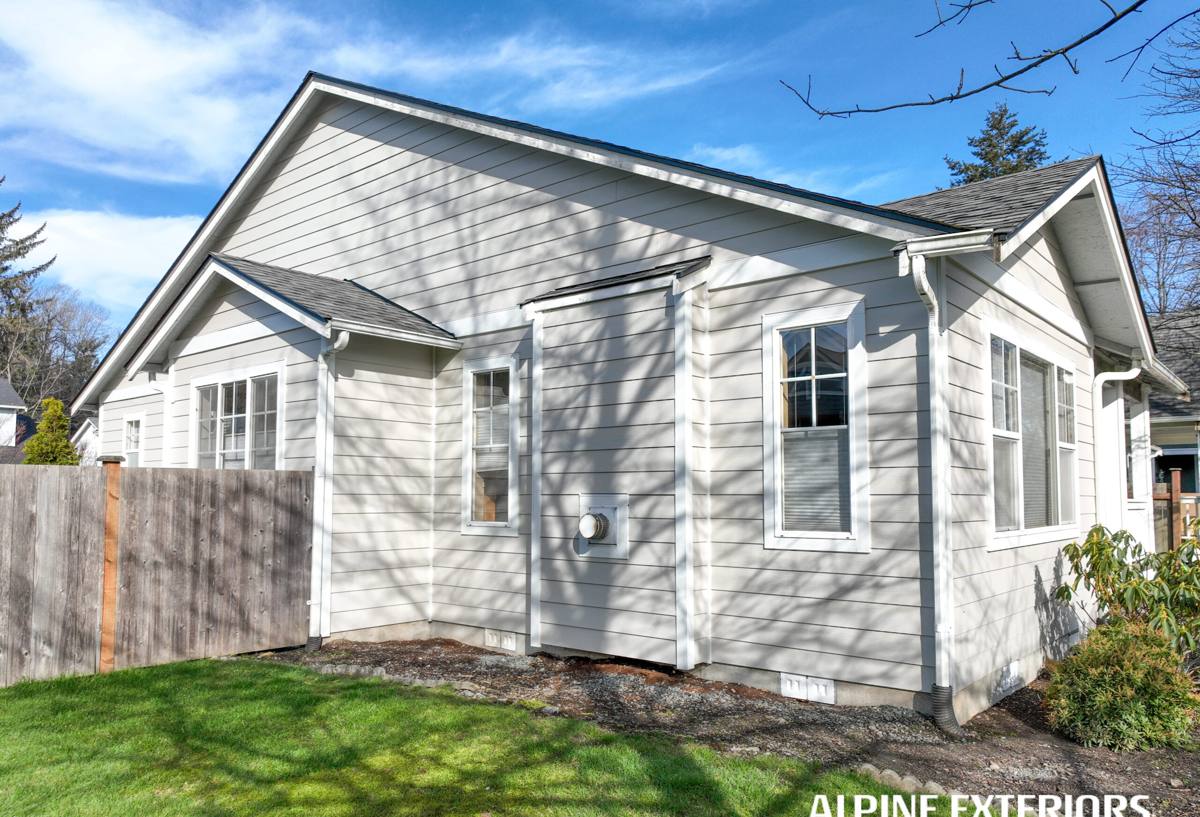
Why Salt Air, Driving Rain, and Moss Change the Repair Approach
Salt Air and Corrosion
Airborne salt accelerates corrosion on anything metal — nails, staples, flashing, trim fasteners. On a lot of siding systems, the fasteners fail before the siding material does. If a repair only addresses the visible crack or gap and reuses corroded fasteners or damaged flashing underneath, the same failure shows up again in a season or two, often worse than before.
Driving Rain and Wind-Loaded Walls
Custer doesn't just get rain — it gets rain pushed sideways by wind coming off open, exposed terrain near the coast. That kind of weather finds every gap in a lap joint, every under-caulked seam, and every spot where siding wasn't held to proper clearances. Water that gets behind the cladding doesn't dry out quickly in our climate, which is how a small entry point turns into rot, sheathing damage, or mold you can't see until it's already spread.
Moss Season
Shaded, north-facing, and tree-adjacent walls in this area hold moisture long after a storm has passed. Moss and algae take hold in that dampness, and once established they hold even more water against the siding surface — which is bad news for any material that isn't dimensionally stable when wet. A repair that just power-washes moss off without addressing the underlying moisture retention is a short-term fix at best.
Signs Your Siding Needs Repair
Most siding problems in Custer give warning signs well before they become structural. Here's what we tell homeowners to watch for:
- Soft or spongy spots when you press on the siding, especially near the bottom courses or around windows and doors
- Visible cracking, splitting, or buckling in individual boards or panels
- Rust streaks running down from nail heads or trim fasteners
- Persistent moss, algae, or black staining that keeps coming back after cleaning
- Gaps opening up at seams, corners, or where siding meets trim
- Peeling or bubbling paint, which often signals moisture trapped underneath rather than just a paint failure
- Visible daylight or drafts felt from inside near exterior walls
- Warping or separation where siding meets window and door trim
Catching any of these early is almost always cheaper than waiting. A localized repair addressed promptly is a fraction of the cost of replacing sheathing or framing that's been sitting wet for a year.
What a Correct Siding Repair Actually Involves
A repair that holds up in this climate isn't just about matching the visible siding — it's about what happens underneath it. Our process on a repair typically includes:
Diagnosis Before Demolition
We start by figuring out why the damage happened, not just where it is. A cracked board near a downspout might mean the downspout is the real problem. Rot at a corner might trace back to a caulk joint that failed years ago. Fixing the symptom without finding the cause just buys time.
Checking What's Behind the Siding
Once damaged siding is removed, we look at the water-resistive barrier, flashing, and sheathing underneath. If moisture has gotten past the siding, this is where it shows up — and it's the step that gets skipped in a rushed patch job. Any compromised sheathing or barrier gets addressed before new siding goes back on, not covered over.
Matching Material and Finish
For homes already sided in James Hardie fiber cement, we match the plank profile and ColorPlus finish so the repair blends into the existing wall rather than standing out as an obvious patch. Because ColorPlus is a factory-applied, baked-on finish, matching it correctly matters — a field-painted patch next to factory-finished siding will weather differently over time and eventually look mismatched again.
Fasteners and Flashing Rated for the Exposure
Given how hard salt air is on hardware in this area, we use corrosion-resistant fasteners and properly lapped flashing on every repair, not just on new installs. It costs a little more up front and saves the callback in three years.
Common Repair Situations We See in Custer
| Situation | What's Usually Happening | Typical Fix |
|---|---|---|
| Rust streaking below fasteners | Corroding nails or trim screws, often original to the install | Remove and replace with corrosion-resistant fasteners; touch up finish |
| Soft or crumbling siding near grade | Splash-back moisture and prolonged ground contact | Cut out and replace affected boards; correct clearance from grade |
| Recurring moss on shaded walls | Moisture retention with no drying opportunity | Clean, address any board damage, and improve airflow/drainage where possible |
| Cracking at window and door corners | Failed sealant or flashing letting wind-driven rain in | Remove trim, correct flashing, reseal, reinstall |
| Panel separation at seams | Improper original installation or fastener failure | Re-secure to proper fastening pattern and clearances |
Repair vs. Replacement: How We Decide
Not every problem needs a full re-side, and we don't push replacement when a repair will genuinely hold. We generally recommend repair when damage is localized, the underlying structure is sound, and the rest of the siding is in good condition. We start talking about replacement when damage is widespread, when we find rot or moisture problems in multiple areas, when the siding material itself (not just individual boards) is failing, or when a home has vinyl, LP SmartSide, or wood siding that's reaching the end of its practical life and repeated patching is no longer cost-effective. We'll walk you through what we find and why, so the decision is based on the actual condition of your walls — not a sales target.
Why We Only Repair and Install James Hardie
We standardized on James Hardie fiber cement for a reason that matters even more on repair calls: it's dimensionally stable, non-combustible, and engineered for exactly the wet-and-swing climate this part of Washington has. When we repair Hardie siding, we're working with a material that resists the moisture-driven swelling, softening, and rot that drives most of the repair calls we get on other products. Its HZ5 product line is specifically engineered for climates with sustained moisture exposure, which describes Custer well.
We don't install or patch vinyl, LP SmartSide, Cemplank, Allura, primed spruce, or cedar — not because those products can't perform when installed and maintained well, but because we've made a professional call to specialize in one system we can stand behind fully, from a first install to a repair fifteen years later. If your home currently has one of those materials and it's failing repeatedly, we'll be straight with you about what we're seeing and what your realistic options are, including whether a transition to Hardie makes sense at your next full re-side.
How Our Repair Process Works
- Free on-site inspection — we look at the damage, the cause, and what's behind it
- Straight explanation of what we found, in plain terms, with photos if useful
- A written estimate covering material, labor, and any underlying repairs needed (flashing, sheathing, etc.)
- Scheduled repair work, timed around weather where possible for proper sealant cure
- Final walkthrough so you can see the finished repair before we consider the job done
We don't upsell repairs into replacements, and we don't hide underlying damage to make a bid look smaller. If we open a wall and find something worse than expected, we show it to you before we proceed.
Why a Crew That Already Works This Area Matters
Siding repair in Custer isn't the same job as siding repair in a drier, more inland part of the county. A crew that hasn't worked this specific mix of salt exposure, wind-driven rain, and moss pressure can underestimate what's needed — using standard fasteners where corrosion-resistant ones matter, or missing that a "cosmetic" moss stain is sitting on top of softened material. We work this area regularly enough to recognize the patterns fast, which means a shorter diagnosis, a more accurate estimate, and a repair that's built for the exposure your home actually gets, not a generic one.
If you've got a section of siding that's cracked, staining, gapping, or just doesn't look right, we're happy to take a look. Reach out for a free, no-pressure estimate — we'll tell you honestly what we find and what it'll take to fix it right.