 Lynden Siding
 Siding Installation Built for Bellingham's Climate
Bellingham sits close enough to the water that salt-laden air is a real factor in how exterior materials age, and it sits inside a stretch of Whatcom County that sees long, wet winters with driving rain that comes in sideways off Bellingham Bay and the Strait. Add in a moss season that can run from fall through spring on shaded north- and west-facing walls, and you have a climate that is genuinely harder on siding than most of the country experiences. A siding installation done right in Bellingham has to account for all three of these factors at once, not just keep water out on a calm day.
We install siding across Lynden and the surrounding Whatcom County communities, including Bellingham, and the patterns we see on service calls are consistent: siding that failed here almost always failed at a seam, a fastener, or a transition detail — not across a flat wall field. That's where correct installation earns its keep.
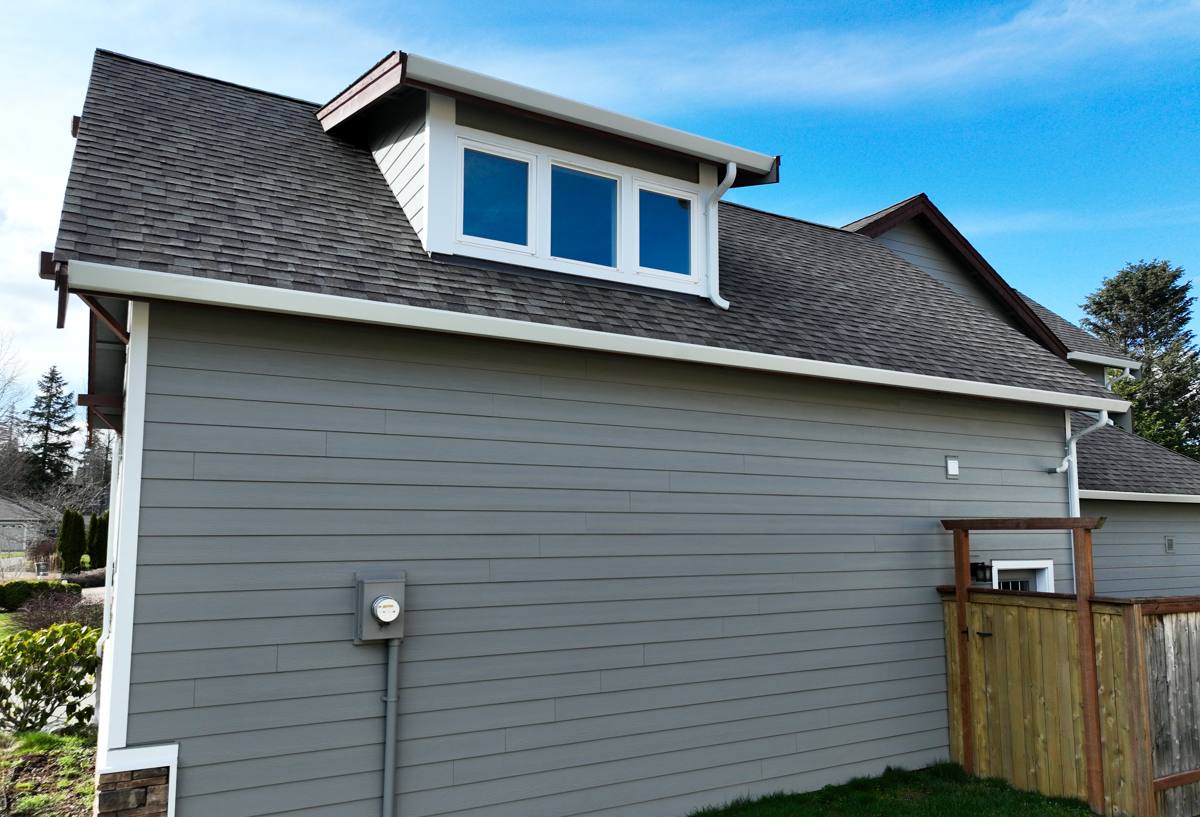
What Bellingham Homes Need From Their Siding
Salt Air and Coastal Exposure
Homes closer to the bay deal with airborne salt that accelerates corrosion on exposed metal fasteners, flashing, and trim hardware. Over years, that corrosion can telegraph through paint and stain siding from the inside out, or weaken fastener holding power at the exact spots where wind uplift matters most. Material choice and fastener choice both need to account for this, not just the finish coat.
Driving, Wind-Driven Rain
Bellingham's rain rarely falls straight down. Wind off the water pushes it laterally into wall assemblies, which means water management depends far more on flashing, lap sequencing, and drainage behind the cladding than on the siding material's face being "waterproof." A siding product can be excellent and still let water in if the installation doesn't give that water somewhere to go.
A Long Moss Season
Shaded, north-facing, and tree-adjacent walls in this area can stay damp for months at a stretch. Moss and algae don't just look bad — sustained organic growth holds moisture against the siding surface and, on the wrong substrate, can accelerate softening, swelling, or coating breakdown over years. Siding that resists this without constant homeowner maintenance is worth paying for.
Why We Install Only James Hardie Fiber Cement
We standardized on James Hardie fiber cement siding for every project we take on, including Bellingham installs, and we don't install vinyl, LP SmartSide, Cemplank, Allura, primed spruce, or cedar. That's not a marketing position — it's a decision based on what actually holds up under this specific climate mix of salt air, sustained wet weather, and heavy shade-driven moss pressure.
- Non-combustible core: fiber cement doesn't feed a fire the way wood-based products can, which matters for insurance conversations as much as safety.
- Engineered for moisture cycling: James Hardie's HZ5 product line is formulated for the freeze-thaw and moisture-cycling conditions typical of the Pacific Northwest, rather than a generic national formulation.
- Factory-applied ColorPlus finish: the color coat is baked on under controlled conditions before the boards ever reach the jobsite, which gives far more consistent, UV- and moisture-resistant coverage than field-applied paint or stain, and it holds up better against the kind of algae and moss growth that plagues shaded Whatcom County walls.
- Dimensionally stable: fiber cement doesn't swell, cup, or split the way engineered wood and solid wood products can when they take on repeated moisture.
- Strong transferable warranty: James Hardie backs its products with a warranty structure that holds up specifically because the material behaves predictably when installed to spec — which is the other half of this equation.
We're not going to tell a homeowner that other products are junk — vinyl, LP SmartSide, and cedar all have legitimate uses and real advantages in the right setting. But for the specific combination of conditions Bellingham throws at a wall assembly — salt exposure, driving rain, and prolonged damp shade — we decided fiber cement done correctly gives homeowners the best long-term outcome, and we'd rather install one product exceptionally well than spread ourselves across five.
What a Correct Siding Installation Involves
The siding material is maybe half the equation. The other half is the installation details that determine whether that material actually performs for 30-plus years instead of 10.
Water-Resistive Barrier and Drainage Plane
Every installation starts with a continuous water-resistive barrier behind the siding, with a drainage gap that lets any water that gets past the cladding find its way back out instead of sitting against the sheathing. In a climate with Bellingham's rain load, skipping or shortcutting this step is the single most common cause of hidden rot we find behind old siding.
Flashing at Every Penetration
Windows, doors, hose bibs, light fixtures, and vents all interrupt the wall plane, and each one needs proper flashing integrated with the water-resistive barrier — not caulk alone. Caulk is a maintenance item; flashing is a permanent detail. Wind-driven rain finds every gap a fair-weather installation leaves behind.
Correct Fastening
James Hardie specifies fastener type, spacing, and placement for a reason — over- or under-driven nails, wrong fastener material, or incorrect spacing all create weak points that show up years later as cracking, popped boards, or corrosion staining, which is a bigger concern this close to salt air.
Proper Clearances
Siding needs clearance from grade, roof lines, decks, and other transitions so it isn't sitting in standing water or trapped moisture. This is a frequent miss on older installs we replace, and it's a major contributor to moss and rot taking hold at the bottom courses first.
Caulking and Sealant Details
Used correctly, sealant at trim and butt joints is a backup to good flashing, not a substitute for it. We use it as intended — as a secondary line of defense, applied at the right joints with the right product.
Our Process for a Bellingham Siding Project
| Stage | What Happens |
|---|---|
| Assessment | We walk the exterior, check existing siding condition, sheathing, and moisture history, and identify shaded or exposed areas that need extra attention. |
| Estimate | You get a clear, written scope and price — no vague allowances that turn into change orders mid-project. |
| Prep and Tear-Off | Old siding and trim come off, sheathing is inspected and repaired as needed before anything new goes up. |
| Water Management Install | Water-resistive barrier, flashing, and drainage details go in first — this is the layer you won't see again once siding is up, so it has to be right. |
| James Hardie Installation | Boards, panels, or shingles installed to manufacturer spec for fastening, spacing, and clearances. |
| Trim and Finish Details | Corners, trim, and sealant details completed for a clean, weather-tight finish. |
| Final Walkthrough | We review the finished work with you before calling the job done. |
Cost Factors for Bellingham Siding Installation
Every home is different, but the same handful of factors drive most of the variation in price:
- Total square footage of exterior wall area
- Number of stories and roofline complexity (steep or cut-up roofs add labor)
- Condition of existing sheathing — hidden rot repair adds cost but shouldn't be skipped
- Amount of trim, corner, and window/door detail work
- James Hardie product line and profile selected (lap siding, shingle-style, or panel systems)
- Tear-off and disposal of existing siding
- Access and site conditions, including tree cover and setback from the water where relevant
We give straightforward written estimates rather than rough phone quotes, because a job priced without seeing the actual wall condition is a guess, not an estimate.
Why Local Installation Experience Matters
A crew that has worked walls in Bellingham and across Whatcom County has already seen how these specific conditions play out over time — which elevations take the worst wind-driven rain, which shaded sides grow moss fastest, and where salt exposure shows up first on hardware. That's not something you get from a national install guide alone; it comes from doing the work here, season after season, and seeing which details actually hold up. We service this area regularly, which means warranty follow-up and future questions don't involve a crew that has to drive in from somewhere else.
Signs Your Bellingham Home May Need New Siding
- Persistent moss or algae growth that returns within months of cleaning
- Soft spots, bubbling, or visible swelling in existing boards or panels
- Paint or finish that's failing faster than expected, especially on shaded walls
- Visible gaps, cracking, or warping at seams and corners
- Rust staining around fasteners or trim hardware
- Rising energy bills that may point to a compromised wall assembly
If you're seeing any of these on a Bellingham-area home, it's worth an inspection before the next wet season adds to the damage.
Get a Free, No-Pressure Estimate
If you're weighing a siding replacement for a Bellingham home, we're happy to take a look, explain what we see, and give you a straightforward written estimate for a James Hardie installation built around this area's salt air, driving rain, and moss exposure — no pressure, no obligation. Use the form below to get started.