 Lynden Siding
 Why Bellingham Decks Wear Out Faster Than the Manual Says
Most deck boards and framing lumber are rated based on general exposure assumptions — a few good soaking rains a year, some sun, some cold. Bellingham doesn't work that way. Between the marine air coming off the water, a rainy season that can stretch for months, and the shaded, moisture-holding conditions that let moss and algae take hold on north-facing and tree-covered decks, a deck here is under near-constant low-grade stress for most of the year. It's not one big event that kills a Bellingham deck. It's the slow accumulation of moisture cycling in and out of wood fibers, fasteners corroding from the inside out, and organic growth holding water against surfaces that were never designed to stay wet this long.
That's the backdrop for every deck replacement we do in this part of Whatcom County. We're not just swapping old boards for new ones — we're building a structure meant to hold up to a specific climate, not a generic one.
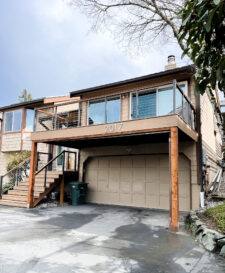
Signs a Bellingham Deck Needs Replacement, Not Repair
Not every tired-looking deck needs a full rebuild. But there are a few signs that tell us repair would just be delaying the inevitable:
- Soft, spongy, or spring-back decking boards — especially near the house or in shaded corners where moss tends to collect
- Visible rust streaking or crumbling around fastener heads and joist hangers
- A ledger board (where the deck attaches to the house) that shows staining, softness, or gaps — this is a structural safety issue, not cosmetic
- Posts that have shifted, footings that have heaved or settled, or a deck that feels different underfoot than it used to
- Persistent moss or algae growth that keeps coming back no matter how often it's cleaned
- A railing system that no longer meets current safety spacing or height requirements
If the framing is sound and it's really just the decking surface that's failed, a resurfacing job can make sense. But once moisture has gotten into the structural members — joists, beams, posts, or the ledger — patching the surface just hides the problem under new boards for a year or two.
The Part Homeowners Usually Don't See: The Ledger Connection
The ledger board — the piece that bolts the deck to your house — is the single most common point of failure on older decks in this region, and it's almost always hidden behind the decking and rim joist where you can't see it. Whatcom County's driving rain gets pushed sideways by wind more than people expect, and if that ledger wasn't properly flashed when the deck was built, water has been working its way behind it for years. We check this on every replacement, because a deck that looks fine on top can still be failing where it meets the house.
What a Correct Deck Replacement Involves Here
A deck rebuild done right for this climate isn't just decking material choice — it's a system, from the ground up.
Footings and Framing
We check footing depth and condition first. Whatcom County's freeze-thaw cycles are mild compared to inland climates, but repeated saturation and drying still stresses concrete and undersized footings over the years. Framing lumber gets upgraded to pressure-treated stock rated for ground contact where it's near soil or moisture, with joist hangers and structural connectors in corrosion-resistant coatings suited to a marine-influenced, high-moisture environment — standard galvanized hardware corrodes faster here than it does further inland.
Ledger Flashing
This is where most deck failures start, so it's where we spend the most care. Proper flashing directs water away from the house band board instead of letting it collect behind the ledger. It's not a step that shows up in the finished look of the deck, but it's the difference between a deck that lasts and one that rots from the inside out again in ten years.
Decking Material
Composite, PVC, and quality treated wood all have a place depending on budget and how the deck will be used. What we steer homeowners away from is decking that traps moisture against the framing or requires maintenance schedules that are unrealistic given how often this area actually gets sun to dry things out. We'll walk through the honest trade-offs — upfront cost, maintenance, appearance, and how each material actually behaves in sustained damp shade — rather than just pushing whatever has the widest margin.
Drainage and Airflow Underneath
A deck built low to the ground, over a shaded yard, with poor airflow underneath is a moss and rot factory. Where the site allows it, we build in ventilation gaps and grade the ground beneath the deck to shed water instead of holding it — a small design decision during framing that has an outsized effect on how long the structure lasts.
Comparing Decking Materials for This Climate
| Material | Moisture Behavior in Shade/Rain | Maintenance | Typical Lifespan Here |
|---|---|---|---|
| Pressure-treated wood | Absorbs and releases moisture; needs to dry out between rains | Annual cleaning/sealing recommended, especially in shaded areas | 10-15 years with upkeep |
| Cedar | Naturally moisture-resistant but still needs airflow to stay dry | Periodic staining/sealing to maintain appearance and protection | 15-20 years with upkeep |
| Composite decking | Doesn't absorb water into the board itself; surface can still hold moss/algae if shaded | Periodic washing to prevent surface growth; no sealing/staining | 25-30+ years |
| PVC/capped polymer | Fully moisture-resistant surface; least affected by standing dampness | Occasional washing | 25-30+ years |
Lifespan figures are general ranges, not guarantees — actual performance depends on sun exposure, grading, airflow underneath the deck, and how consistently a homeowner keeps up with basic cleaning.
Our Deck Replacement Process
- On-site evaluation. We inspect the existing deck, ledger connection, footings, and framing to determine what's actually driving the failure — not just what's visible on the surface.
- Honest scope and material discussion. We walk through material options and what they mean for cost, maintenance, and how the deck will hold up given its sun/shade exposure and orientation to weather.
- Written estimate. Clear scope, materials, and cost before any demolition starts — no surprise change orders for things we should have caught in the inspection.
- Demolition and disposal. Old decking, framing, and hardware removed and hauled off; we check for any hidden rot at the house connection once the old decking is off.
- Rebuild. Footings, framing, ledger flashing, decking, and railings installed to current code, with hardware and fasteners chosen for this region's moisture exposure.
- Final walkthrough. We go over the finished deck with you, including basic maintenance guidance specific to the material you chose.
Cost Factors Homeowners Should Understand
Every deck is different, so a real number only comes from an on-site look. But the main variables that move the price are usually the same:
- Deck size and shape — multiple levels, angles, or cutouts add labor and material
- Framing condition — if footings or structural framing need replacement versus just decking and railings
- Decking material selected — treated wood, cedar, composite, or PVC span a wide cost range
- Railing style and any code-required updates to height or baluster spacing
- Height above grade and stair requirements
- Site access — how easily materials and equipment can reach the build area
We'd rather walk a homeowner through these factors on-site and give a real number than throw out a broad range that doesn't hold up once we see the actual deck.
Why It Matters That We Already Work in Bellingham
Lynden Siding Company works throughout Whatcom County, and Bellingham's mix of tree cover, waterfront-influenced weather, and older housing stock is territory we're on regularly. That matters for a few practical reasons: we already know which hardware coatings hold up and which ones don't in this specific moisture environment, we're not guessing at how a deck built low over a shaded yard is going to perform, and we understand what Bellingham's building department expects for permits, setbacks, and railing code on residential deck projects. A crew that's rebuilding decks in a dry, sunny inland climate one week and a shaded coastal lot the next isn't building the same level of judgment into material and flashing decisions that a crew focused on this region develops over time.
Maintaining Your New Deck
Whatever material you choose, a few habits go a long way in this climate:
- Sweep debris and standing leaves off the deck regularly, especially in fall — trapped organic material holds moisture against the surface
- Keep gutters and downspouts near the deck clear so runoff isn't draining directly onto it
- Trim back vegetation that's shading the deck and keeping it damp longer than necessary
- Wash the surface periodically to prevent moss and algae from establishing, even on low-maintenance materials
- Check the ledger area and fasteners visually once a year for early signs of staining or corrosion
If your deck is showing its age or you're just not sure whether it needs repair or full replacement, we're glad to take a look. Fill out the form below for a free, no-pressure estimate — we'll give you a straight assessment of what your Bellingham deck actually needs.